Evaluation of a Master’s Thesis

The Master’s thesis I chose for this task is from University of Zagreb – School of Designs and it was written by Nikola Heged. The title of this Master Thesis is “TERAPINO — System for Advancing Therapeutic Techniques“.
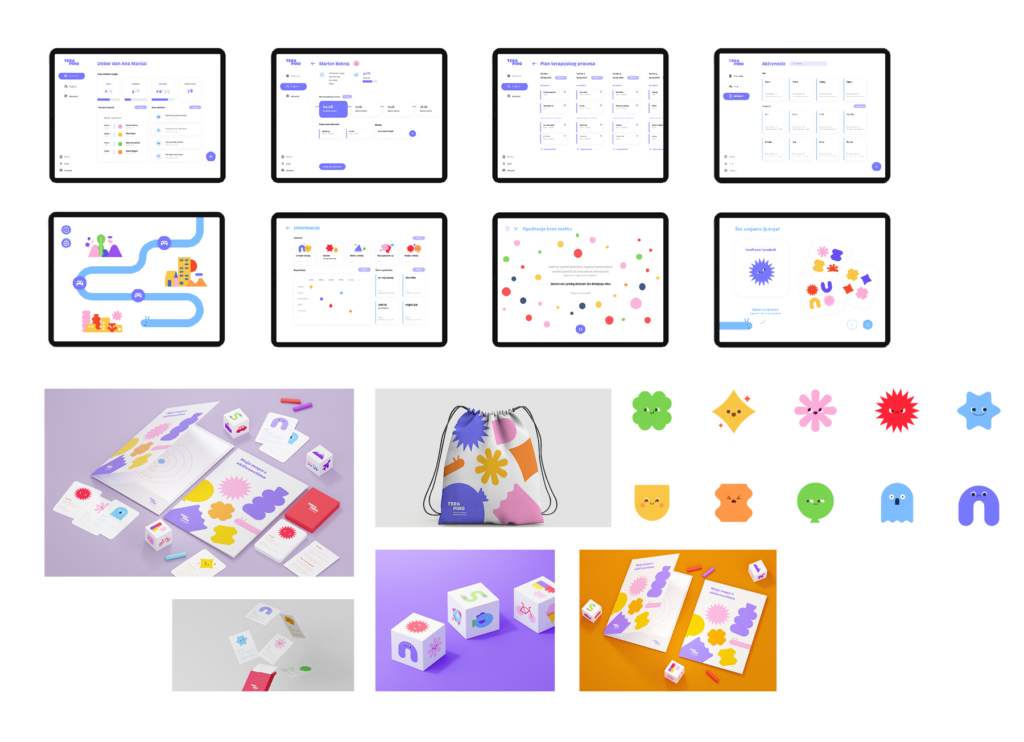
1. Level of design

The design of this thesis follows the guidelines set by the university. While there is no freedom in designing the format itself, small adjustments to the layout of elements are allowed. In my opinion, the format used is quite interesting; it is rather large and horizontally oriented, which gives it a sense of importance and formality. The author skillfully utilized the given format to create a cohesive and harmonious whole.

2. Degree of innovation

I consider this project to be innovative because it connects the physical and digital aspects of therapy for children. The system fundamentally functions as a digital application with an extension in an analog form, depending on the specific needs of the therapeutic process, patients, and/or therapists. The system covers the process during therapy but also enables individual therapeutic activities that the child can complete independently at home or with parents. In this way, the overall therapeutic process is rounded out and enhanced, extending beyond the therapist’s office to the home environment.

3. Independence

The author collaborated extensively with the Polyclinic for Children and Youth of the City of Zagreb, and this project is based on their professional work. From this, I conclude that a great deal of effort and independence was invested in collecting, summarizing, and conceptualizing the project — under the mentorship of professors, of course.

4. Outline and structure

I find that the structure is clearly laid out, starting with an analysis of the area of interest, followed by creative research methods, which further guides the author towards defining the target group and designing the project. The flow of this thesis makes sense to me, and the sections are well-connected. In its outline, the topic appears to be well-focused and not overly broad, addressing only what is necessary for the final outcome.

5. Degree of communication

The degree of communication in this thesis is clear and effective. The author does a good job of keeping a consistent tone while explaining complex ideas in a simple way. The structure helps with communication by moving logically from one section to the next, so each point builds on the last one. The use of visuals and examples makes it easier to understand, which helps a wider audience follow along. This focus on communication adds to the overall clarity and effectiveness of the project.

6. Scope of the work

The scope of the work is well-defined and focused. The author clearly outlines the main goals and objectives, making it easy to understand what the project aims to achieve. He saw the clear pain points of the topic, and without going off track or including unnecessary information, worked his way to the solution. Overall, the scope of the project is appropriate and supports the main thesis effectively

7. Orthography and accuracy

The thesis is well organized, clearly divided into logical chapters and subchapters, also the author uses footnotes for citations the right way. However, the thesis does contain some spelling errors, which could have been avoided with a more thorough review of the entire work.

8. Literature

I believe that a sufficient number of works have been used for the literature review, all of them seem relevant and credible sources, which I consider very important for this topic. Additionally, the literature is divided into books, scientific articles, and online sources, which I appreciated as it makes it easier to review.

03/01 Evaluation of an external Master’s Thesis

The master’s thesis I am evaluating is called „An investigation of Realism in Animation“ by Dott. ssa Flavia Montecchi. The thesis was supervised by Mag. Dr. Claus Tieber, Privatdozent.
She submitted it in 2020 at the university of Vienna to obtain the title Master of Arts (MA).

(1) Level of design

The layout of the thesis follows the guidelines of the university and shows no additional effort, the author had to put into layouting the work.
The text is easy to read with a fair size of the font as well as enough line height.
However, I sometimes find the use of the photographs in layouts following university guidelines difficult. The lack of space between the pictures and the text has a negative effect on the layout. Other than that, I can’t find any negative points regarding that matter.

(2) Degree of innovation

I find the degree of innovation in Flavia Montecchi’s thesis to be high due to her contributions to the fields of animation studies and cinematic realism.
She bridges diverse fields, such as animation studies as well as film theory. She also uses case studies.

Her comparative analysis of “Spider-Man: Into the Spider-Verse” and Sam Raimi’s “Spider-Man Trilogy” highlights the techniques each medium uses to establish realism. This methodology demonstrates how animated realism has evolved to parallel cinematic realism while still respecting animation’s unique qualities, such as exaggeration for narrative or comedic effects.

Montecchi’s discussion of animation’s use of „codes of realism“ like the realism of motion and psychological continuity offers a framework that future studies can apply to other works. This theoretical approach allows animation realism to be studied in its own right, not merely as an offshoot of film realism.

(3) Independence

Montecchi combines ideas from cinematic realism, animation studies, and psychology to argue that animated realism has its own unique methods, separate from the photographic focus of live-action film. She compares the techniques used in „Spider-Man: Into the Spider-Verse“ and the live-action „Spider-Man trilogy“ to show how each medium, animation as well as live-action, uses different approaches to make their worlds feel believable. This comparison highlights her independent approach by emphasizing the unique strengths of both art forms.

(4) Outline and structure

The work seems well structured and is divided into three chapters.

Realism in Live-Action Cinema: Discusses various forms of realism, including naturalism, social realism, and photorealism, within the historical context of film theory.

Realism in Animation: Examines animated realism through theories on hyperrealism and perceptual realism, focusing on techniques that support believability.

Film Analysis: Compares the Spider-Verse and Raimi’s Spider-Man trilogy, analyzing how each of them uses realism.

The table of contents is laid out logically and makes it easy to see through the structure of the work and follow the thoughts of the author.

(5) Degree of communication

I find the level of communication to be high. Montecchi uses clear language that bridges theoretical complexity with practical insights. The structure is well-organized, with subheadings and summaries that guide the reader through each part of the thesis. She provides a valuable resource for students in animation and media studies.

(6) Scope of the work

The scope of „An Investigation of Realism in Animation“ is interdisciplinary. She draws on film theory, animation studies and film analysis to find out how realism can be achieved with animation in real films. Her research contextualizes realism in animation in comparison to traditional film realism.

The thesis integrates technical and narrative aspects of realism in animation, expanding beyond traditional views of realism as inherently photographic.

(7) Orthography and accuracy

Unfortunately, when reading the german abstract, it is noticeable that this part of the text has not been corrected. In some cases, the chosen words do not seem appropriate compared to the english abstract. In addition, there were grammatical errors and colloquial expressions. I could not detect these errors in the rest of the work (written in English). I assume that these errors occurred due to a different native language. Regarding spelling and accuracy, the rest of the work seems thoughtful and error-free.

(8) Literature

I noticed that the bibliography has been divided into books and online sources. I don’t know what citation system the work is structured under, but I think it is unusual for the bibliography to be structured in this way also with citation rules other than those of our institute. The sources used seem to be either current (important in terms of online sources) or appropriate to the time the author is writing about. Perhaps the work would have benefited from the use of additional sources. It is 132 pages long, including the title page and table of contents. However, the bibliography, excluding the online sources came to only one and a half pages. This seems a bit too few for such an extensive master’s thesis.

Evaluation of a Master’s Thesis

Title: Performativity and Liveness: Approaches to Performance and Composition in Electroacoustic Music
Author: Leonie Patrizia Strecker
Institution: University of Music and Performing Arts, Graz
Date: September 2023
Field: Computer Music
Degree Name: Master of Arts (MA)

Artistic Quality:
The thesis tackles challenging concepts like performativity and spatial interaction, which Strecker tries to weave into her artistic work. However, the artistic interpretation feels limited to her personal approach, which could be enhanced by looking at other artists’ work for comparison. Examining how different genres approach these themes could offer valuable context and strengthen her own interpretations.

Degree of Innovation:
Strecker’s work has moments of originality, especially in how she applies theoretical ideas to her performances. Yet, the approach stops short of exploring newer methods or current technologies that could deepen the study of “liveness.” For instance, exploring real-time audience interaction or using AI-driven components might take the concept of liveness in a direction that resonates more with today’s audiences. The potential for further innovation is present but could be expanded.

Independence:
The thesis shows independence, especially in how Strecker applies theory to her compositions. However, a more questioning approach to her chosen ideas could have added depth. For example, considering viewpoints that challenge or add complexity to the idea of performativity in electroacoustic music would show a willingness to explore different angles, which could make her conclusions stronger.

Organization and Structure:
The thesis is clearly organized, but sometimes feels compartmentalized. The theoretical and practical sections could be more smoothly connected, creating a flow that lets theory and application reinforce each other. This reorganization might make the work feel more engaging for the reader.

Clarity and Communication:
Strecker’s writing is mostly clear, though some sections are quite dense with academic language, which could be challenging for readers unfamiliar with performance theory. Simplifying some of the complex ideas, or using more everyday examples, would make the thesis accessible to a wider audience. Terms like “corporeal liveness” and “mediatized presence” could especially benefit from being explained in simpler terms.

Scope of the Work:
The thesis stays focused, allowing for a deep dive into its topics, but this focus might be a bit too narrow. Relying mainly on her own compositions restricts the broader applicability of her findings. Looking at other artists’ work, or contrasting her pieces with notable electroacoustic compositions, might offer a more well-rounded perspective. Including recent advances in music technology, like machine learning in live performances, could also give the thesis a more modern edge.

Orthography, Diligence, and Accuracy:
The thesis is carefully proofed, though there are minor inconsistencies in digital citations. Additionally, bringing in newer scholarship, especially recent studies on live electronic performance, would make the arguments feel timely and better connected to current discussions in the field.

Literature:
Strecker has done well covering essential sources, referencing foundational theorists like Erika Fischer-Lichte and Philip Auslander. However, more secondary sources, particularly from fields like media studies or digital performance, could help add new angles to her analysis. Expanding the literature review in this way could show how her work fits into a broader conversation.

Evaluation of a Master’s Thesis

The Master’s thesis I chose for this task was written by Diogo da Costa Alves Pinto for the acquisition of a Master Degree in Sound Design at the Portuguese Catholic University of Arts. It aims to explore the taxonomic and causal link between emotions and sound objects and is titled “A Sound is Worth a Thousand Words”.

I chose this thesis because I was hoping it might give me pointers in my own research, since the abstract hinted that there is an element of deconstruction in the audio experiments.

  • Level of Design

      As has been observed with multiple Master’s theses in the field of Sound Design, this one also just seems to follow university protocol – there are no special elements that stick out in terms of visual design, and it also does not seem like it was a requirement for fulfilment of the task. However, I did notice that there are mixed fonts throughout the thesis (i.e. index is formatted differently from the main body of text, headings are different than continuous text), so the coherence throughout the whole document in terms of readability is missing a bit.

      • Degree of Innovation

      The topic itself does not seem to bring an entirelynew idea into the field, however, there are good points that are being made about the translation of studies into other languages and possible bias or issues that could stem from that – in that sense, taking the field of study into an environment with a different mother tongue brings new insights.

      • Independence

      It seems like the author has carried out multiple experiments on their own and managed to evaluate the results thereof on their own, in addition to doing literature research in advance to inform those experiments.

      • Outline and Structure

      On the first glance, the structure makes sense in the index. However, when reading the thesis, the layout begins to seem a bit clumsy in a way that does not fully support the intended structure or the reading flow (e.g. numbering of chapters and subchapters). There is a separate chapter titled ‘Structure’ which is mostly self-explanatory or reiterates the methodology chapter. Overall, in its outline, the topic appears to be a bit too broad for its initially stated purpose. There is also one sub chapter which only consists of one sentence – this could have probably been combined with another sub chapter.

      • Degree of Communication

      The author does a good job of explaining basic concepts and ideas using appropriate literature and references from the field of study. Connections and comparisons in between sources and experiments are drawn, but sometimes in illogical order (e.g. comparison to other method is made before the reader has been introduced to other method). There is an awareness that external factors influence associations with sounds and that the rationalized involved in causal listening influences test results. This is expressed well, and there is a lot of needed detail about variances and why specific models are utilised more in sound and music.

      • Scope of Work

      There is mixed detail when it comes to analysis of the work that was undertaken. A lot of value was placed on literature research, but especially the evaluation and setup of the second experiment might have required a little more detail in the explanation. It was not clear whether the alterations in the sound should bring about a specific emotion or whether the individual original sounds were to be considered for their emotional feedback, and there is no Appendix showing the details of the test results in a way that could clarify that. The author managed to recruit quite large sample groups for the scope of the study twice, but there was not a lot of background on which sounds were used, why they were used and what the use of these specific sounds would bring to the conclusion, so in some ways, the thesis felt a little too broad-angled to concisely and effectively bring depth into a field that has been explored before.

      • Orthography and Accuracy

      Overall, the work is quite neat in terms of orthography. The citations seemed to be incomplete at time, so there is an aspect of the work that appears as if the diligence has been placed on other aspects, such as the experiment and the content over the formatting.

      • Literature

      The thesis cites mostly papers, books, dissertations and standard literature for the field. It draws back on historical references, but always puts them into context with more up-to-date literature examples.

      Overall, this thesis tries to approach a large topic with the help of two empirical experiments. A lot of effort has been put into those and the literature research, but it appears that some of the insights and critical evaluations get lost in the communication and the broad scope of the thesis.

      # 01 || Evaluation of a Master Thesis

      Animated Short Film: How to Become a Knight (Kratki animiran film: Kako postati vitez) by Kaja Kregar, dipl. obl. vizual. kom. (UN)

      The master thesis I chose researches the topic of animation and creating a story with an environmental message. It is divided into two parts, the theoretical and the practical. In the theoretical part the author writes about animation, types of animation, modern environmental issues and how they affect our way of life. Her research questions are:

      • How to present the issue of pollution creatively with the media of animation?
      • Is art important for fixing said issues and how can it influence the viewer?

      The author defines the meaning of used symbols and allegories and how they represent real modern day social issues. Specifically how they represent issues in ecology and how climate change effects the younger generation. The author explains her use of fairy tale themes and knights as well as touch upon pre-existing animated works with similar messages.

      The practical part of her thesis consists of the animation process, from the inspirations to sketches, narrative and the storyboard. The author how they used the principles of animation to communicate the story and atmosphere, what digital programs they used and the analysis of the used colors and textures in the animation (the symbolical and allegorical meaning). They also talk/write about the use of music and sound effects for the animation.

      1. Level of Design

      The master’s thesis was created according to the faculty’s regulations, giving it the standard design of a master’s thesis. However, the thesis has a very good structure. The table of contents clearly shows how the author divided the individual chapters and systematically organized them. I appreciate that it starts with ecological issues and only later moves on to what animation is, and finally to the animation process. The appendix also includes all illustrations and sketches, which I find great, as it’s an excellent way to display individual parts of the animation in the book. The research question is clearly visible; unfortunately, a clear conclusion from the research is missing, as well as the methodology.

      2. Degree of innovation

      The topic the author addresses is not new; it’s a subject that many media designers engage with. The innovative part of the thesis is the connection between ecological issues and animation, as well as research on the theme and role of the knight in stories. The author explores how animation has been used throughout history and how certain animations have already included this theme. Her mentioned examples of animations are globally recognized animated films. The author discusses basic animation techniques and does not delve into new areas of animation. As mentioned earlier, the author speaks very little about the research itself and mainly describes how the practical work was created.

      3. Independence

      The thesis shows the student’s strong ability to work by herself, taking initiative and managing the research process with little outside help. The author also created an original animation by herself, showing both skill and creativity. This project adds a practical element to her research and highlights her commitment to bringing her ideas to life on her own.

      4. Outline and structure

      The master’s thesis is very well-structured, dividing into a theoretical and practical section. The author first discusses ecological issues in today’s society in general (from waste and recycling issues, corporate responsibility, habitat endangerment, to the consequent rising sea levels and how these impact young people), also providing an example of Mount Everest. After researching and writing about ecological issues, the author delves into the topic of animation, explaining what animation is and its basics. She also addresses social and historical issues of fairy tales, the influence of Walt Disney in the 20th century, and the significance of the knight in modern storytelling. The knight is the main character in the author’s animation. The last chapter of the theoretical part of the thesis is a study on how to create an animated film with an environmental message, where the author explores what animation as a medium can achieve and performs a comparative analysis of existing examples (Wall-E, Princess Mononoke).

      In the practical section, the author begins by researching the target audience and then moves on to the analysis of story structure, sketches, and design (covering character design, environment, and a guidebook) and creating a storyboard. She then discusses her animation process, the animation technique used, the application of animation principles, software, visual analysis, editing, and post-production. The author has included the entire storyboard, character design, and background design as an appendix, so all work is visible in one place.

      While I think the thesis is very well-structured, it seems to me that everything is somewhat superficially researched, and the author should delve deeper into certain topics. The research methodology is not clear in the thesis; I assume it is experimental since the author does not address it. In the conclusion, the author notes that she only supported her research theoretically.

      5. Degree of communication

      The author clearly explains various concepts and goes into specific areas of research. She describes the process of creating her work in detail, adding various technical details. Each step in creating her practical work has its own subchapter, where she professionally describes the process. The author also uses many examples to illustrate different areas of the thesis and includes images to facilitate understanding of individual topics.

      6. Scope of work

      The author explores the topic rather superficially, but places significant detail on the practical work. Although she writes about current ecological issues, provides examples, and discusses animation in general, this remains only a rough outline of individual subchapters, with the theoretical part covering only a third of the printed work. The rest of the thesis is dedicated to describing the animation creation process. The thesis lacks “research” where the author could present findings (if she has any) related to the stated question.

      7. Orthography and acuracy

      The thesis is well structured, it being divided into logical chapters and subchapters. It also includes an introduction, body, and conclusion, along with sources and an appendix with all the illustrations. The author also uses footnotes for citations and correctly lists sources in the bibliography. However, the thesis does contain spelling errors. The first spelling mistakes already appear in the abstract and in the English translation.

      8. Literature

      Considering the length of the thesis, it seems that very little literature was used. Many things are cited from the same source, so the thesis lacks comparative analysis. Altogether, 26 sources were used, half of which are online sources. Additionally, I was surprised to see how many of the sources were news articles, which were barely related to the topic.

      Evaluation of a Master Thesis

      Title: Enhancing Educational Experience: A Digital Approach to Visual Education Tool for Children with ASD (Autism Spectrum Disorder)
      Author: Gladys Theresia Suryana
      University: Aalto University School of Arts, Design and Architecture
      Master’s Degree Course: International Design Business Management – Arts Department of Design

      In this blog post, I have decided to evaluate a master thesis by Gladys Theresia Suryana called „Enhancing Educational Experience: A Digital Approach to Visual Education Tool for Children with ASD (Autism Spectrum Disorder)“. I decided on this thesis because it seemed relevant to my current research topic, therefore I studied it according to given criteria.

      Level of design

      This thesis has a very user-centered approach. By collaborating with educational institutions and involving caregivers and therapists, the work demonstrates a careful design process that takes into account the unique needs of ASD students, demonstrating a high level of empathy and understanding of the design context.

      Degree of innovation

      The work shows a high degree of innovation, especially in the integration of co-design methods to create a visual educational tool for children with ASD. Even though the application of digital tools in education is not new, the focus on creating visual tools specifically for children with ASD and using a feedback system makes this approach really interesting.

      Independence

      Suryana did extensive research for this thesis with minimal relying on assistance from others. This independent approach shows a high level of initiative in solving the problem.

      Outline of structure

      The structure of the paper is well organized, it logically moves from the literature review and research of ASD challenges to the development and application.

      Degree of communication

      Communication in the paper is clear and precise, especially considering the complex topic about ASD and visual educational tools. The work includes interviews and case studies, demonstrating Suryana’s ability present information in an engaging and accessible way.

      Scope of the work

      The scope of work is appropriate for a master’s thesis, including a literature review on autism, current state of education, and specific requirements for visual tools.

      Orthography and accuracy

      The spelling and accuracy of the work seem very precise, with terminology that is accurately used in the context of educational techniques and design methodology for ASD, which contributes to credibility.

      Literature

      The paper includes a wide range of literature, with references covering ASD, design thinking, educational tools and co-design processes. This approach shows an understanding of interdisciplinary sources, which is critical in addressing inclusive design.

      Evaluation of a Master’s thesis

      Author: Qian Ye
      Title: Natural Interface in Mixed-Reality
      Publiaction Year: 2020
      Institution: Kunstuniversität Linz
      Study Programme: Interface Cultures
      Source: NATURAL INTERFACE IN MIXED-REALITY (The University of Art and Design Linz Phaidra – o:2046)

      This thesis was chosen for my analysis because the field of Tangible and Natural Interfaces has a lot of overlap with the topic of Calm Technology by making human-computer interaction (HCI) smoother and less digital. What is ultimately one of the key points why I am interested in Calm Technology is to change technology to interact with us on our terms, rather than us having to adapt to technology.

      The overall aesthetics of the thesis is clear, clean and well structured. It is easy to read and follow the line of thought. The content focuses on mixed reality interfaces that integrate natural elements for human-computer interaction (HCI). It explores Tangible User Interfaces (TUIs) and includes extensive theoretical research combined with artistic practice, showing a deep understanding of interface development.

      The thesis presents innovative ideas for merging physical and virtual worlds through mixed reality. In particular, the author proposes new ways of creating „natural“ interfaces, especially by using elements of nature. The inclusion of projects such as „TRIALITY“ and „Water Instrument“ adds a hands-on, experimental dimension, showing the practical side of the theoretical part.

      The author demonstrates independence in research and design execution. The projects and experimental frameworks presented, such as the ‚PAPERPAL‘ educational interface for children, show a high level of self-directed exploration, especially in the development of unique interfaces.

      The thesis is clearly structured. It begins with an introduction, followed by theoretical discussions, practical applications and concludes with future perspectives. The reader is directed through theory, artistic practice and contextual discussions in a coherent structure.

      The thesis is effectively communicated, with well-written ideas and clear transitions between chapters. The author has a clear grasp of technical language and can express complex concepts concisely, making it easy to read and understand without oversimplification.

      The scope is comprehensive, covering both theoretical and practical aspects of Mixed Reality, TUIs and educational applications. It addresses broader themes in interactive art while exploring specific approaches for children and natural elements, demonstrating a balanced approach between depth and width. All in all, a topic and work that meets the requirements of an academic Master’s thesis.

      The thesis appears to have been carefully proofread, maintaining high standards of spelling and accuracy throughout. The language is professional, with no noticeable errors, suggesting careful editing and attention to linguistic precision.

      The literature review is thorough, with references to foundational HCI and interface design theories and pioneers such as Donald Norman and Mark Weiser. With a total of 92 different references, ranging from current to older but not obsolete resources, the author establishes a solid theoretical framework that supports the foundation of the thesis.

      *All texts have been paraphrased using DeepLWrite.

      #1 Kritische Bewertung einer Masterarbeit

      Autorin: Nicole Beno
      Titel: Exploring Materiality in Graphic Design Through Creative Play
      Erscheinungsjahr: April 2015
      Institution: York University
      Studiengang: Graduate Program in Design

      Gestaltungshöhe:

      Es handelt sich um eine klassische Thesis ohne besonderen Gestaltungsansatz. Es wurden sich an die üblichen Gestaltungsregeln einer Thesis gehalten. Große Zeilenabstände, Lange Zitate wurden eingezogen, und Texte wurden durch Absätze klar strukturiert.

      Innovationsgrad:

      Ich empfinde den Innovationsgrad der Masterthesis als eher gering. Es wurde nach dem Theorieteil eine Umfrage durchgeführt und daraus drei verschiedene Arten des „creative play“ anhand von Materialität im Grafik Design gezogen. Anschließend wurden diese Arten von der Autorin selbst in praktischen Versuchen ausprobiert. Im Fazit der Thesis sind meiner Meinung nach wenig Ergebnisse, die nicht schon im Theorieteil festgestellt wurden.

      Selbstständigkeit:

      Die Autorin scheint selbstständig gearbeitet zu haben und hat im Zuge dessen eine Umfrage, sowie eine praktische Umsetzung des Erlernten erstellt. Außerdem hat sie die theoretischen Grundlagen ihres Themas recherchiert und zusammengetragen.

      Gliederung und Struktur:

      Die Gliederung der Thesis war ordentlich und gut nachvollziehbar. Von der Einleitung, über verschiedene theoretische Aspekte und eine Umfrage bis hin zur späteren eigenen Umsetzung und dem Fazit, haben die einzelnen Kapitel grundsätzlich gut aufeinander aufgebaut.

      Kommunikationsgrad:

      Es wurden einige Interessante Punkte genannt, jedoch hatte ich das Gefühl die Zusammenhänge und Schlüsse, die daraus gezogen wurden, waren teils unklar formuliert oder zu knapp.

      Umfang der Arbeit:

      Ich bin der Meinung die Arbeit hätte von einem größeren Umfang profitieren können. Besonders die Umfrage hätte wissenschaftlicher und detaillierter sein können als auch die darauf aufbauenden Kapitel. Außerdem hätte ich mir nach ihrer Umsetzung eine iterierte Auseinandersetzung mit den Ergebnissen gewünscht. Hier hätte evtl. nochmal eine Umfrage Sinn gemacht.

      Orthographie sowie Sorgfalt und Genauigkeit:

      Die Orthografie wirkt ordentlich, mir sind so gut wie keine Fehler aufgefallen. Auch Zitate und Eigennamen im Text waren immer ordentlich gekennzeichnet.

      Literatur:

      Die Autorin hat einige verschiedene Quellen benutzt. Hierzu zählen viele Universitätsschriften und Fachbücher aber auch Magazin Artikel und eine Rede.

      Road to M.A. 1: Evaluation of a Master Thesis

      Female Rage, Revenge, and Catharsis: The „Good for Her“ Genre Defined in Promising Young Woman (2020) by Tara Heimberger

      !!! In this Blog post Chat GPT and DeepL are used for english translations, spelling and finding synonyms

      DETAILS

      Title: Female Rage, Revenge, and Catharsis: The „Good for Her“ Genre Defined in Promising Young Woman (2020)
      Author: Tara Heimberger
      Institution: Georgia College and State University
      Date: 4-18-2022
      Field: English
      Degree Name: Master of Arts (MA)
      Source: https://kb.gcsu.edu/english/10/

      ABSTRACT

      By analyzing relevant cultural contexts to the popularity of the “Good for Her” genre, such as the “#MeToo” movement, the Trump presidency, and the resurgence of conservatism in the United States, the development of the “Good for Her” genre and its impact can be made clear. Given the genre’s development through social discourse on social media, it has become a universal and collaborative representation of liberation from oppressive experiences under a patriarchal society. The lead women in these films give those who experience patriarchal oppression a reprieve and an opportunity for catharsis they would not typically get in a male-led, male-focused film. The genre reinforces and builds upon the works of feminist film theorists such as Carol Clover and Laura Mulvey by offering a more contemporary evolution of Clover’s “Final Girl” through the combination of slasher and Final Girl to create the “Good for Her” films’ “victim-villain” and Mulvey’s theory of the “male gaze” by subverting and satirizing the typical female objectification of the old-school horror genre. Promising Young Woman acts as a definitive example of the genre and a crucial representation of the reality of rape culture while depicting a sense of voyeuristic and vicarious revenge and catharsis against the systems of patriarchal oppression that exist within the United States.

      WHY I CHOSE THIS THESIS

      I chose this thesis for its vital exploration of how female rage is portrayed in film and how this contributes to and challenges patriarchal structures. Right now I mostly dwelled on how directors instruct female characters to express emotions, not how the viewers and audience perceive it differently. By examining the “Good for Her” genre through a theoretical lens, this work clarifies how cinematic depictions of female rage, in examples like Promising Young Woman, provide catharsis and critique. This insight is essential for understanding both the empowerment and limitations faced by women in film and the broader societal impact of these narratives.

      1. Level of Design

      The Level of Design in this thesis is quite low. There is not much emphasis placed on design possibilities or layout. The focus here is clearly on content. I’m certain that this faculty has specific guidelines that the students need to follow, and creative freedom in design is very limited. This, however, is completely legitimate, considering that it’s a scientific thesis for an English faculty. At our institute, a layout like this would definitely result in a lower grade. The author barely uses even pictures or statistics.

      2. Degree of Innovation

      This thesis has a high degree of innovation, as I found very few related works during my general research in this field. This is unsurprising, however, as it’s a relatively new area of research that has only gained popularity with digitalization and the influence of younger generations. In this case I think it’s really smart to support this phenomenon immediately with a concrete example as done here in this thesis.

      3. Independence

      The author demonstrates a high level of independence, especially because of her innovative approach to the relatively new field of the „Good for Her“ genre. She critically and thoroughly examines the cultural and societal contexts that contributed to the rise and popularity of this genre, thereby making an independent contribution to feminist film theory. I also like the linking of social movements like #MeToo and political events such as the Trump era with the cinematic portrayal of female liberation – even though this topic is really overplayed in 2024 (you need to consider that this thesis was written in 2022 – and therefore she was really going with the zeitgeist). The thesis develops an original perspective that is both theoretically grounded and creatively responsive to contemporary societal issues. I aspire to also include this much of societal background for my own work.

      4. Outline and structure

      For me the overall structure is really good. When I look at the table of contents it all makes really good sense to me – Especially contextualising the the socio cultural background is necessary for understanding the emergence of the „Good for Her“ genre. This section effectively sets the stage for the authors discussion by linking the genre’s popularity to broader societal movements.

      Another section that stood out to me was where the author was defining and contextualizing the „Good for Her“ genre. It allows to clarify the characteristics that define this genre, situating it within the landscape of contemporary cinema. This foundation is crucial for readers who may not be familiar with the genre’s nuances. This way of contextualizing in my opinion is totally necessary in order to make sure that the reader and the author are on the same page. Particularly when we are speaking about pop culture or concepts that have a small target group

      5. Degree of communication

      As far as I can evaluate I think the author definitely has a way with words and also can play her way around which makes it actually fun to read. Is is noticeable that she is doing her Masters Degree in english – it seems really professional but also not to intellectualized. The words used fit the overall theme of the thesis and the topic.

      6. Scope of the work

      The scope of work appears to be appropriate for an academic paper. However, I would have preferred fewer direct quotations, as it would have been more beneficial to see a deeper analysis of the few visual examples mentioned. More emphasis on the author’s insights and interpretations rather than simply reiterating existing opinions would enhance the overall depth of the analysis. Many examples are revisited throughout the paper, even though I thought the topic had already been thoroughly explored. This repetition sometimes makes the discussion somewhat redundant and less engaging. It would be more effective to introduce new perspectives or analyses to keep the discourse fresh and compelling.

      7. Orthography

      Occasionally, the flow of reading is disrupted for me by the words set in quotation marks. It might be more effective to integrate these terms more seamlessly into the text, allowing for a smoother reading experience without compromising the clarity of the concepts being discussed. Other than the word repetitions stand out significantly, I don’t have much to criticize. I also don’t like the font that is used. It makes the text for me personally harder to read.

      8. Literature

      The literature used is very contemporary and includes very few sources older than seven years. Notably, it relies heavily on many online articles. Caution is warranted here, as it’s essential to assess whether these sources are reputable and credible. For this blog post I did not check every online source used but what I could find in researching three of them is that they seem to be based on credible sources.

      Impulse #01 – World Usability Congress

      Links

      World Usability Congress: https://worldusabilitycongress.com
      European Accessibility Act: https://ec.europa.eu/social/main.jsp?catId=1202
      Material Design Accessibility: https://m2.material.io/design/usability/accessibility.html#understanding-accessibility