IMPULSE #2: Raphaela Egger on Systems Thinking

As part of this semester’s course Future Design Lab at FH JOANNEUM our lecturer Raphaela Egger made an excursion to the topic of Systems Thinking.

In her lecture Egger distinguishes between Systems Thinking and Design Thinking, which are complementary approaches for solving complex problems and enhancing the design of products, services and systems. Design Thinking emphasizes understanding users‘ needs and developing solutions that are intuitive, functional, and appealing. Conversely Systems Thinking centers on comprehending how an entire system operates and recognizing how modifications in one area can impact other parts. 1,2

Egger states that a complex system cannot simply be dismantled, reorganized, and reassembled, nor can it be simplified.3 Once its complexity is destroyed, the system itself stops to function. Interventions in complex systems almost always lead to unexpected side effects and long-term consequences because we rarely understand all the interconnections and unintentionally create unexpected system dynamics.

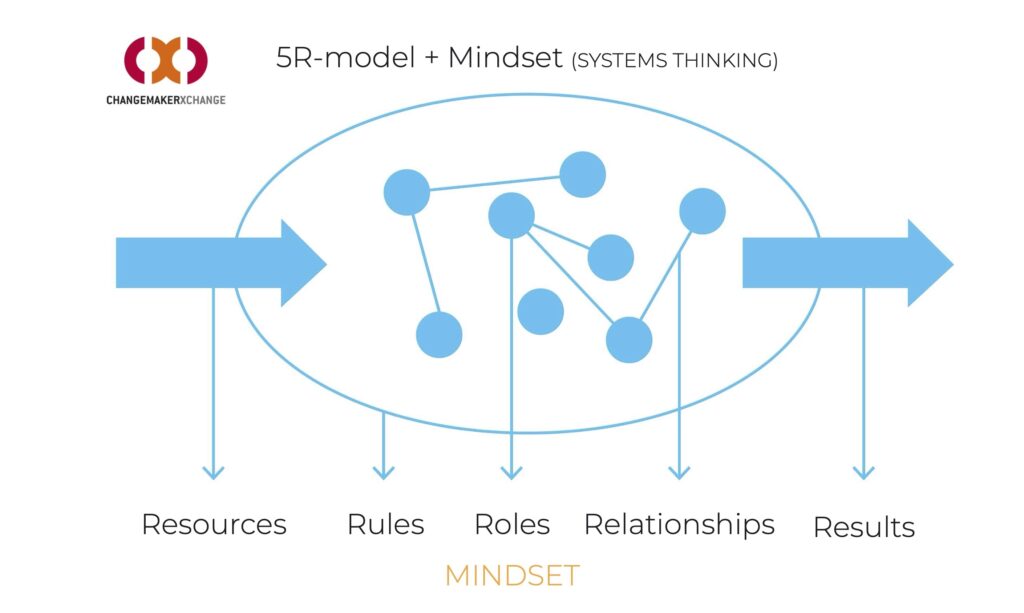
5R model of Systems Thinking

Egger introduced us to the 5R model of systems thinking, which is a framework that highlights five key dimensions of systems: results, roles, relationships, rules and resources.4,5 This model serves as a lens for assessing local systems and guiding interventions to strengthen them.

  • Resources: The inputs or „fuel“ required for the system’s interactions to give results.4
  • Rules: The formal and informal guidelines, laws, cultural norms and protocols that govern the system’s operation.4,6
  • Roles: The functions and responsibilities assumed by different actors within the system.4,6
  • Relationships: The connections and interactions between various actors in the system.4,6
  • Results: The target outcomes or impacts that the system is designed to produce.4,6
© Raphaela Egger, plasticpreneur®

Team task

During the lecture Mrs. Egger gave us the task to apply an system of our choice to this model. Our group talked about the education system in industrialized countries and how artificial intelligence might influence it in the future:

Resources

AI brings advanced tools and technologies into classrooms, redefining the resources available to students and educators. Intelligent tutoring systems, adaptive learning platforms and generative AI applications offer new and personalized educational experiences. However this may lead to a loss of conventional analog skills, such as handwriting or mental calculation, as digital tools take precedence. Educational institutions must balance leveraging AI with preserving foundational skills to ensure holistic development.

Rules

The integration of AI in education sectors will most likely need new guidelines and policies for its usage. For instance, rules regulating the ethical use of AI, data privacy and intellectual property must be developed to address emerging challenges. There may be a redefinition of what is truly essential in education, focusing less on rote memorization and more on teaching students how to effectively interact with and use AI. This shift might require the curricula to be revised to prioritize AI skills and critical thinking over conventional ways of education.

Roles

AI has the potential to transform the roles of both teachers and students. Educators may transition from being primary sources of knowledge to facilitators, who guide students in AI-enhanced learning. Conversely students may be more active in directing their learning journeys, taking advantage of AI tools to explore topics at their own pace. As these changes provide a lot of chances for individuals, they also come with concerns about the children’s development: the importance of interpersonal interaction and the risks of depending too much on technology for example.

Relationships

It is predictable that AI in education will change the way actors will interact within the system. The relationship between teacher and student may change as AI becomes an intermediary, which will provide instant feedback and support. Peer relationships with collaborative learning could increasingly be mediated by digital platforms. These changes might impact social development, particularly for younger children. Health implications are happening already, such as excessive screen time and shortening of the attention span and reduced sleep quality. This could get more intensive.

Results

Results of an AI-influenced education could reshape societal outcomes. With AI making learning more accessible and personalized, students in industrialized countries could perform better in school and university, becoming more innovative. But the effects are more than academic success. As humanity grows alongside AI, we must think about what intelligence means, how human creativity fits in and what values should guide education. Balancing technology with the human side of learning should be the overall goal.

In relation to my research topic

In particular, it would be interesting to see how my research topic of improved first aid for epilepsy would affect the emergency response system in terms of decision making through a mobile app when a seizure occurs.

Resources

  1. https://www.linkedin.com/pulse/how-can-design-thinking-systems-work-together-caglar-korun/ ↩︎
  2. https://www.ideou.com/blogs/inspiration/differences-between-systems-thinking-and-design-thinking ↩︎
  3. http://systemthinking.de/Systeme-verstehen/ ↩︎
  4. https://usaidlearninglab.org/system/files/resource/files/5rs_techncial_note_ver_2_1_final.pd ↩︎
  5. https://www.ashoka-visionaryprogram.org/tools-for-systems-change/ ↩︎
  6. https://collaboratiohelvetica.ch/en/blog/2021/7/28/the-5r-framework-gn2bw ↩︎
IMPULSE #4 | Lecture Performance: “REPAIR!_Fashion” by Evelyn Roth

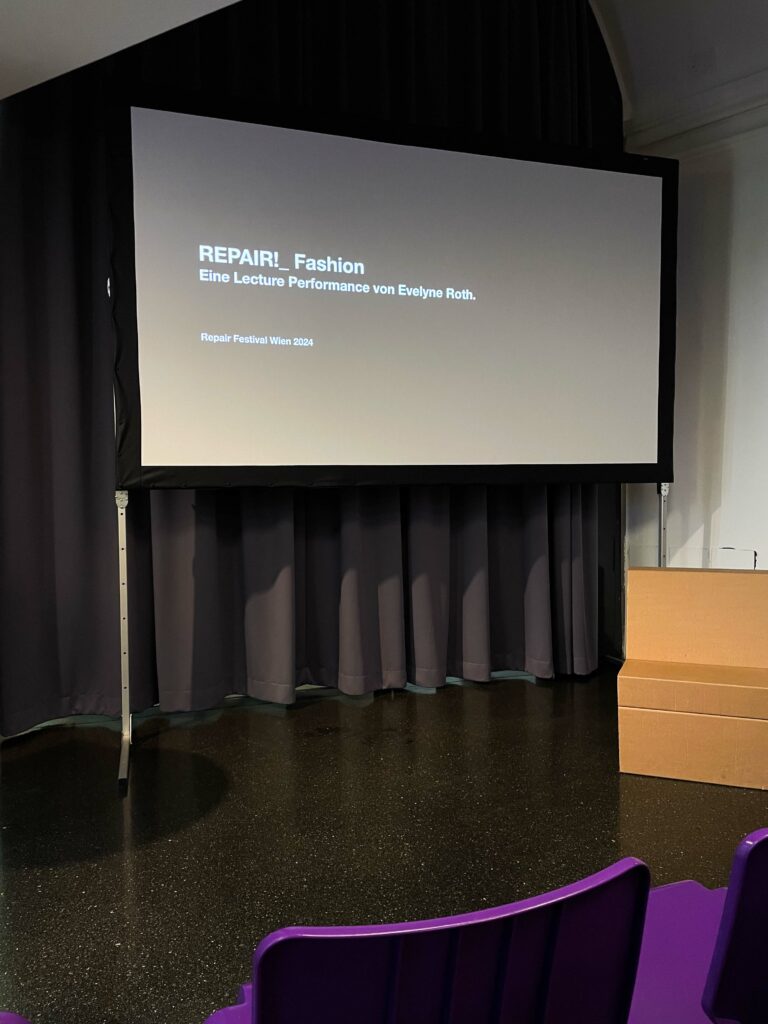
On the 27th of October, a lecture performance by designer Evelyn Roth took place as part of the program of the Vienna based “re:pair festival” 2024. The lecture performance dealt with the role of the repair process in the current fashion system. Under the title “REPAIR!_Fashion – The Relevance of Repair as an Act of Creativity in Circular Processes”, Roth engaged in an act of repairing a garment live on stage before elaborating on the role and the status of the act of visibly repairing and mending garments. Using the example of a blouse, Roth illustrated the repair process as a socio-political statement and creative act. Within the design context, the lecture discussed the possible future of design processes in circular workflows.

The focus of the talk was on the emerging hierarchical change in the structure of fashion: REPAIR!_Fashion aimed to be understood in the context of a systemic and structural change in fashion. Repairing fashion provokes an expanding aesthetic perception and a political positioning that the act of repairing as a design process entails.  In the words of Orsola de Castro, upcyclist, fashion designer, author and co-founder of Fashion Revolution: “Repairing your clothes can be a revolutionary act. “1

About Evelyn Roth

“Evelyne Roth is a designer and a lecturer on the BA in Fashion Design, the MA Master’s Studio ICDP and the cross-institute CoCreate programme of the FHNW Academy of Art and Design. She has held posts at a number of institutions as an expert in Design Thinking and Forecasting. Questioning common processes in the fashion industry, attempting to break with them and launching products that make a contemporary statement are all part of her holistic brief as a designer. Her practice and teaching in design focus on circular design, research, conception and materiality.”2

Key Takeaways

The main issue concerning the visible repair and resale of clothes Roth illustrated in her lecture is the uncertain legal status of reselling a visibly mended garment as a new or updated design under the name of the repairing designer. Roth highlights that for a long time, the goal of repairing was to make the repair process as invisible as possible. She mentioned brands like the luxury fashion house Hermès, who have a dedicated repair program for their bags. The goal of their repair strategy is to “reset” the products to their original state as well as possible, without leaving visible traces of the repair process. Roth postulates that the act of repair should be reconsidered as a creative act of its own which is allowed to leave traces. Through her example of a blouse however, she illustrates what the challenges for such a recontextualization can bring. In her performance, Roth visibly mended a blouse which was originally designed by Dries van Noten. If she wanted to resell the blouse as her own design, there would be a legal argument for copyright infringement because of the protections on the original design. The entire discussion went into more detail, illustrating that within fashion, copyright is a complicated question in general. Some aspects of fashion designs are protectable by copyright, like pattern designs. Certain other aspects however, cannot be protected by copyright, such as silhouettes for example. The copyright question does not come up when a garment is sold without visible mending manipulations as a second hand item attributed to the original designer, which begs the question – when does a repair become visible enough to be relevant and what are the rights of the visible mender in this process.

My impression of the talk was that this issue is certainly interesting and seems to be quite complicated. I personally do not quite see the visible repair of garments and the resale of them on a large scale as an issue that reach dimensions where it will really disrupt the fashion system. However, I of course have not done extensive research on this and can therefore only state my first impression and general opinion in this case. 
As for the relevance to my research topic – I believe digital fashion faces a similar issue of copyright and especially ownership. These topics will be discussed further in a future regular blog post.  


1Programm – Re:Pair Festival 10.-27.10.2024. October 27, 2024. Re:Pair Festival. https://repair-festival.wien/programm/?date=2024-10-27.
2FHNW. “Evelyne Roth.” Accessed November 11, 2024. https://www.fhnw.ch/en/people/evelyne-roth.

Sources

“Evelyne Roth,” FHNW, accessed November 11, 2024, https://www.fhnw.ch/en/people/evelyne-roth.

Programm – Re:Pair Festival 10.-27.10.2024, October 27, 2024, Re:Pair Festival, October 27, 2024, https://repair-festival.wien/programm/?date=2024-10-27.

All Images © Helene Goedl 2024

IMPULSE #3 | Open House: Die Angewandte – Fashion Department and University Library

At their yearly Open House, the Angewandte (University of Applied Arts Vienna) opens its doors to everyone who wants to get to know the courses on offer at the university or is just interested in taking a look behind the scenes. At the Open House, the studios, workshops and departments of the University of Applied Arts are open to visitors. Students and teachers share insights into everyday university life. Information stands on site and online provide the opportunity for further exchange about the study programmes.1 This year, I seized the opportunity to visit the fashion department at the Angewandte Open House.  

Why was the Open House relevant for my Thesis?

Fashion study programs, fashion design education and their curricula are excellent indicators of where the fashion scene is headed at a given time. Sometimes, these study programs are on the pulse of current developments, sometimes they lag behind for one reason or another. My main objective in visiting the open house was to explore where the fashion department at the Angewandte stands on the role of digital fashion design, whether this development is incorporated into the education and if there are projects already on display that might show the status on this question. Additionally, I made use of the opportunity to take a tour of the Angewandte university library to explore the possibility of using it for my Master’s thesis research.

The Fashion Department

The fashion department at the Angewandte is one of the most successful fashion design education programs in Europe. The admission is highly selective, only taking on between 5 and 10 students each year. The program is currently headed by fashion designer Craig Green.

“London-born designer Craig Green MBE established his namesake label in 2012 shortly after graduating the Fashion Masters course at Central Saint Martins. He has since carved out a unique position amongst the industry’s most innovative talents and continues to earn both critical and commercial success globally.”2

The head of department position is re-staffed in short intervals in order to provide the students with exposure to different approaches during their 5 year study period. The degree program is a diploma, which means it is not divided into a bachelor’s and a master’s degree.

The Fashion Design programme highly values the development of a distinctive creative style and artistic vision in their students.  In close guidance from the professors, “students explore the critical potential of fashion between materiality, corporeality, and concept.The curriculum comprises traditional pattern cutting and construction skills alongside digital skills and techniques. Students benefit from a state-of-the-art, industry-standard sewing atelier, knitting atelier and a spacious studio with a personal work space for each student. Students are given the possibility to work in professionally equipped studio spaces and workshops both within the Fashion Department and other departments of the University of Applied Arts.”3

The department has seen many highly acclaimed professionals in the lead position, such as l Karl Lagerfeld, Helmut Lang, Jil Sander, Raf Simons, Vivienne Westwood, Viktor & Rolf, Bernhard Willhelm, Hussein Chalayan, Lucie and Luke Meier and  Grace Wales Bonner to name a few.3

“Graduates of the Fashion Department have founded their own labels, such as Bless, house of the very island’s, Wendy Jim, Petar Petrov, Femme Maison, Sagan Vienna, Kenneth Ize, and others. Others occupy leading positions in the fashion industry, working for brands such as Balenciaga, Andreas Kronthaler for Vivienne Westwood, Alexander McQueen, Lanvin, OAMC, Prada, Comme des Garçons or Maison Margiela.”3

With regard to digital fashion, I was able to find out that CLO3D is taught in the curriculum as an industry standard program. In terms of digital fashion collections or digital garment developments, I was not able to find any significant presence, suggesting that while the aspect of digital fashion has a place in the curriculum, it is not a focus of the program. The focus is still very much on physical tailoring and traditional skills in the fashion design process, which I believe is a good and solid approach and the successes of the graduating designers prove this. 

The Library

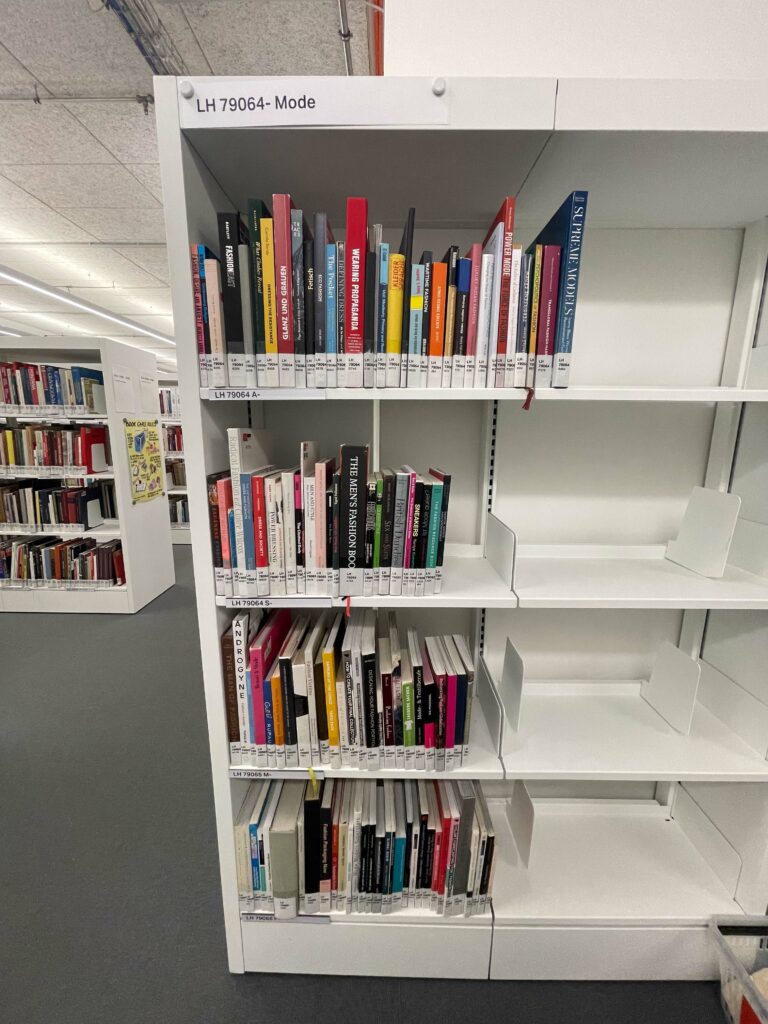
Since the Angewandte has a fashion department, their library catalog naturally is much more extensive than the one at FH Joanneum with regard to this design discipline. I took a guided library tool and created a library account for external students and will be making use of the resources for my thesis. 

Images


1“Angewandte Open House 2024.”
2Craig Green. “About.” Accessed November 11, 2024. https://craig-green.com/pages/about.
3“Fashion – dieAngewandte.”

Sources

“About,” Craig Green, accessed November 11, 2024, https://craig-green.com/pages/about.

“Angewandte Open House 2024,” Angewandte Open House 2024, October 14, 2024, accessed November 11, 2024, https://openhouse.uni-ak.ac.at/en/.

“Fashion – dieAngewandte,” accessed November 11, 2024, https://www.dieangewandte.at/fashion.

All Images © Helene Goedl 2024

IMPULSE #2 | Event: “ORF Lange Nacht der Museen” – Mode Wien Pop Up Museum

On Saturday, October 5, 2024, this year’s “ORF Lange Nacht der Museen” (“night of museums”) took place throughout Austria. For the 24th time, the event allowed visitors to explore a large number of museums with just one ticket. Once again this year, numerous museums and galleries participated in the event and opened their doors from 6.00 pm to midnight.

In addition to varied exhibitions, many exciting special events were part of the evening. Visitors could choose their personal highlights from the wide range on offer and visit all participating museums and events with just one ticket. The participating museums offered a wide range of experiences, from small, curious and eccentric locations to large, renowned cultural institutions.1

I decided to explore the “long night” in Vienna this year, and one of the participating institutions I selected for one of my visits was of special interest to my thesis topic and my research into digital fashion.
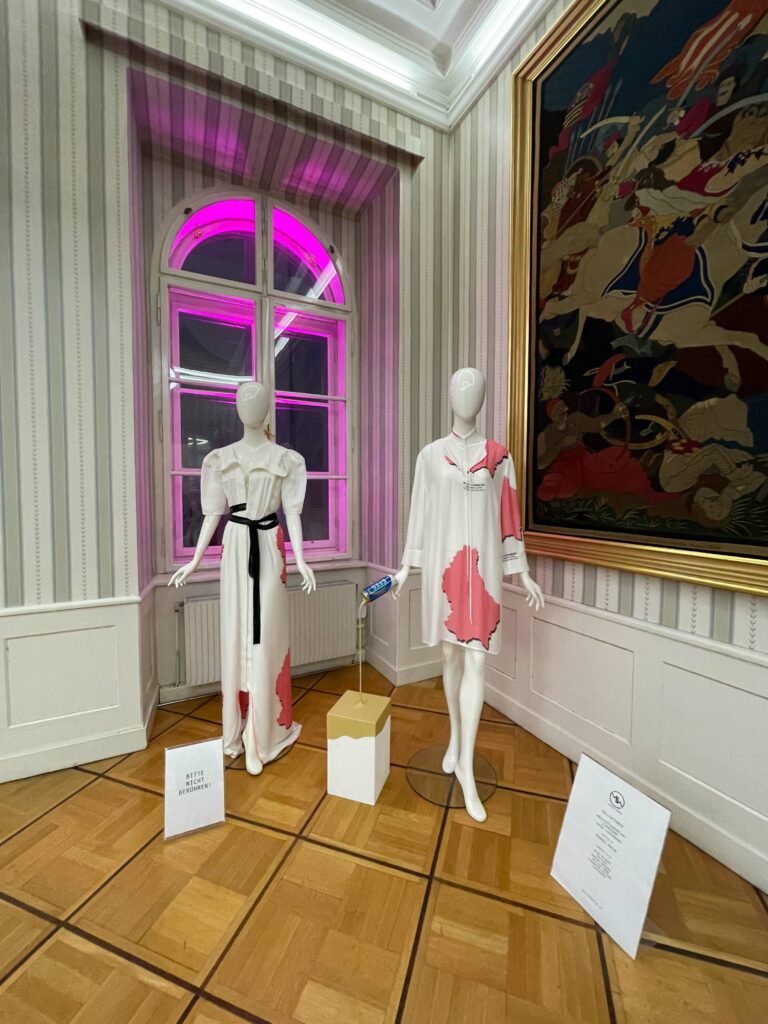
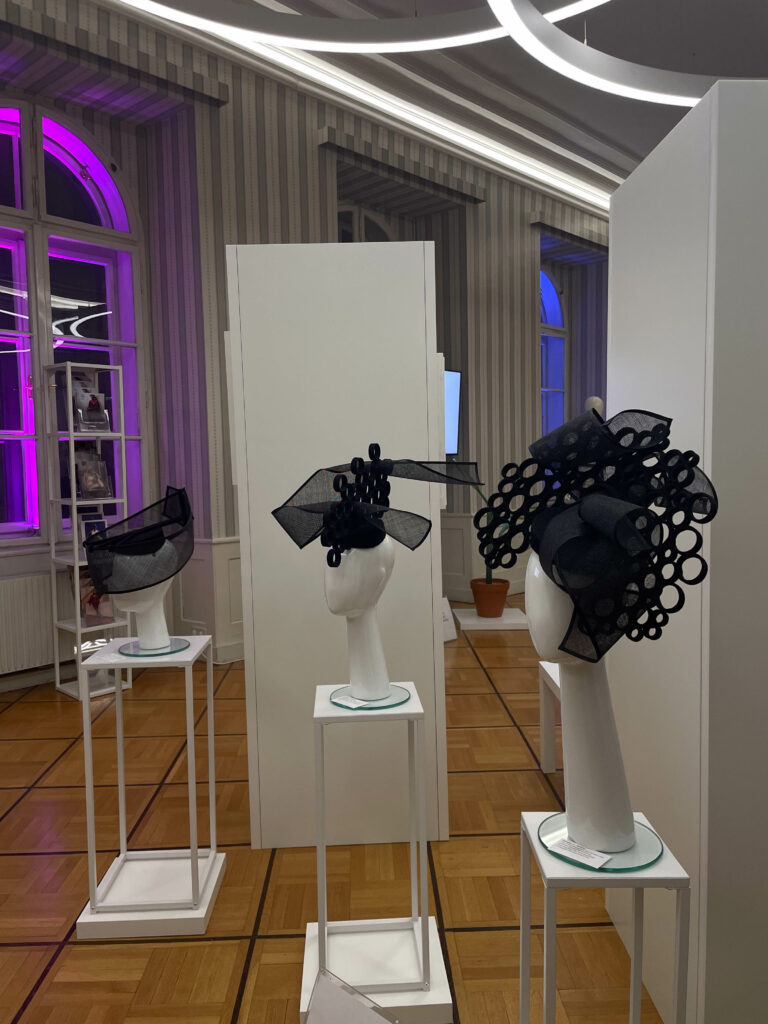
The PopUp Museum of Mode Wien in the Guild House of Viennese Fashion Makers was located in the historic center of Vienna. The site used to serve as an accommodation for itinerant garment makers. The exhibition “Symbiosis”, which was on display during the “long night” pays tribute to the creative energy and craftsmanship of the Viennese fashion scene.2

Why was this Exhibition relevant for my Thesis?

In my research into fashion design, one component of interest for my research is the way fashion is displayed in museum exhibitions. Fashion has a long history of “fighting” to be viewed as an art form, often times being perceived as lesser than classic artistic disciplines such as painting, sculpture or even literature and music. The idea that fashion is more trivial as an artistic discipline certainly has many underlying causes, not least of which is the aspect that fashion was and is to this day perceived as a female domain as well as a part of pop culture, which lowers its merit in the eyes of certain fractions of the art scene. Interest in fashion is not often equated to other interests in the arts, often being dismissed as something mundane and trivial. In recent years however, the perception of fashion has shifted and the artistic merit of the craft as a discipline of art is finally gaining more traction. Along with this tension of fighting for its place in the art cannon, exhibiting fashion can be a challenge because fashion usually depends to a certain extent on the incorporation of movement, body and the context of being worn. This makes it a challenge to exhibit in an engaging way.

Exhibition Review

The space in the guild house was divided into sections. In one of the rooms, the exhibition “Symbiosis” was displayed. This exhibition featured designs from Viennese fashion designers in correspondence with artworks by local artists, all elaborating on the same topic. The correspondence between the garments and the art pieces created an interesting dialogue and extended and re-contextualized the designs on display. The overall exhibition design however, was unfortunately not quite as successful as it could have been. Since the “long night” always attracts a large number of visitors, the exhibition was quite crowded and the space did not provide good opportunities for easy crowd guidance, resulting in a rather hurried exhibition experience. 

The other section of the space was dedicated to a pop up shop where some local designers had the opportunity to sell some of their designs and give insights into their design process. The designers were present and this provided an opportunity to ask further questions about their creations which was a nice component. Overall however, I would have preferred if they could have dedicated the whole space to the exhibition concept in favour of a better visitor flow and a more pleasant overall visiting experience. It became quite clear that the exhibition was likely more of an afterthought and the pop up shop spatially took priority over it, which was a pity. Although I understand the overall concept and I appreciate the approach with the correspondence to other art disciplines, I must say that I have seen fashion exhibited in more engaging ways in other museums, such as the exhibition “Dressing the Body” at the Disseny Hub Barcelona. 

Images


1ORF Lange Nacht Der Museen. “Info,” 2024. https://langenacht.orf.at/info.
2ORF Marketing & Creation GmbH & Co KG. “ORF Lange Nacht der Museen Booklet.” Press release, 2024.

Sources

“Dressing the Body. Silhouettes and Fashion (1550-2015),” Disseny Hub Barcelona, December 12, 2023, https://www.dissenyhub.barcelona/en/exhibition/dressing-body-silhouettes-and-fashion-1550-2015.

“Info,” ORF Lange Nacht Der Museen, 2024, https://langenacht.orf.at/info.

ORF Marketing & Creation GmbH & Co KG, “ORF Lange Nacht der Museen Booklet,” Press release, 2024, accessed November 11, 2024.

All Images © Helene Goedl 2024

Impulse #2 – SUX-Podcast EP13 – „Changing design towards a better world“ with Don Norman

Links

The Podcast: https://podcasters.spotify.com/pod/show/suxpodcast/episodes/SUX-EP-13—Changing-design-towards-a-better-world-with-Don-Norman-e2gococ

SUX: https://sustainableuxnetwork.com

Don Norman. Design for a Better World: https://jnd.org/books/design-for-a-better-world/

IMPULSE #1 | Film: “Notebook on Cities and Clothes”

About the Film

In his 1989 film “Notebook on Cities and Clothes”, Wim Wenders documents Japanese fashion designer Yohji Yamamoto’s journey through developing a collection for a fashion show in Paris. Although Wenders previously expressed a disinterest in fashion, he accepted the commission to create a film on Yamamoto when he was approached by the Centre Pompidou in Paris for the production.
In the film, Wenders intercuts interviews with Yamamoto with documentary scenes shot in his atelier while he develops a collection with his team. In the process, Wenders finds appreciation and understanding for the process of fashion design by finding parallels to his own creative practice. Wenders labels this project as a “diary film”, shooting primarily without a team and filming most of the material himself.1 

About his approach to fashion before making the project, Wenders says in his voiceover in the film: “The world of fashion… I am interested in the world, not in fashion. But maybe my judgement was premature. Why shouldn’t I try to approach the topic without prejudices. Why not look at fashion like any other industry, the film industry for example?”

“Filmmaking…should sometimes just be a way of life. Like going for a walk, reading a newspaper, writing something down, driving a car, or making this film. From day to day it writes itself, driven by the curiosity for the topic.2

About Yohji Yamamoto

Yohji Yamamoto was born on the 3rd of October 1943. He is among the most notable modern Japanese fashion designers. Yamamoto is based in Tokyo and Paris. Noted as a masterful tailor, his brand identity is marked by his avant-garde tailoring which also incorporates Japanese design aesthetics.3

Why is this Film an Impulse for my Thesis?

In the course of my research, it is becoming more and more clear that my thesis will deal at least in part with an exploration of the material component of fashion and clothing, the role materiality plays in our relationship to clothing and the challenges this poses for extending the fashion design discipline into the digital world. 

In the film, director Wim Wenders mentions his starting point for his exploration into the world of fashion design – a jacked he owned that gave him a special feeling when he wore it. The piece was by Yohji Yamamoto.2 This is an example for the importance of materiality in fashion design, especially in how the wearer builds a relationship to garments. 

Wenders and Yamamoto connect over the famous August Sander photo documentary work “People of the 20th Century” in which Sander “documented” everyday people in their environments through portraits (The word “documented” is in quotations because we know today that some of the images were staged by Sander and are not truthful to the real circumstances of the portrayed people). While Wenders admires it as an iconic work of photography, Yamamoto is fascinated by the clothes and demeanour of the portrayed people. Yamamoto appreciates how clothes back in that time reflected and communicated a lot more about a persons circumstances in life.2
This can be seen as positive or negative. Clothing as a tool of social stigmatisation is also a common occurrence throughout history. 


Personal Key Moments from the Film: 

  • Digital craftsmanship – Wim Wenders interjects the elaborations of Yamamoto on Sander’s work by questioning the value of digital craftsmanship in comparison to classical craftsmanship. Especially connected to the people depicted in Sander’s portraits. Wenders essentially questions whether digital processes will ever be able to compare to the value of physical craftsmanship.
From: Notebook on Cities and Clothes (1989).
  • Craftsmen’s morals – “[…] in short, to find the essence of a thing through the process of fabricating it”.2 – Another instance of an argument in favour of the importance of physical process. 
From: Notebook on Cities and Clothes (1989).
  • Designing time – Yamamoto postulates that if he could design anything, it would be time. He says some materials are alive, they age and the true finished garment is a product of time.2 Here, we see another component of the analog fashion’s life cycle that cannot be translated into digital space. Or does digital fashion have the ability to age? What would digital aging look like? Will digital fashion age through outdated formats, low resolution, outdated shading and 3D modelling conventions?
From: Notebook on Cities and Clothes (1989).
  • Importance of collaboration – fashion as a collaborative art form is brought up in the final scenes of the film. Yamamoto and his team come together to review the collection shown at Paris fashion week and celebrate. Wenders acknowledges the importance of each of their contributions – does this collaboration get lost in the digital fashion design process?

1“Notebook on Cities and Clothes | Wim Wenders Stiftung.”
2 Notebook on Cities and Clothes.
3 Wikipedia contributors, “Yohji Yamamoto.”

Bibliography:

“Notebook on Cities and Clothes | Wim Wenders Stiftung,” n.d., https://wimwendersstiftung.de/en/film/notebook-on-cities-and-clothes/.

Notebook on Cities and Clothes. 35mm Color, 1989. https://www.primevideo.com/detail/amzn1.dv.gti.52af787f-a727-4c08-92cd-19e1ac0a8357.

Wikipedia contributors. “Yohji Yamamoto.” Wikipedia, November 5, 2024. https://en.wikipedia.org/wiki/Yohji_Yamamoto.

24 | IMPULSE #3 – “Zu viel Konsum? Zu viele Menschen? – Die Erde am Limit“

Having watched the documentary “Zu viel Konsum? Zu viele Menschen? – Die Erde am Limit” by Arte, I felt a real sense of urgency about the issues it explored. The film dives into two powerful themes that are tightly intertwined: population growth and resource consumption. It shines a light on the challenging question of whether our planet can support its current trajectory of population growth and ever-increasing consumer demand. For those of us in the global north, this film is a wake-up call—a reminder of how deeply our lifestyles impact the environment and others across the globe. And as I watched, I realized just how closely this topic aligns with my own thesis project, which seeks to encourage climate-friendly actions in everyday life through gamification.

The documentary opened by tackling population growth, examining the differences between a couple in Italy and a large family in Ethiopia. This contrast was big: while in Sub-Saharan Africa, families are often large because children provide labor and support, in Italy, the birth rate has dwindled, with only 1.2 children per woman, one of Europe’s lowest rates. The film points out that while population growth in regions like Sub-Saharan Africa continues to soar, other parts of the world face their own problem: high resource consumption.

Ethiopia, for instance, currently has a population of 120 million people, projected to double in the next three decades. Here, lack of education and family planning often contribute to high birth rates. Many rural women, often married young, work up to 16 hours daily, and societal norms give men the say on family size. Meanwhile, limited education and health services mean fewer opportunities for family planning. The film shows the efforts of organizations like Menschen für Menschen, founded by Austrian Karlheinz Böhm, to integrate family planning into broader socio-economic initiatives. By improving access to healthcare, education, and clean water, they empower families to make informed decisions about their family size and overall well-being.

Projects like these illustrate that sustainable development doesn’t have to follow the path of overconsumption seen in wealthier countries. They are not only reducing immediate poverty but are also considering long-term sustainability. Watching these initiatives in action, I felt motivated to integrate similar ideas into my app, such as creating community-focused challenges or reward systems for local environmental contributions, like tree planting or waste reduction.

The documentary highlights that the global north is just as responsible for the current ecological strain as areas with high birth rates. The issue isn’t just about “too many people” but also “too much consumption.” Take the Italian couple in the documentary, who use more resources before breakfast than an Ethiopian family might use in an entire year. The wealthiest billion people worldwide consume 72% of global resources, whereas the poorest 1.2 billion consume just 1%.

Our way of life in the global north, with frequent air travel and a consumption-heavy lifestyle, is a significant factor in pushing the Earth to its limits. Climate compensation schemes – where travelers pay extra to offset emissions—are mentioned in the documentary as symbolic, even superficial solutions. They offer a “greenwashed” way to soothe our conscience without addressing the core problem: a mindset of consumption that treats Earth’s resources as endless.

One of my main reflections after watching this documentary was how crucial it is to inspire climate-friendly choices within our own lives. The app I want to develop shall be designed to encourage and reward people for making sustainable choices, from simple actions like reducing energy consumption to bigger ones like rethinking travel or food choices. By creating a system that rewards users for climate-conscious decisions, I hope to make sustainability feel achievable and engaging, not like a burden.

The documentary illustrated how infrastructure can support sustainable behaviors. For instance, Copenhagen has made biking the norm by implementing bike-friendly infrastructure and by making it easier for people to get around without cars. In the app, I envision features that will allow users to see the impact of their actions, whether it’s tracking how many resources they’ve saved or learning about the carbon reduction tied to their choices. Just like Copenhagen’s motivational billboards that display CO2 savings from public transport usage, this app shall help users stay aware of their positive impact.

As a final thought, the documentary emphasizes the gap between the climate goals of industrialized nations and their current actions. For example, the G20 countries are responsible for 75% of global emissions and, without more drastic changes, we’re still on track for more than a 2.5°C increase in global temperatures. While some progress has been made – such as the EU’s Green Deal aimed at making Europe climate-neutral by 2050 – the documentary makes it clear that much more needs to happen.

The documentary showed me why an app that encourages small, daily changes might be of essential value. By combining incentives and accessible resources, I hope my app can empower individuals to make a difference. The film’s message is urgent: it’s time to address overpopulation through smarter consumption and by fostering sustainable choices. And in the Global North, that means facing our consumption habits head-on and making changes that can lead to a more sustainable future.

Link to the movie: https://www.arte.tv/de/videos/115507-000-A/zu-viel-konsum-zu-viele-menschen/

More insights on population growth: https://ourworldindata.org/population-growth

Sustainability in Copenhagen: https://www.wonderfulcopenhagen.com/wonderful-copenhagen/international-press/sustainability-copenhagen

Menschen für Menschen in Ethiopia: https://www.menschenfuermenschen.at/

IMPULS 1: Ausstellung „IN*VISIBLE x RAUM FÜR ERREGUNG“

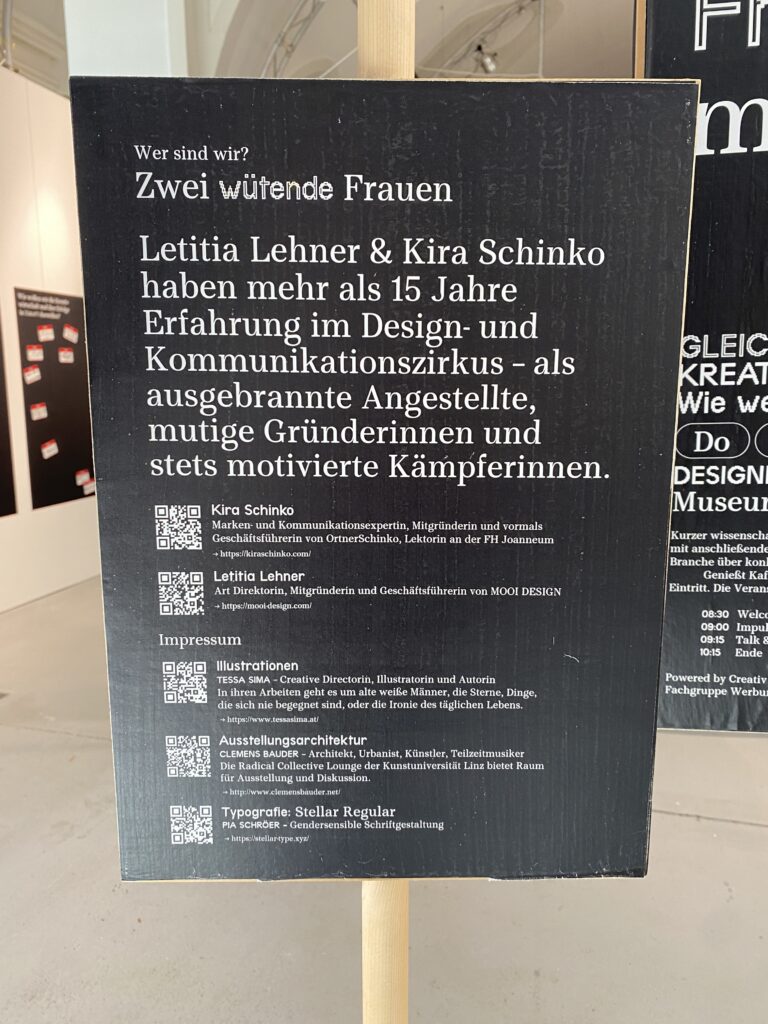
Anfang Oktober besuchte ich die Ausstellung „IN*VISIBLE x RAUM FÜR ERREGUNG“ in Wien. Bei einem Videodreh bin ich mit Lisa Hopf auf mein Masterarbeitsthema zu sprechen gekommen. Ich wurde von Lisa auf die Ausstellung „Raum für Erregung“ von Kira Schinko und Letitia Lehner aufmerksam gemacht. Kira Schinko hielt in unserem Bachelorstudiengang Informationsdesign eine Vorlesung, wo wir über den Umgang mit Kund*innen sprachen. Diese Lehrveranstaltung war sehr spannend für mich und ich wurde hellhörig als Lisa Hopf ihren Namen im Zusammenhang mit meinem Thema aussprach. Noch am selben Tag informierte ich mich über diese Ausstellung und fuhr bei der nächsten Gelegenheit nach Wien, um diese zu besuchen.

Die Ausstellung „IN*VISIBLE x RAUM FÜR ERREGUNG“ fand vom 19.09.2024-10.11.2024 im designforum Wien, Museumsplatz 1 Hof 7 statt. Montag bis Freitag war die Ausstellung von 10:00 bis 18:00 geöffnet und am Wochenende von 14:00 bis 18:00.1

Johanna Wicht und Christine Poplavski setzen sich mit „IN*VISIBLE“ für Gleichberechtigung in der Kreativbranche ein. Sie beschäftigen sich mit der Frage, ob in der Designbranche Gendergerechtigkeit gelebt wird. Die Ausstellung kritisiert die progressive Positionierung der Kreativbranche. Sie wird als Vorreiter gesehen, wenn es um Veränderungen in der Arbeitswelt geht. Mit der Ausstellung beweisen Wicht und Poplavski, dass dies nicht Realität entspricht. Den beiden Frauen geht es darum diese unsichtbaren, genderspezifischen Probleme mit ihren Exponaten aufzuzeigen. Sichtbarkeit ist der erste Schritt in Richtung Besserung, denn unsichtbare Missstände können nicht behoben werden. Christine Poplavski und Johanna Wicht studierten gemeinsam im Master an der Fachhochschule Salzburg und teilen das Interesse an feministischen Inhalten. Im Jahre 2023 wurde „IN*VISIBLE“ vom Art Directors Club Germany ausgezeichnet. Die Ausstellung erhielt einen bronzenen und einen goldenen Nagel.2

„RAUM FÜR ERREGUNG“ beschäftigt sich mit dem Fakt, dass die Anzahl an Frauen in der Kreativbranche immer mehr zunimmt. Diese positiv erscheinende Entwicklung bring Veränderungen mit sich, die zu einer Entwertung dieser Branche führen könnte. Kira Schinko und Letitia Lehner haben über 15 Jahre in der Kreativbranche gearbeitet. Sie waren in Angestelltenverhältnissen und selbstständig tätig. Die Ausstellung bietet Raum für Reflexion über den Gender Pay Gap, die mögliche Entwertung der Branche, mangelnde Vielfalt und überholte Führungsstile.3

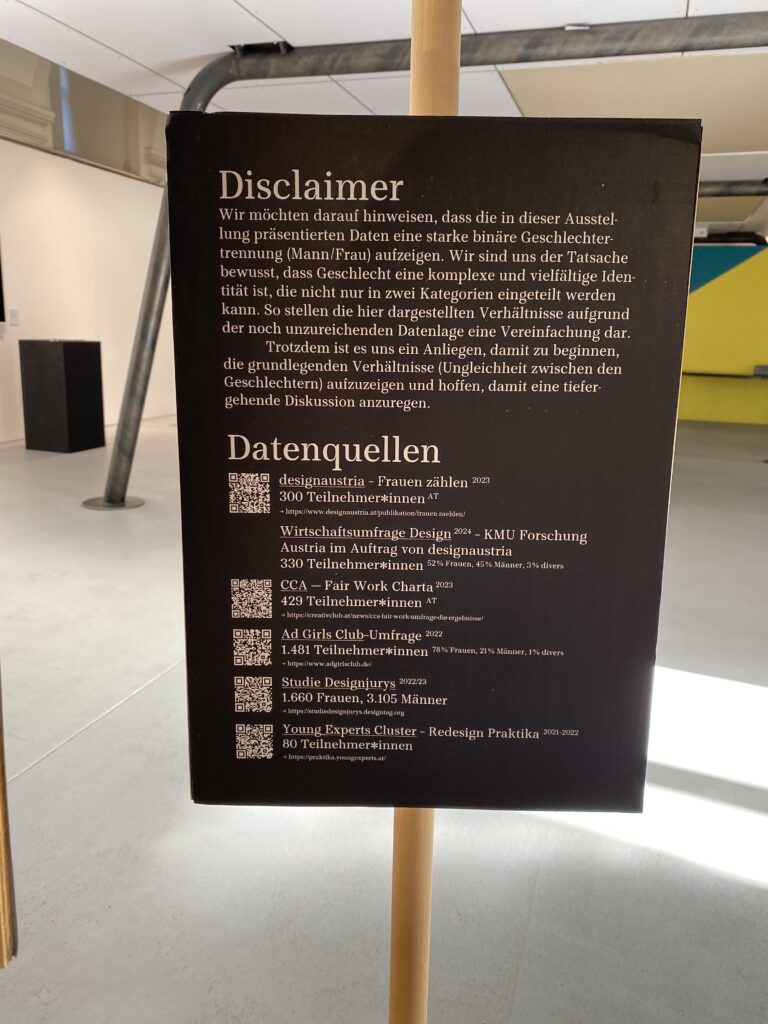
In der Ausstellung „IN*VISIBLE x RAUM FÜR ERREGUNG – ZUR GLEICHSTELLUNG IM DESIGN“ wurde gezeigt, dass der Lohn in Berufsfeldern sinkt, sobald Frauen in ihn einsteigen. „Eine Langzeitstudie der US-Census-Daten zeigt: Sobald Frauen in ehemals männlich dominierte Berufe eintreten, sinken Gehälter und Prestige drastisch – um bis zu 57 %.“ 4 Dieses beschriebene Phänomen geht auch in die andere Richtung. Demnach steigt der Gehalt, wenn in weiblich dominierte Berufsfelder Männer einsteigen. Als Beispiel nannte die Ausstellung die IT-Branche. Diese wurde in ihren Anfängen von Frauen dominiert. Programmieren galt als einfache Aufgabe und erst mit dem Einstieg der Männer in diese Branche, stieg auch der Gehalt und das Ansehen rapide an. In den USA sind aktuell 26 der 30 Jobs, mit dem höchsten Gehalt, von Männern dominiert. 23 der 30 Jobs mit der schlechtesten Bezahlung sind im Gegensatz dazu zum Großteil von Frauen besetzt. Den Daten zufolge handelt es sich daher um ein strukturelles Problem. Die Arbeit von Frauen wird geringer entlohnt und geschätzt. Selbst wenn Frauen in den gleichen Positionen und Berufsfeldern arbeiten, die von Männern dominiert werden, liegt ihr Gehalt systematisch unter dem der Männer. Laut der Ausstellung verdienen Frauen um 34 % weniger in der Kreativbranche und um 13 % weniger in der Medienbranche.

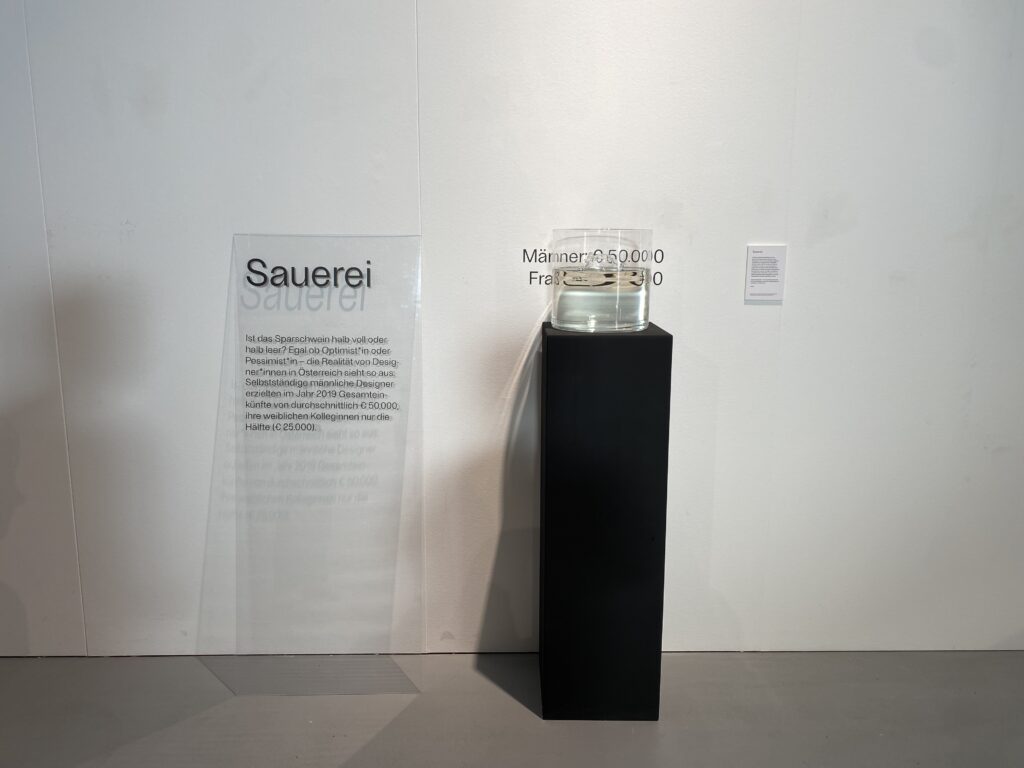
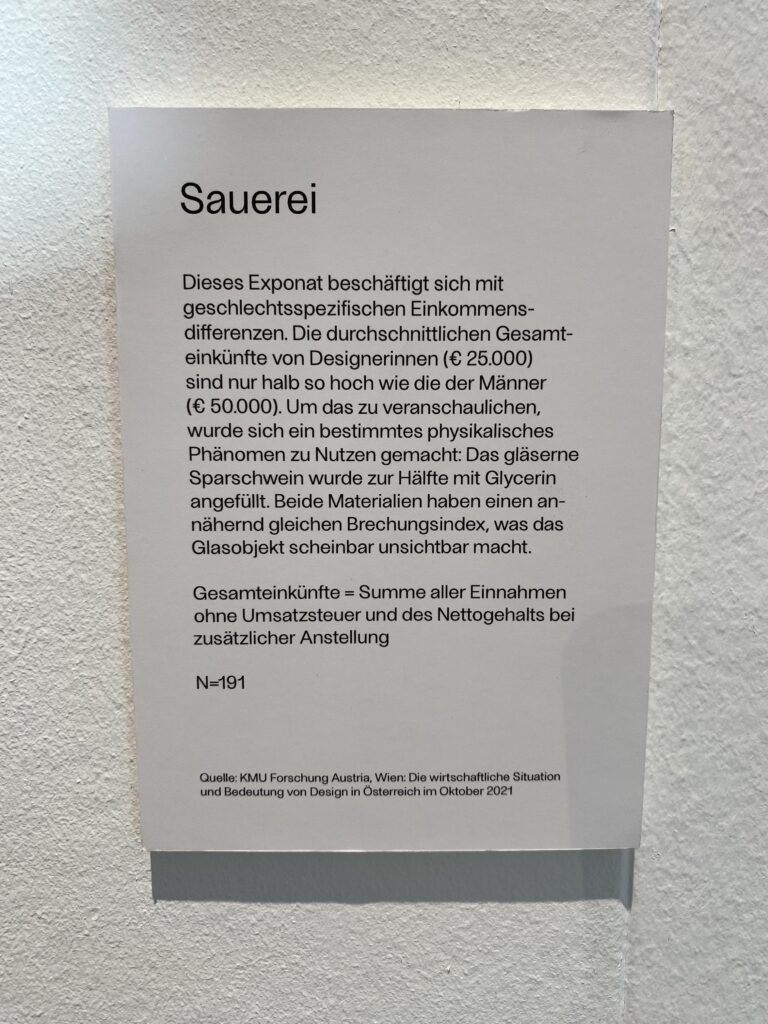
Sauerei

Das Exponat „Sauerei“ zweigt ein halb volles bzw. halb leeres Gefäß, in welchem ein Sparschwein schwimmt. Dahinter steht in schwarzen Buchstaben „Männer: € 50.000“ und darunter steht „Frauen: € 25.000. Die Installation soll zeigen, dass Männer, die selbstständig als Designer arbeiten, im Jahr 2019 durchschnittlich 50 000 € an Gesamteinkünften verdienten, Frauen hingegen nur 25 000 €.6

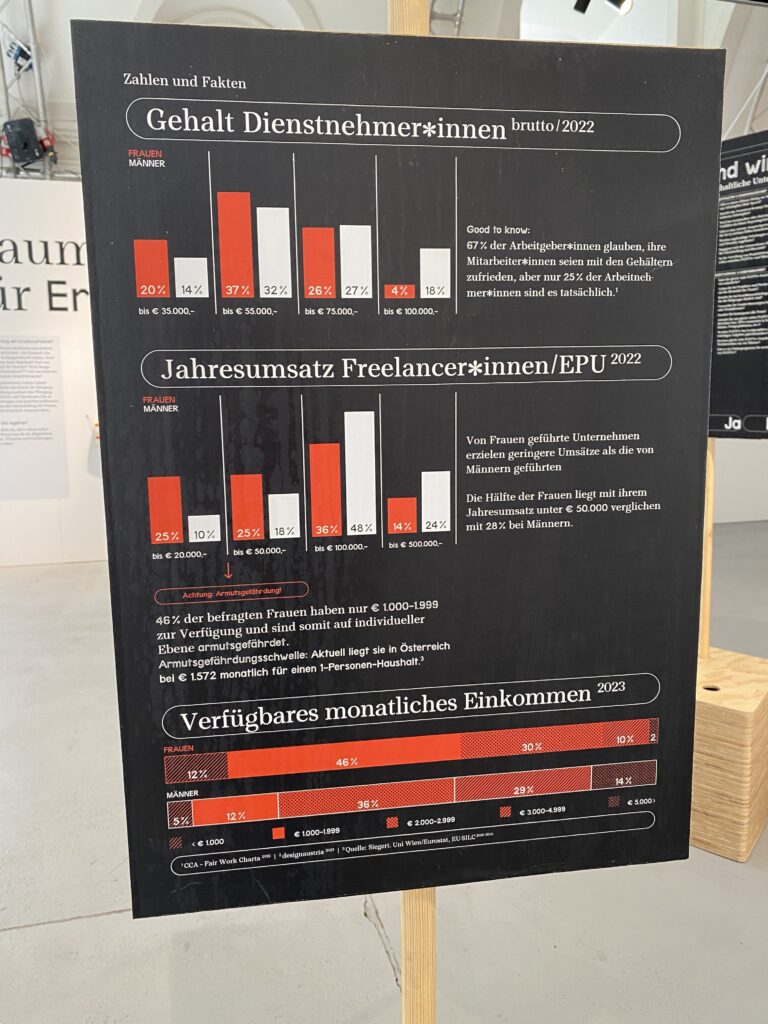
Zahlen und Fakten

Das Exponat „Zahlen und Fakten“ zeigt den Jahresumsatz von Freelancer*innen (Ein-Personen-Unternehmen EPU) im Jahr 2022. Die Grafik wurde in Frauen und Männer unterteilt. Die Hälfte der weiblichen Freelancerinnen liegen mit ihrem Umsatz unter 50 000 €. Bei Männern sind es nur 28 %. Mit 46 %, fast der Hälfte der Frauen haben 1000-1999 € monatlich zur Verfügung. Die Armutsgefährdungsschwelle wird in Österreich aktuell mit 1572 € pro Monat in einem 1-Personen-Haushalt angegeben.7

Männer sind häufiger in der höchsten Gehaltsklasse, Frauen in der niedrigsten – das gilt sowohl für Dienstnehmer*innen als auch für Selbstständige. 8

Laut designaustria sind in der Kreativbranche Frauen häufiger in einem Angestellten Verhältnis (25 % der Frauen, 15 % der Männer). Trotzdem ist der Anteil an Frauen in Führungspositionen mit 11 % Frauen im Gegensatz zu 32 % Männern erheblich geringer.9

Die Ausstellung gab mir einen erschreckenden Einblick in die Thematik. Meine Motivation über Frauen in der Selbstständigkeit zu schreiben, ist durch diese Ausstellung maßgeblich gesteigert geworden.

1 (vgl. designaustria 2024)

2 (vgl. designaustria 2024)

3 (vgl. designaustria 2024)

4 (IN*VISIBLE x RAUM FÜR ERREGUNG 2024)

5 (vgl. IN*VISIBLE x RAUM FÜR ERREGUNG 2024)

6 (vgl. IN*VISIBLE x RAUM FÜR ERREGUNG 2024)

7 (vgl. IN*VISIBLE x RAUM FÜR ERREGUNG 2024)

(IN*VISIBLE x RAUM FÜR ERREGUNG 2024)

(vgl. IN*VISIBLE x RAUM FÜR ERREGUNG 2024)

Literaturverzeichnis

designaustria (2024): IN*VISIBLE x RAUM FÜR ERREGUNG. ZUR GLEICHSTELLUNG IM DESIGN. In: designaustria, https://www.designaustria.at/veranstaltung/invisible-x-raum-der-erregung/ (zuletzt aufgerufen am 11.11.2024)

IN*VISIBLE x RAUM FÜR ERREGUNG. ZUR GLEICHSTELLUNG IM DESIGN. (2024) Kuratiert von Wicht, Johanna u.a. designforum Wien, Wien, 19.09.2024-10.11.2024

Impulse #4 // Customer Workshop and Development of an Interface for Industrial Roboter

Within my profession, I had the opportunity to participate in a customer workshop that focussed on the design of an interface for industrial robots. While I can’t share details about the project for confidentiality reasons, the experience itself was incredibly enlightening for me and my research topic and provided a unique, hands-on experience.

The workshop began with an in-depth discussion about the problem and the customer’s needs for their clients and their expectations. This was followed by development of personas, mapping of user journeys and brainstorming of initial concepts. These early stages of the process were essential for understanding the core requirements and user needs. As the day progressed, we developed and refined the ideas and came up with new insights that had not previously been considered. This process emphasised the importance of early cooperation between different teams as new solutions and directions emerged through discussion and collaboration.

As we progressed and as a follow-up for the workhops, we created user journeys, wireframes, and user interfaces, which were continuously refined through client feedback. This iterative approach allowed us to build a clearer picture of the design requirements and adapt to the project’s evolving needs.

For my research topic, this workshop was an invaluable experience, as it firstly highlighted the impact of external (and internal) influences on user interfaces – in that case in industrial environments. Factors such as poor lighting conditions, dust, and the use of gloves had a significant effect on how the touch interface should be designed. This sparked my interest in exploring how different (in that case environmental) factors influence the usability and design of interfaces, leading to my new initial idea for my master’s thesis topic: Internal and External Influences on User Interfaces and User Experience: Towards Holistic Understanding and Adaptive Design Strategies, which was later expanded to Adaptive and Context-Aware User Interfaces: Strategies for User-Centered Design and Optimizing User Experience in Response to Internal and External Influences.

Impulse #3 // UX Graz // Regularly Meetups orginized by Johannes Lehner

Attending UX Graz meetups has been an invaluable experience in expanding my understanding of user experience (UX) design and its real-world applications. These meetups have provided significant inspiration, new insights, and practical knowledge that I can integrate into my work. UX Graz is a community for UX professionals and anyone interested in UX, providing a platform for learning, networking, and sharing knowledge about the latest trends in UX design. The events feature a variety of talks and discussions, and I’ve had the opportunity to attend several sessions throughout 2023 and 2024, each offering unique insights into different areas of UX.

UX Graz – A Platform for Networking and Learning

UX Graz is an inclusive community for UX enthusiasts of all levels. It offers both local and online meetups, allowing people to connect, learn, and collaborate on UX-related topics. I’ve attended both in-person and online events, each providing distinct advantages. Online meetups offer the flexibility to join from anywhere, which is perfect when you don’t have the time to attend in person. However, attending in person allows for networking opportunities and deeper engagement, especially when the meetup is hosted by a company, offering a chance to interact with industry professionals in a real-world setting. Over the past year, I’ve participated in various events, including topics like Live UX Expert Reviews, Unlocking Synergy: DEV x UX, UX for AI, and From UX to Perfect UI in 5 Simple Steps etc.. Each event has been informative, engaging, and has inspired new directions for my research, particularly around how to build adaptive systems that consider the diverse needs of users.

Unlocking Synergy: DEV x UX

The first session I’d like to highlight is „Unlocking Synergy: DEV x UX“, which addressed the often challenging but highly rewarding relationship between UX designers and developers. This talk focused on the miscommunication and silos that commonly arise between these two fields, hindering collaboration. However, it also explored the great potential for innovation when these two disciplines align their efforts. The speaker, Tobias Lubrano and Johannes Lehner, provided practical strategies for bridging the gap between UX designers and developers, emphasizing the importance of understanding each other’s roles and goals. This session resonated with me, as it aligns with my research on how to foster collaboration and create adaptable systems that work seamlessly across different disciplines. This collaboration can elevate user experience and efficiency, which is crucial for building successful adaptive systems.

UX for AI

Another event that piqued my interest was “UX for AI”, where the topic revolved around designing user experiences for artificial intelligence systems. As AI continues to be integrated into more products and services, designing for AI interfaces presents unique challenges, particularly in ensuring that AI systems remain user-friendly and accessible. This session provided valuable insights into AI-driven design and how to make AI interactions more intuitive for users. Understanding how to design these interfaces, keeping users in mind while maintaining the functionality of AI, has become a critical part of my research, especially as I explore how adaptive systems can integrate AI without compromising user experience or accessibility.

From UX to Perfect UI in 5 Simple Steps

Lastly, within the event “From UX to Perfect UI in 5 Simple Steps”, where Urszula, a UI Designer at Parkside, walked us through the process of transforming wireframes into a visually appealing and functional user interface. She covered important topics like design systems, color theory, typography, and UI components, all of which are fundamental to creating a coherent, accessible UI. This event deepened my understanding of how crucial visual design elements are in improving user experience and accessibility. It also showed me how to efficiently transition from UX research and wireframes to a polished UI design, while maintaining consistency and usability across different platforms. This experience directly informs my work on creating adaptive systems that not only function well but are also aesthetically appealing and user-friendly.

Networking and Learning

One of the most valuable aspects of attending these UX Graz meetups is the networking opportunities. Each event encourages open discussions and Q&A sessions, where attendees can ask questions, share their challenges, and receive feedback from experts and fellow participants. The chance to meet like-minded individuals and industry professionals in a more informal setting is incredibly beneficial. The events are also a great way to learn about new tools, methods, and trends in UX, which I can apply to my own research.

Conclusion

The UX Graz meetups have been an invaluable source of inspiration, offering new perspectives that are directly applicable not only to my research but also to my profession. The discussions on collaboration between UX and development, designing for AI, and creating intuitive UI designs have enriched my understanding of how to design systems that are both functional and inclusive. These meetups have reinforced the importance of user-centered design, ensuring that the systems I develop are accessible, adaptable, and truly meet the needs of all users. I will continue attending these meetups to stay informed, exchange knowledge, and gain fresh insights that will help shape my research and expand my professional network in the UX field. Networking, sharing knowledge, and staying current with the latest trends are crucial, and these events provide an ideal platform for all of these.

Links

https://www.meetup.com/de-DE/uxgraz
https://www.linkedin.com/company/uxgraz
https://www.linkedin.com/in/jbeargraphics/