#03 Literature Research 2

Rosiny, Claudia: Tanz Film. Intermediale Beziehungen zwischen Mediengeschichte und moderner Tanzästhetik. Bielefeld: transcript 2013, E-Book

Survey: The book explores the intermedial relationships between dance and various audiovisual media, focusing on six key themes: influences of media on dance aesthetics, use of media on stage, film genres involving dance, videotanz, integration of digital technologies, and internet-based dance aesthetics. The structure includes theoretical discussions, historical contexts, case studies, and mediatheoretical conclusions. It provides an interdisciplinary examination of the interplay between modern dance and media evolution.

Question: How do audiovisual media influence modern dance aesthetics? What are the significant historical and contemporary examples of dance works using media? Does the author provide clear methodological frameworks to analyze these intermedial relationships?

Read:

  • Historical analysis of how film and photography intersected with dance since the early 20th century.
  • Examination of specific works (e.g., Maya Deren’s A Study in Choreography for the Camera).
  • Discussions on mediatheoretical concepts like intermediality, transmediality, and multimediality, and their relevance to dance.
  • Detailed case studies on technological innovations like motion capture and the choreographic possibilities of digital tools.

Six Themes of Intermediality in Dance:

1.Media Influences on Dance Aesthetics: This section traces historical influences, such as the integration of photography and film into dance in the early 20th century, and the shift in aesthetic paradigms due to modern media.

2. Media Use on Stage: Focuses on performance art from the 1910s to the present, highlighting how multimedia technologies have transformed the stage.

3. Dance in Film and Television: Discusses Hollywood musicals, Bollywood dance films, and televised dance. Iconic works like Singin‘ in the Rain and The Red Shoes are analyzed for their choreographic contributions to cinema.

4. Videotanz: Investigates the evolution of dance-for-camera works, emphasizing pioneers like Maya Deren and Merce Cunningham.

5. Dance and Digital Technologies Examines innovations such as motion capture and interactive installations.

6. Dance Aesthetics via the Internet: Considers how platforms like YouTube have democratized dance. Case studies include flash mobs and viral dance phenomena like Evolution of Dance.

Recite: The book posits that dance and media are deeply interconnected, with media shaping not only how dance is preserved but also its aesthetic and conceptual boundaries. The analytical frameworks provided help readers dissect the complexities of these intermedial relationships. The examples enrich understanding, showcasing the evolution from early cinema’s influence to digital and virtual innovations in contemporary dance.

Review: The book is highly structured, with chapters logically progressing from foundational theories to specialized topics. The arguments are well-supported by interdisciplinary research, making the book a valuable resource for understanding the fusion of dance and media. Its focus on both historical and cutting-edge examples ensures a comprehensive perspective.

Is the author an expert? Yes, Claudia Rosiny holds a doctorate in philosophy, directs dance and theater funding at the Swiss Federal Office of Culture, and teaches at universities. Her extensive academic and practical background in dance and media underscores her expertise.

How would you rate the structure of the text, the quality of the content, the style? The structure of the E-Book is excellent, it is methodically organized into thematic sections, allowing readers to focus on specific aspects of intermedial relationships. The quality of its content is high, it integrates rigorous academic research with practical examples and mediatheoretical concepts. It is written scientifically but also accessible at the same time, the writing maintains clear, thus making complex ideas comprehensible as a reader.

Is the book/article useful for your purpose? If yes, which chapter % aspects? If not, why not? What is missing, what is inadequate? Yes. It is particularly useful for exploring the chapters on „Medieneinflüsse auf die Tanzästhetik“ (= ”Media Influences on Dance Aesthetics”) and „Tanz und digitale Technologien“ (= ”Dance and Digital Technologies”). These sections provide valuable insights into how media reshapes dance, aligning with contemporary research needs. While comprehensive, the book could benefit from more comparative analyses between non-European and European traditions of dance-media intersections. The focus is predominantly Western-centric, leaving room for further exploration of global intermedial practices.

#02 Literature Research 1

Mitoma, Judith: Envisioning dance on film and video. New York/London: Routledge 2002

Survey: The book examines how dance is captured on film and video, covering its historical evolution, technical challenges, and creative innovations. It features contributions from choreographers, directors, and editors, providing diverse perspectives on integrating dance and media.

Question: How has technology shaped the filming of dance? What methods do filmmakers use to adapt choreography for the camera? Who are contributors to the field of dance on film and what are their notable works?

Read: The introduction of the book highlights the significance of recording dance for archival and creative purposes, exploring tools like cinematography and editing. Specific chapters detail milestones in dance film history, profiles of innovators – like for example Merce Cunningham – and techniques for preserving choreography.

Recite:

Chapter 1: Dance as Television: A Continuing Challenge

  • Dance and television have had a complicated relationship, as TV often prioritizes entertainment over the artistic integrity of dance.
  • Early broadcasts struggled to capture the full energy and complexity of live performances.
  • Pioneers like Jac Venza explored ways to adapt choreography for TV while keeping its artistic value.
  • Television pushed dance creators to innovate by thinking beyond the stage.
  • There was resistance from traditionalists who feared the loss of the „live experience.“
  • However, these adaptations allowed for a new form of creative expression that could reach global audiences.

Chapter 2: Music Video as Short Form Dance Film

  • This chapter explains how dance is adapted for film and video, the creative techniques used by choreographers and filmmakers, and the ways technology enhances or changes the presentation of movement.
  • It also explores the historical development of dance media, the intersection of visual and performing arts, and the evolving role of film as a tool for preserving and reinterpreting dance.
  • Music videos revolutionized dance on film by blending choreography with cinematic storytelling.
  • Directors used fast editing, close-ups, and creative camera movements to amplify the energy of the dance.
  • Examples like Michael Jackson’s Thriller showcased how dance could drive a narrative and reach mass audiences.

Some general Keywords:

  • Preservation (Dance captured for future study and enjoyment)
  • Adaptation (Choreography reimagined for film and TV)
  • Audience Accessibility
  • Creative tools (Camera angles, lighting, editing)
  • Pioneers (Merce Cunningham, Jac Venz)
  • Music videos (Dance and film merging to tell stories visually)
  • Multi-Camera Techniques

Review: The book connects historical practices with contemporary innovations, demonstrating how film has become a vital tool for the preservation and evolution of dance. It bridges performance and media, offering practical insights for dancers, filmmakers, and scholars.

Is the author an expert? Judy Mitoma is an expert in intercultural performing arts, having led the UCLA Center for Intercultural Performance and the Department of World Arts and Cultures.(https://www.wacd.ucla.edu/people/retired-faculty/judy-mitoma)

How would you rate the structure of the text, the quality of the content, the style? Written from the perspective of Jac Venza, Chapter 1 highlights his role as an American public television producer who was directly responsible for most of the theater and music programs seen on PBS since its creation in 1970. Because of his expertise, it is really nice to read, and even with it being more of a personal experience, it is definitely not useless or less valuable information. I would rather say it is to get to know the history from the inside. Furthermore, the texts examine their topics in much detail. There are a lot of references, shows, experts and so on mentioned to support greater research in depth in its fields. Generally, it is structured clearly due to bullet points, graphics and pictures with descriptions.

The second Chapter against the first is written scientifically. The examples and references to continue like in the previous chapter, and it has many important pioneers mentioned as well. Visually and in writing, it is clear from where certain passages in the texts are cited and are obviously used word by word. I really liked this while reading, because I researched the mentioned literature and got into my research even deeper.

Is the book/article useful for your purpose? If yes, which chapter % aspects? If not, why not? What is missing, what is inadequate? For the theoretical part of my master thesis, it can be really helpful, but I also think that the first two chapters are not that necessary for my topic. I want to go more in depth with my written part, thus writing more about the visual language in dance films or videos. So Chapter 14, which is titled “A Dancer behind the Lens” will be more useful for my purpose and my thesis’ theoretical part. Finally, I would say the first two chapters are not inadequate, but I would only pick out small points of the chapter’s content.

Excerpt

  • How does contemporary dance differ from traditional storytelling techniques in film?

Contemporary dance diverges from traditional storytelling techniques by focusing on abstraction, gesture, and movement rather than dialogue or structured narratives. Unlike film, which often adheres to a clear dramatic arc and character development, contemporary dance prioritizes the emotive and interpretive power of physical motion. However, some choreographers have begun to reintegrate narrative elements into their works, blending traditional and modern approaches to storytelling. (S.163)

  • What role does the setting play in the storytelling of dance films like Enter Achilles and Reines d’un jour?

In dance films such as Enter Achilles and Reines d’un jour, the setting serves as a crucial narrative element that enriches the choreography. In Enter Achilles, the British pub setting grounds the dance in a realistic sociocultural context, while in Reines d’un jour, the natural Swiss village landscape contrasts with modern dancers, highlighting themes of generational change. The settings are not mere backdrops but active participants in the storytelling, amplifying the emotional and thematic resonance of the dances. (S. 164-165)

  • What makes Pascal Magnin’s Contrecoup an effective example of blending stage and cinematic elements?

Pascal Magnin’s Contrecoup effectively blends stage and cinematic elements by using distinct locations, lighting, and camera techniques to contrast and eventually merge the stage and street worlds. His dynamic editing, close-ups, and use of real-world settings heighten the emotional intensity and psychological depth of the choreography. By tying all movements and scenes to the characters’ conflicts and resolutions, Magnin crafts a narrative that maintains the abstraction of dance while adhering to the cause-and-effect structure of classical storytelling. (S. 165-166)

IMPULS #02 Dein letztes Solo – Serie

Für meinen zweiten Impulsbeitrag habe ich mir die Serie „Dein letztes Solo“ auf Netflix angesehen. Die Serie handelt um Ballett und auf einer fiktiven Academy, wo ein dramatischer Mord vorgefallen ist. Die Schüler der Schule führen ein neues Stück auf, dass diesen Vorfall thematisiert und gleichzeitig versuchen sie alle den Schuldigen oder die Schuldige für den dramatischen Vorfall zu finden.

Für diesen Beitrag habe ich währenddessen meine Eindrücke in Stichworten gesammelt und für diesen Beitrag ausformuliert was mir bezüglich filmischer Aspekte aufgefallen ist. Dazu zählen Kameraführung, Effekte, Bildausschnitt, Dynamik der Kamera gegenüber der Tanzperformances.

Kameraführung

In der Serie werden häufig Hand-Held Kameraaufnahmen mit statischen Aufnahmen kombiniert. Handaufnahmen werden vor allem in emotional aufgeladenen oder sehr intensiven Momenten verwendet. Diese zeigen besonders die echte Energie und das Chaos in der Storyline. Statische Aufnahmen hingegen verstärken die technische Präzision der Tänze ein, vor allem bei Proben oder Aufführungen, und konzentrieren sich auf die Choreografie der Performances.

Kameraauschnitt

Nahaufnahmen zeigen Details wie Gesichtsausdrücke, Hände oder Füße und lenken die Aufmerksamkeit darauf, wie die TänzerInnen mit ihrer Performance verbunden sind. Weitwinkelaufnahmen geben einen klaren Blick auf die gesamte Bühne und die Choreografie, insbesondere bei Gruppentänzen. Dynamische Kamerafahrten zeigen die Bewegung der TänzerInnen und vermitteln dem Publikum das Gefühl, an der Aufführung teilzunehmen.

Effekte

Die Zeitlupe wird häufig verwendet, um die emotionalen Höhepunkte zu verstärken. Sie fängt normalerweise die entscheidenden Momente ein, wie Sprünge, Drehungen oder eine Berührung zwischen zwei Tänzern. Die Verlangsamung gibt dem Publikum Zeit, sowohl die Technik als auch die Emotion der Bewegung zu würdigen.

In Sequenzen, die nicht der Realität entsprechen, Erinnerungen oder Träume darstellen, diese besitzen oft kräftige Farben und dramatische Lichtwechsel. Somit wird die Stimmung des Tanzes verstärkt oder eine surreale Atmosphäre erzeugt.

Beziehung zwischen Kamera und Tanz

Die Kamera bewegt sich oft mit den TänzerInnen mit, besonders wenn es sich um eine Solo-Performance handelt. Diese Bewegung vermittelt den Eindruck von Fluss und Intimität, wodurch der Tanz als Ausdruck eines inneren Konflikts oder einer Freude noch besser zur Geltung kommt. Bei Gruppentänzen bleibt die Kamera manchmal weiter weg, um die Komplexität und Synchronität der Choreografie zu erfassen

Dynamik Kamera vs. Tanz

Die Kameraführung gibt oft die Dynamik des Tanzes wieder und verstärkt dessen Emotionen. Manchmal gibt es aber auch bewusste Kontraste. Während der Tanz dynamisch und energiegeladen ist, ist die Kamera ruhig und beobachtend. Manchmal ist die Kamera jedoch hektisch und ruckelig, während der Tanz Ruhe oder Melancholie zeigt.

Insgesamt sind die Tanzszenen in Dein letztes Solo von einer durchdachten Kameraführung und intelligenten Effekten geprägt. Die Kamera passt sich der Stimmung und der Energie des Tanzes an – es geht nie nur darum, die Bewegungen zu zeigen, sondern immer darum, eine Geschichte zu erzählen und das Publikum emotional mitzureißen.

Trailer-Link: https://www.youtube.com/watch?v=JSs_bznLjPo

Cast Interview: https://ew.com/tv/tiny-pretty-things-cast-interview

IMPULS #01 Black Swan

Für diesen Impulsbeitrag habe ich mir ein Best-Practice Tanzfilm Beispiel angesehen – Black Swan. Während des Films, habe ich alle Tanzszenen, nach der chronologischen Reihenfolge, dokumentiert. Ich habe Kameraführung, Effekte, Umgebung, Zeitverzerrungen und etliche weitere Dinge festgehalten:

Der Film beginnt mit einer Tanzszene, wo fast rein statische Kameraeinstellungen vorhanden sind. Kamerabewegungen sind im Vergleich zum Tanz ruhig und smooth.

Die Szene spielt in einem düsteren, schwarzen, leeren Nichts Raum. Die Balletttänzerin ist mit einer Spotlight Beleuchtung beleuchtet, was ihr weißes, fast kitschiges Tütü Outfit in den Fokus bringt.

Tanztraining-Szene ist auf den Charakter, der spricht der Trainer, fokussiert und Tanz ist hierbei eine Nebenhandlung und liegt definitiv nicht im Fokus. Das Tanzen trägt zur Handlung bei, aber erzählt von sich selbst nichts Zusätzliches.

Tanztraining, wo die Hauptdarstellerin ein Solo vortanzt, die Kamera bewegt sich Hand-Held sehr stark mit den Bewegungen des Tanzes mit und hat somit die gleiche Dynamik wie die Performance.

Eine kurze Tanzszene zuhause bei der Hauptfigur, wo sie trainiert, und versucht mehrere schöne Pirouetten zu machen. Die Pirouetten wurden aus POV der Tänzerin mit der Kamera gedreht, also die Kamera hat sich im Kreis wie in einer Pirouette bewegt. Statische Kamera mit langsamen Schnitten und nur einmal eine größere Aufnahme auf die Füße. Jedoch sind die Szenen der Drehung in Zeitlupe, bis sie sich verletzt.

Training, nachdem die Hauptdarstellerin die Hauptrolle bekommen hat: Kamera ist Hand-Held und bewegt sich zum Tanz mit, aber trotzdem nicht so dynamisch wie der Tanz selbst. Die Kamera hält die Performance fest, wie wenn sie in der Fläche beinahe im Weg steht und der Tänzerin und dem Tänzer entkommen versucht und die beiden beim Tanz beobachtet.

Tanztraining mit dem Trainer daneben und aktiv an Anpassung einwerfen. Kamera ist Hand-Held und bewegt sich dem Trainer fast Over-the-Shoulder hinterher, wie wenn sie ihm nachlaufen würde, wie er dem Tanzpaar nachgeht.

Tanztraining wo die Hauptdarstellerin mit dem Tanzlehrer/Trainer gemeinsam das Solo übt und tanzt.  Kamera ist Hand-Held und bewegt sich dynamisch mit den Bewegungen mit, Schnitte in der Szene selbst und Detaillaufnahmen, die unterschiedlichen Aspekte des Tanzes einfängt. Eingefügt wird auch eine Totale die statisch von weit weg ist. Die Tanzszene entwickelt sich jedoch mit der Zeit in eine Verführungsszene, die sexuell übergriffig vom Trainer scheint. Dann endet sie Szene abrupt und es ist in einer Totale ersichtlich, wie der Tanzlehrer hinausstürmt und die Tänzerin im Trainingsraum stehen bleibt.

Tanzszene im Club auf der Tanzfläche unter Einfluss von Drogen. Hand-Held Kameraführung mit Effekten, die das Bild verschwimmen lassen. Die Farben dieser Szene sind rot und grün und das Licht blinkt, also die Szene wird abwechselnd schwarz und dann wieder erleuchtet. Viele Schnitte und das Tanzen sind chaotisch und nicht nach einer geplanten, linearen Performance.

Tanztraining-Szene, wo die Hauptdarstellerin zu spät kommt. Hand-Held Kameraführung, dass es eben auch aussieht, wie wenn die Hauptdarstellerin das andere Tanzpaar zusieht und sie von der Seite beobachtet. Danach sind weitere Szenen der Performance auf der Bühne, diese starten mit einer statischen weit entfernten Kamera. Ein Schnitt geht dann auf eine Detailaufnahme zur Hauptdarstellerin in ihr Gesicht während des Tanzens, um ihre Gesichtsausdrücke klar wahrzunehmen.

Probe der Performance auf der Bühne mit den anderen TänzerInnen zusammen, aber es ist dann das Solo der Schlussszene der Hauptdarstellerin. Hand-Held Kameraführung mit Schnitten zu Detailaufnahmen in ihr Gesicht. Die Führung der Kamera wirkt wieder, wie wenn sie die Tänzerin verfolgt, beziehungsweise versucht zu verfolgen.

Die Hauptdarstellerin trainiert allein im Trainingsraum. Die Bildausschnitte sind viel Over-the-Shoulder und man verfolgt die Darstellerin. Etliche Schnitte, die zwischen Hand-Held Detailaufnahmen und statischen Totalen wechseln.

Bei der Solo-Performance auf der Bühne: Ruhige Detailaufnahmen und die Kamera ist Hand-Held geführt. Schnitte zu 2-3 Totalen von der gesamten Bühne. Die Bühnenbelichtung ist rot mit kühlen weißen Akzenten auf die Hauptdarstellerin. Etliche Schnitte in der Perfomance. Die Kamera bewegt sich mit der Tänzerin mit, als wenn sie sie verfolgt und hinterhergeht.

Black Swan Performance Szene: Sehr dynamische schnelle Kamerabewegungen, wieder Hand-Held. Keine Schnitte, sondern wirklich verfolgen der Tanzperformance.

Ruhige Kamerabewegungen, aber Verfolgung der Tänzerin bei der Black Swan Performance, wo sie sich in den Schwan verwandelt. Keine Dynamische oder hektischen Bewegungen dabei, erst als die Performance endet und es keine Tanzszene mehr ist.

Weißer Schwan Performance: Dynamische, Hand-Held Kamerabewegungen. Schnitte zu Totalen von der gesamten Bühne. Die letzte Tanzszene ändert sich von hektisch auf ruhig, bis hin zu einer Zeitlupe, wo sie auf der Bühne von der Erhöhung springt. Nachdem sie dort gelandet ist und die Tanzszene zu Ende ist, ist alles wieder in normaler Geschwindigkeit.

Behind the Scenes/Making Of: https://www.youtube.com/watch?v=_BSZymoCUsU

https://screenrant.com/black-swan-behind-scenes-facts-darren-aronofsky-natalie-portman-ballet-movie

IMPULSE #1

RISOGRAD Workshop 9.11.2024

The First Visit

I discovered RISOGRAD looking for riso printing opportunities in Graz, since my master thesis has a lot to do with risography. RISOGRAD is a printing collective based in Schaumbad – Freies Atelierhaus Graz. They have been out there since 2017. You can find out more about them here.

Their webpage informs that they have these machines: RP3700 (2); MZ790EZ390

And these colors:

Black / Metallic Gold / Burgundy / Green / Medium Blue / Bright Red / Risofederal Blue / Purple / Teal / Hunter Green / Red / Yellow / Orange / Crimson / Fluorescent Pink / Fluorescent Orange / Sunflower / Grey / Aqua / Mint

Their main means of communication is their Instagram profile @risograd; otherwise, this simple email address: info@risograd.org.

I used the first opportunity to visit them, which happened to be an open workshop that takes place once a month on Saturdays, from one to six. During the visit I found out how one can print something with them.

Well, first things first. The machine being used as the main one is MZ790, and it is a double drum machine! The colors available for this one are sunflower, crimson, aqua, hunter green, grey, and black. One of the two RP3700 is alright, the second one got the drum stuck second time within few months. EZ390 does not seem to be operating.

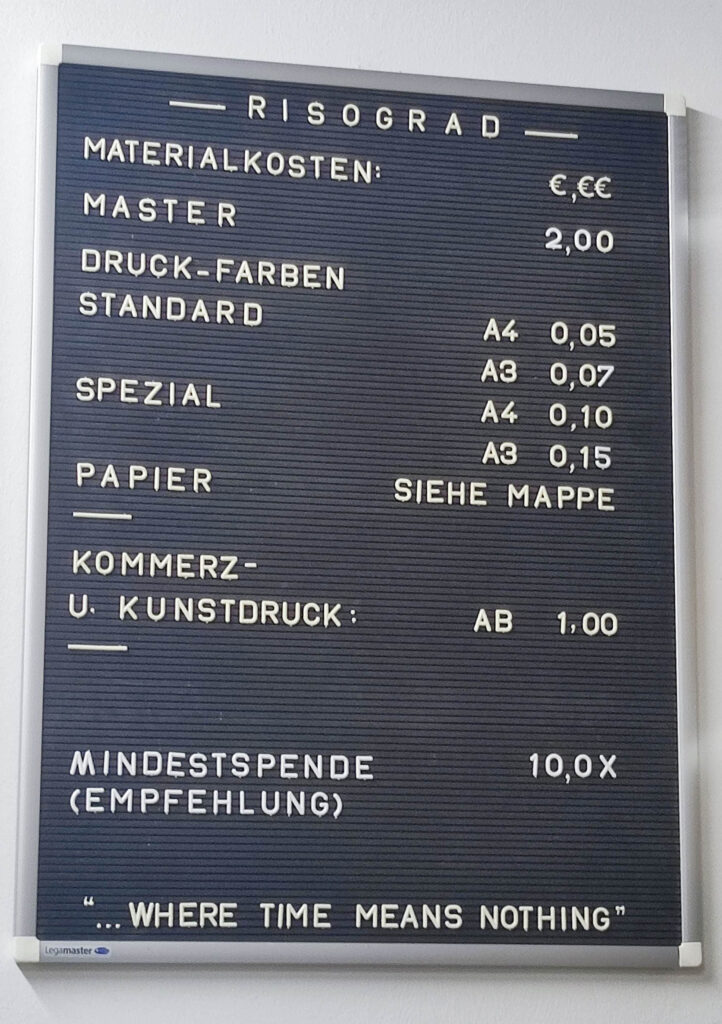
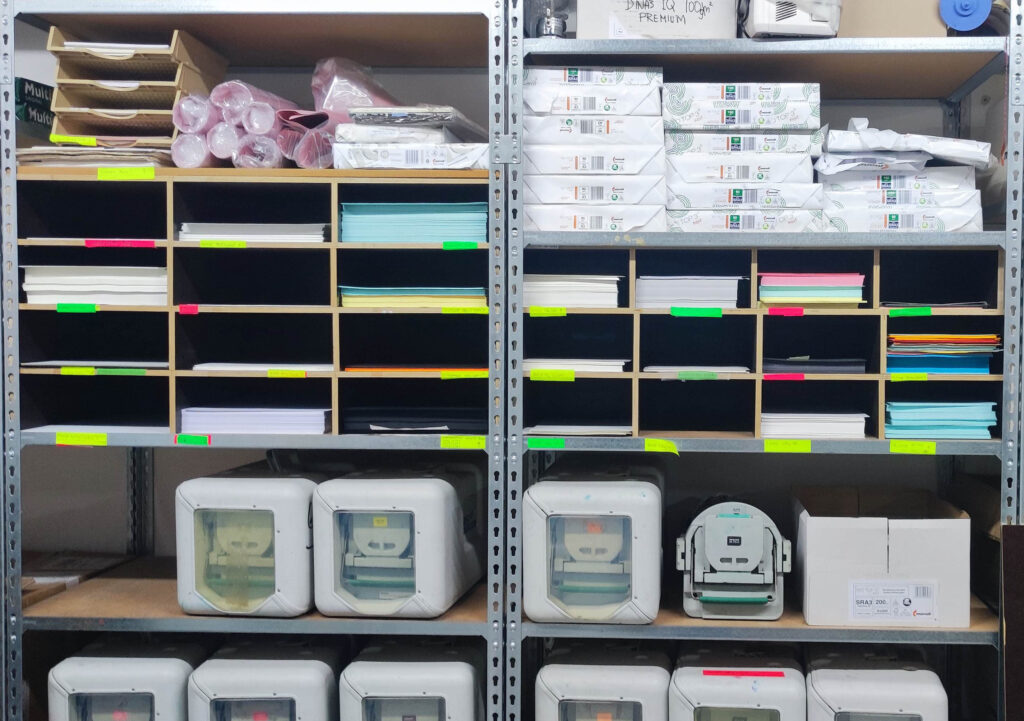
They have a selection of papers you can use, for a price. The papers have different prices per sheet, depending on the type and size of the paper. On the wall they have a table with price list for all the services. Two main things to keep in mind are these:

  1. They kindly ask for a donation of minimum 10€ per project being printed.
  2. Each master costs 2€. Which can make a project expensive-ish, depending on it’s scope, so be mindful of this when printing at RISOGRAD. In case you are not familiar with workings of risograph, let me briefly explain: it is a stencil duplicator, think screen printing, but automated. You create one stencil – a master, for each layer of print. For example let’s say you have a poster which you need to print using 4 colors. Each color would be one layer, one stencil = one master. That would come up to usage of 4 masters. That is, if everything goes well :).

You also pay for inks (per printed sheet), and if you want to commercialize your prints, you also pay little extra for it.

All that being said – it is still pretty cheap and very accessible, and I’d say if you can afford it, donate more. It’s a nonprofit and everyone involved is doing it for no gain; all the money goes towards the operation.

As I was saying goodbye I was told that unfortunately, they might be closing up by the end of the year, since they collectively don’t have that much extra time to put into RISOGRAD. The next workshop was to be on the 7th on December, and there was to be more information, all of which I will cover in my next IMPULSE.

Impulse #3

CoSA – Center of Science Activities, Graz

Visiting CoSA was such a cool experience, I was planning to do it for a long time, and it seemed like a perfect opportunity to somehow try to connect it to my research topic for my master thesis. The center is all about making science fun and hands-on, which got me thinking about how learning tools can be more engaging for kids, especially those with different needs.

CoSA has all kind of exhibits that approached different scientific topics, like math and physics. Instead of feeling like I was just passing through and absorbing information, I was actively involved in the learning process—solving puzzles, treating patients, building my own car… it felt more like a game than a lesson. All of this reminded me how important it is to make learning fun, rather than something stressful or overwhelming. This visit showed me that when learning is designed to be playful, it becomes more intuitive and natural for everyone.

I was really looking forward to checking out the AR exhibition, but unfortunately it was closed when I visited. I can only imagine how augmented reality could add another layer to these interactive experiences, and it made me think about the potential of digital tools in education.

I have to admit, I completely lost track of time while I was there. I felt like a kid again, excited to try everything. This made me realize how powerful interactive learning can be when it’s done right. It doesn’t just teach, it pulls you in, making you want to explore more. That’s exactly the kind of experience I want to create for my master thesis, learning that feels natural and fun.

What I Took Away From This Visit:

  • Multi-Sensory Learning Works
    CoSA does a great job of making science interactive by engaging different senses. This really connects to my research, especially for kids with autism.
  • Hands-On Learning is More Engaging
    Instead of just looking at information, visitors at CoSA get to experiment and explore. This made me think about how learning tools should focus more on interaction rather than passive learning.

My visit to CoSA really reinforced the idea that learning should be interactive, inclusive, and engaging. Seeing these concepts in action gave me a lot of ideas for my own research, and I hope to apply some of these insights to the educational tools I design in the future.

Impuls #1 – Buch: Creating Characters for the Entertainment Industry

Mein erster Impuls ist das Buch Creating Characters for the Entertainment Industry von Kenneth Anderson, Devon Cady-Lee, Cécile Carre und Hollie Mengert. Es behandelt die Herangehensweisen an Character Design aus der Sicht von Game Designer:innen, Illustrator:innen und Animator:innen. Dieser multidisziplinäre Ansatz eignet sich sehr gut für mein Masterarbeitsthema und beleuchtet unterschiedliche Bereiche. Das Buch verfolgt einen sehr praktischen Ansatz, ist klar strukturiert und erklärt den typischen Ablauf eines Character Design-Projekts.

Introduction: Grundlagen und Zielsetzung des Character Designs

Tutorials: Detaillierte Anleitungen der Autor:innen für verschiedene Medien wie Animation, Videospiele oder Illustration.

Try it now: Bonus-Briefs: Praxisaufgaben, um das Gelernte selbst umzusetzen.

Auch ein Glossar, das wichtige Begriffe des Character Designs definiert, ist im Buch enthalten. Das könnte in weiterer Folge auch für meine Arbeit nützlich sein. Die Tutorials sind praxisorientiert und erklären, wie man Originalität entwickelt, Feedback verarbeitet und Präsentationen vorbereitet.

Ein Zitat aus dem Buch bringt die Philosophie der Autor:innen auf den Punkt und fasst für mich gut zusammen, worauf es bei Character Design ankommt:

„Storytelling is the foundation of any character design. Characters do not exist on their own – they exist in a story world.“

Momentan habe ich noch wenig Erfahrung im Bereich Character Design, weswegen ich mich dafür entschieden habe, dazu zu recherchieren und speziell dieses Buch zum Thema zu lesen. Ein Teil meiner Idee für die Masterarbeit umfasst die Entwicklung von Charakteren für ein Kartenspiel sowie die Vorbereitung dieser Charaktere für Animationen (im Rahmen einer Kickstarter-Kampagne).

Ein weiterer Aspekt meines Themas, der im Buch erwähnt wird, ist die Vorbereitung von Illustrationen für Animationen. Ein Thema, mit dem ich sowohl im Arbeitskontext als auch in meinen Projekten an der FH häufig in Berührung komme und das ich in der Dokumentation meines Werkstücks in der Masterarbeit näher erläutern möchte.

Insgesamt begeistern mich an dem Buch auch die Karriere und Arbeitserfahrung der Autor:innen, die bei den großen Firmen der Unterhaltungsindustrie gearbeitet haben: Pixar, Disney, Paramount…

Devon Cady-Lee, Cécile Carre und Hollie Mengert setzen jeweils dieselben Charaktere (die Abenteurerin, den Schuljungen, den Magier und den Drachen) um. Dabei ist es spannend, ihre Herangehensweisen zu sehen und die Unterschiede in ihrer Arbeit, die sich durch die verschiedenen Branchen ergeben.

Ihre Tutorials beschreiben den Arbeitsprozess der Autor:innen, der von der Recherche über Skizzen und Iterationen bis zur finalen Umsetzung reicht, und beinhalten im Detail den Brief, den Umsetzungsplan, Gestaltung, Korrekturschleifen, Posen, Kolorierung und Kostüme. Dabei wird auch der Umgang mit Feedback und die Integration von Originalität in den Designs thematisiert.

Das Buch betont auch die Bedeutung des Storytellings: Charaktere existieren nie allein, sondern immer in einer narrativen Welt, die ihr Aussehen und ihre Persönlichkeit beeinflusst. Diese Verbindung von Theorie und Praxis macht das Buch zu einer wichtigen Ressource für mich, da ich sowohl bei der Gestaltung des Werkstücks als auch bei der Erklärung des Gestaltungsprozesses in der Master Arbeit darauf zurückgreifen kann.

Unterschiede Illustration, Animation und Game

Unterschiede beim Character Design ergeben sich oft im Hinblick auf die Kleidung der Charaktere. Während bei der Gestaltung für Illustrationen oft komplexere Kleidung und Accessoires verwendet werden können, kann das im Animationsbereich Komplikationen mit sich bringen. Insgesamt bieten die Autor:innen einen guten Überblick über die verschiedenen Anforderungen.

Ein anderer hilfreicher Abschnitt des Buchs befasst sich mit der Erstellung von Turnarounds. Dabei werden die Charaktere aus verschiedenen Perspektiven – von vorne, der Seite und von hinten – dargestellt, um die Konsistenz des Designs zu gewährleisten. Vor allem für die Produktion von Animationen oder 3D-Modellen ist das entscheidend.

Darüber hinaus zeigt das Buch auch, wie man gezielt durch Farben, Formen und Gestik die Persönlichkeit eines Charakters definiert. Große, runde Formen wirken beispielsweise freundlich, während kantige Designs oft Stärke oder Aggressivität ausdrücken.

Insgesamt hat mir das Buch wertvolle Einsichten und Methoden gegeben, um Charaktere für verschiedene Medien und Zielgruppen zu gestalten, und ich werde es definitiv für die Gestaltung der Charaktere des Kartenspiels nutzen können.

Weiterführende Links:

https://characterdesignreferences.com

https://figurosity.com/figure-drawing-poses?actions=310&page=1

https://posemy.art

„Dieser Text wurde mit Hilfe von ChatGPT 4o auf Beistrichfehler und Rechtschreibfehler korrigiert. Der inhaltliche Kern der Arbeit ist davon unberührt.”

IMPULSE #8: Exposé & Peer-Review

In den letzten Monaten habe ich intensiv an der Konzeption meiner Masterarbeit gearbeitet, die sich mit dem Thema „Mitgestalten statt Konsumieren: Wie User-Involvement den Branding-Prozess transformiert“ beschäftigt. Mein Ziel ist es, herauszufinden, wie Kund:innen aktiv in den Branding-Prozess eingebunden werden können, um eine stärkere Identifikation mit Marken zu schaffen. Dabei möchte ich einen besonderen Fokus auf digitale Tools wie interaktive Apps legen und deren Potenzial untersuchen.

Der bisherige Fortschritt

Seit der Fertigstellung meines Exposés habe ich mich intensiv mit der Planung der nächsten Schritte beschäftigt. Mein Fokus lag dabei auf der Entwicklung eines klaren Fahrplans, der die theoretischen Grundlagen, die methodische Vorgehensweise und die praktische Umsetzung meiner Masterarbeit abdeckt. Insbesondere habe ich mich mit folgenden Aspekten auseinandergesetzt:

  • Co-Creation und User-Involvement: Ich habe erste Recherchen und Literaturanalysen geplant, um fundierte Einblicke in bestehende Konzepte und deren Herausforderungen zu gewinnen.
  • Digitale Tools und UX-Design: Die Konzeption eines interaktiven Prototyps steht im Mittelpunkt meiner Arbeit. Aktuell befinde ich mich in der Phase, in der ich Funktionen und Designansätze sammle, die für den Branding-Prozess sinnvoll sind.
  • Empirische Vorbereitung: Ich habe die Struktur für geplante Interviews mit kleinen Agenturen skizziert, um deren Perspektiven auf User-Involvement und Co-Creation zu erfassen.

Diese Vorarbeiten bilden eine solide Basis für die nächsten Phasen meiner Masterarbeit. In den kommenden Monaten werde ich die geplanten Ansätze konkretisieren und umsetzen.

Nächste Schritte

Der nächste große Meilenstein ist die Entwicklung eines Prototyps, der eine mögliche Lösung für User-Involvement im Branding darstellt. Dazu möchte ich folgende Schritte gehen:

  • App-Konzeption: Ein interaktives Design, das Kund:innen ermöglicht, aktiv an Branding-Entscheidungen teilzunehmen, etwa durch Feedback-Tools oder Co-Creation-Module.
  • Testphase: Der Prototyp soll mit Fokusgruppen getestet werden, um Nutzerfreundlichkeit und Effektivität zu evaluieren.
  • Empirische Analyse: Die Ergebnisse aus den Interviews und Tests werde ich nutzen, um praktische Handlungsempfehlungen für Agenturen und Unternehmen zu entwickeln.

Herausforderungen und neue Erkenntnisse

Während meiner bisherigen Arbeit habe ich festgestellt, wie komplex das Thema User-Involvement ist. Besonders herausfordernd ist es, eine Balance zwischen Kund:innenbeteiligung und der Bewahrung der Markenidentität zu finden. Gleichzeitig habe ich gelernt, wie wichtig es ist, einfache und intuitive Tools zu entwickeln, um eine breite Nutzerbasis zu erreichen.

Durch den Besuch verschiedener Veranstaltungen wie „Öslam 2024“, „Elfie Semotan – Siolence“, „Energy Ma(r)ker“ und „Klanglicht 2024“ konnte ich viele Impulse sammeln, die meine Perspektive erweitert haben. Die kreative Herangehensweise und die Interaktion mit den Zielgruppen in diesen Formaten haben mir gezeigt, wie wertvoll Emotionen und Authentizität für eine gelungene Kommunikation sind.

Erfahrungen aus dem Peer-Review-Prozess

Im Rahmen der Vorbereitung meiner Masterarbeit hatte ich die Möglichkeit, die Exposés von zwei Mitstudierenden zu lesen und ihnen konstruktives Feedback zu geben. Beide Arbeiten boten spannende Ansätze, hatten jedoch auch Bereiche, die aus meiner Sicht weiterentwickelt werden konnten.

Durch diesen Peer-Review-Prozess habe ich nicht nur die Themen der anderen besser verstanden, sondern auch wichtige Learnings für meine eigene Arbeit mitgenommen:

  • Bedeutung eines klaren Forschungsstands: Mir wurde bewusst, wie wichtig es ist, den aktuellen Forschungsstand detailliert darzustellen. In beiden Exposés war dieser Punkt ausbaufähig, was mir gezeigt hat, dass ich diesem Aspekt in meiner eigenen Arbeit besonders viel Aufmerksamkeit widmen sollte.
  • Fokus auf Präzision: Die Fragestellung und Zielsetzung sollten klar und messbar formuliert sein. Besonders bei der Methodik wurde deutlich, dass eine präzise Beschreibung der Datenerhebung und -auswertung entscheidend ist, um die wissenschaftliche Fundierung zu stärken.
  • Struktur und Zeitmanagement: Der Zeitplan muss realistisch und gut durchdacht sein. Ich habe erkannt, wie hilfreich es sein kann, Meilensteine und kleinere Aufgaben klar zu definieren, um den Fortschritt der Arbeit zu organisieren.

Der Austausch mit meinen Mitstudierenden hat mir geholfen, potenzielle Schwächen in meiner eigenen Planung zu identifizieren und bereits jetzt gezielt an deren Verbesserung zu arbeiten. Dieser Prozess war eine wertvolle Übung, um die Anforderungen an ein gutes Exposé besser zu verstehen und zu verinnerlichen.

IMPULSE #7: Klanglicht

Vom 24. bis 26. Oktober 2024 verwandelte sich die Grazer Innenstadt in ein strahlendes Gesamtkunstwerk, das die Magie von Licht und Klang auf eindrucksvolle Weise zelebrierte. Unter dem diesjährigen Motto „Welten der Träume“ luden nationale und internationale Künstler:innen dazu ein, surreale und poetische Räume zu erkunden. Zwischen glitzernden Installationen auf dem Schlossberg, poetischen Lichtspielen im Joanneumsviertel und faszinierenden Klangwelten rund um Oper und Schauspielhaus verschmolzen Kunst und Publikum zu einer gemeinsamen Traumwelt. Rund 105.000 Besucher:innen wurden in eine Vielfalt von Stimmungen und Fantasien entführt, die sie staunen, nachdenken und träumen ließen.

Brücke zur Masterarbeit – Emotion und Interaktion

Obwohl „Klanglicht 2024“ ein künstlerisches Festival ist, zeigte es zahlreiche Parallelen zu meinem Masterarbeitsthema User-Involvement im Branding. Die Installationen luden die Besucher:innen ein, aktiv teilzunehmen, sich emotional einzulassen und die Kunst auf individuelle Weise zu interpretieren.

Diese Aspekte – die Schaffung einer Verbindung zwischen Werk und Publikum, die Betonung von Interaktivität und die Inszenierung von Emotionen – sind ebenfalls zentrale Bestandteile von User-Involvement in der Markenführung. Das Festival verdeutlichte eindrucksvoll, wie bedeutungsvoll es ist, Menschen nicht nur als passive Betrachter:innen, sondern als aktive Mitgestalter:innen einzubeziehen.

Erkenntnisse und Impulse für die Masterarbeit

Der Besuch von „Klanglicht 2024“ hat mir wertvolle Einblicke vermittelt, die direkt in meine Masterarbeit einfließen können:

  • Emotionale Inszenierung: Die Installationen zeigten, wie Licht und Klang eingesetzt werden können, um starke emotionale Verbindungen zu schaffen. Im Branding können ähnliche Prinzipien genutzt werden, um Produkte und Marken erlebbar zu machen.
  • Interaktive Formate: Viele der Installationen forderten die Besucher:innen auf, mit ihrer Umgebung zu interagieren. Diese Interaktivität verstärkte das Engagement und könnte eine zentrale Rolle bei der Entwicklung meiner App spielen, um User-Involvement zu fördern.
  • Individuelle Interpretationen: Jede:r Besucher:in erlebte „Klanglicht“ auf einzigartige Weise. Dies unterstreicht, wie wichtig es ist, Flexibilität und Personalisierung in Interaktionen zu ermöglichen – ein Ansatz, der auch im digitalen Branding eine große Rolle spielt.
  • Verbindung von Sinn und Ästhetik: Die Installationen verbanden ästhetische Schönheit mit tiefgründigen Botschaften. Marken können davon lernen, indem sie emotionale Erlebnisse mit relevanten Werten und authentischen Geschichten verknüpfen.

„Klanglicht 2024“ war für mich ein beeindruckendes Erlebnis, das gezeigt hat, wie stark Kunst uns berühren und mitreißen kann. Besonders die Verbindung von Licht, Klang und Interaktion hat mich inspiriert und mir neue Perspektiven eröffnet.

Für meine Masterarbeit nehme ich mit, wie wichtig es ist, Menschen aktiv einzubeziehen und ihnen Raum für eigene Interpretationen zu geben. Diese Erfahrungen motivieren mich, weiter an kreativen Ansätzen zu arbeiten, um Interaktion und Emotion auch im Branding spürbar zu machen.

Weitere Literatur:

  1. Emotional Branding : How Successful Brands Gain the Irrational Edge von Daryl Travis
  2. Experiential Marketing: How to Get Customers to Sense, Feel, Think, Act, Relate von Bernd H. Schmitt
  3. Storytelling for User Experience von Whitney Quesenbery & Kevin Brooks

Impulse 4 – GOTS

The Global Organic Textile Standard (GOTS) is a leading international certification for textiles made from organic fibers. It establishes comprehensive environmental and social criteria throughout the entire textile supply chain to ensure sustainable production and ethical labor practices.

Key Features of GOTS:

  • Environmental Criteria: GOTS mandates that textiles labeled as „organic“ contain at least 95% certified organic fibers, while those labeled „made with organic materials“ must have a minimum of 70% organic fibers. The use of hazardous chemicals, such as toxic heavy metals, formaldehyde, and genetically modified organisms (GMOs), is strictly prohibited. Additionally, environmentally friendly processes, like oxygen-based bleaching instead of chlorine bleaching, are required.
  • Social Criteria: The standard enforces compliance with key norms of the International Labour Organization (ILO), including the prohibition of forced and child labor, ensuring safe and hygienic working conditions, and the payment of living wages.
  • Traceability: GOTS ensures that all stages of production—from raw material harvesting to final product manufacturing—are certified. This guarantees transparency and allows consumers to trace the origin and processing of textiles.

Challenges and Contradictions in Practice:

While the GOTS label aims to help consumers easily identify products that adhere to strict environmental and social standards, several challenges can lead to contradictory practices:

  • Complex Supply Chains: The global nature of textile supply chains can make it difficult to monitor compliance at every stage, potentially resulting in products bearing the GOTS label even if certain production steps do not fully meet the standards.
  • Inspection Limitations: Although GOTS requires regular on-site inspections, factors such as resource constraints or logistical challenges can lead to insufficient oversight, allowing non-compliant practices to go unnoticed.
  • Misuse of Certification: Some companies may engage in „greenwashing“ by using the GOTS label as a marketing tool without fully committing to its principles, leading to a disparity between the claimed and actual adherence to the standards.

To address these issues, it is crucial for certification bodies and companies to enhance transparency and integrity within supply chains. Consumers are encouraged to critically assess certifications and seek additional information to make informed purchasing decisions.

Source:

Muminov, Najmiddin Shamsiddinovich, Zarina Muzaffar qizi Alimova, Moxidil Shuxrat qizi Haqnazarova, and Xayrulla Ulug’bekovich Vasiev. „Quality Analysis and Certification of Textile Products by GOTS—Global Organic Textile Standard.“ Middle European Scientific Bulletin 18 (November 2021). https://cejsr.academicjournal.io/index.php/journal/article/view/892.

Certification Process:

The GOTS certification process involves several steps:

  1. Application: Companies seeking certification must familiarize themselves with the GOTS standard and submit an application to an approved certification body.
  2. On-Site Inspection: An accredited third-party certification body conducts on-site inspections to assess compliance with GOTS criteria. This includes evaluating processing facilities, reviewing documentation, and ensuring that environmental and social standards are met.
  3. Certification: If the inspection is successful, the certification body issues a Scope Certificate, confirming that the company complies with GOTS standards.
  4. Labelling: Certified products can be labeled with the GOTS logo, providing consumers with assurance of the product’s organic status and adherence to environmental and social criteria.

Source: Global Standard gGmbH. „Home – GOTS – Global Organic Textile Standard.“ Accessed December 12, 2024. https://global-standard.org/

The Global Organic Textile Standard (GOTS) explicitly prohibits the use of raw fibers from production sites that engage in mulesing, a practice involving the removal of wool-bearing strips of skin from the breech area of sheep to prevent flystrike. This prohibition reflects GOTS’s commitment to upholding stringent animal welfare principles within the textile supply chain.

GOTS defines mulesing as „the removal of wool-bearing strips of skin from the breech area of sheep intended to avoid problems of fly strike. This includes any type of breech modification, including freeze branding.“

By enforcing this ban, GOTS ensures that certified textiles are produced in accordance with ethical and sustainable practices, aligning with its overarching mission to promote responsible textile production.

Source: Global Standard gGmbH. „GLOBAL ORGANIC TEXTILE STANDARD (GOTS) VERSION 7.0“ Accessed December 12, 2024. https://global-standard.org/images/resource-library/documents/standard-and-manual/GOTS_7.0__DE_signed.pdf?utm_source=chatgpt.com

Concerns Regarding GOTS Certification in Australia:

Despite GOTS’s clear stance against mulesing, concerns have been raised about the trustworthiness of GOTS certification, particularly in Australia. Australia remains one of the few countries where mulesing is still practiced extensively, with reports indicating that less than 20% of Australian wool sold at auction is mulesing-free.

The persistence of mulesing in Australia poses challenges for certification bodies like GOTS. Ensuring that certified wool is genuinely mulesing-free requires rigorous supply chain monitoring and verification. However, the complexity of global textile supply chains can make it difficult to guarantee compliance at every stage, leading to potential instances where mulesed wool is inadvertently certified.

RSPCA Australia

All in all the GOTS Certificate is a general and worldwide known certificate used a lot to identify organic cotton but also wool and other fibers. As with all certificates the question of how can companies get this and who is surveilling the process and later also the execution? There is a lot of opinions on this topic online – GOTS itself and a lot of other sources state you can trust this specific certificate. But through this research I also gathered the information that over all for GOTS and other textile certificates the environment and social aspect are main focuses instead of animal welfare. For that PETA (a non profit animal welfare organisation) has their own certificate PETA approved vegan which also states that in this fibers are non animal recources used. So it is still not easy to navigate the way through these certificates.

https://www.le-shop-vegan.de/blog/fair-fashion-siegel-gots-gruener-knopf-und-peta-approved/#:~:text=Während%20sich%20also%20Siegel%20und,vegan%20Siegel%20beim%20Tierwohl%20an.