Road to M.A. 2: Literature pt1.

Book 1

Goddard, Kevin. „Looks Maketh the Man“: The Female Gaze and the Construction of Masculinity. In: The Journal of Men’s Studies (2000)

Overview: The article explores how the concept of the female gaze redefines masculinity and its representation in media. Goddard examines how men are increasingly subject to objectification, traditionally reserved for women, and how this shift affects societal norms and expectations of masculinity.

Important Headlines/Chapters:

  • Introduction
  • Theoretical framework
  • Analysis of media examples
  • Implications on masculinity
  • Conclusion

Questions:

  1. What is Goddard’s main argument about the impact of the female gaze on masculinity ?
  2. How does the female gaze differ from the male gaze?
  3. What evidence does Goddard provide to show how men are perceived in media ?
  4. How does the female gaze affect gender roles in society?
  5. What conclusions does Goddard draw about the implications of these shifts in media ?

Read:

While reading the text I came across these anwers:

Goddard argues that the female gaze does not simply reverse the dynamics of the male gaze but instead introduces a nuanced perspective on masculinity.

  • He provides examples from advertisements and popular media.
  • The female gaze impacts men by placing new aesthetic pressures on them.
  • This shift has broader cultural implications, as it challenges the idea that only women are subjected to the pressures of physical appearance.

Recite:

The article delves into how the female gaze influences modern representations of masculinity. Goddard argues that the objectification of men in visual culture reflects changing gender dynamics, where both men and women are subject to aesthetic pressures. This shift challenges traditional gender norms by presenting masculinity as an idealized, consumable image.

Review:

  1. What is Goddard’s main argument about the female gaze?
    • The female gaze reconfigures masculinity by introducing new expectations of physical attractiveness and objectification.
  2. How does the female gaze differ from the male gaze?
    • While the male gaze is often about power and control, the female gaze focuses on aesthetics and desire without necessarily aiming to dominate.
  3. What examples does Goddard give?
    • Goddard discusses advertisements and film scenes where men are depicted as objects of desire, highlighting the shift in how masculinity is portrayed.
  4. What effect does this have on gender roles?
    • It complicates the concept of masculinity by introducing traditionally associated with femininity.
  5. What can be concluded?
    • The article concludes that both the male and female gazes contribute to the construction of social expectations around gender, indicating that objectification is not limited to women.

Kevin Goddard is considered an expert in the field, particularly in the areas of media studies, gender studies, and the sociology of masculinity.

Structure: The structure of Kevin Goddard’s article is clear and logical, with a well-organized flow that guides the reader through complex ideas. It begins with an introduction to the concept of the female gaze, followed by a detailed analysis of how masculinity is constructed and perceived in media.

Quality of Content: The content is of high quality, demonstrating a deep engagement with both feminist theory and masculinity studies. Goddard effectively integrates theoretical perspectives with concrete examples, making the arguments compelling and well-supported. He draws on established scholars like Laura Mulvey while also contributing his own insights, adding value to ongoing academic discussions.

Style: The writing style is scholarly yet accessible, striking a balance between theoretical depth and readability. Goddard uses precise language, avoiding overly complex jargon, which helps to communicate ideas in a way that is understandable to readers who may not be specialists in gender studies. However, at times, the theoretical explanations may require a re-reading to fully grasp his point.  

Is it useful for me?

Yes, Kevin Goddard’s article, „Looks Maketh the Man: The Female Gaze and the Construction of Masculinity,“ is very useful for my purposes, particularly in exploring how gendered gazes function to shape societal perceptions of masculinity and power dynamics. The sections that delve into the female gaze and its impact on the portrayal of men in media are especially relevant for my research.

Additionally, while the article effectively discusses the construction of masculinity, it lacks a deeper analysis of intersectionality, such as how race, class, or sexuality might alter these representations.

Book 2

Malone, Alicia: The Female Gaze. Essential Movies Made by Women.Mango Publishing: Florida 2018, E-Book

Overview:

The book, published in 2018, offers an in-depth exploration of movies directed by women and how they embody the „female gaze“ in contrast to traditional cinematic portrayals shaped by the male gaze. Malone highlights key films made by women and discusses how they shape the portrayal of women, the male characters, and the entire narrative.

Question:

  1. What is the „female gaze“ in cinema, and how is it defined in the context of this book?
  2. How does the female gaze challenge traditional portrayals of women in film?
  3. How does the book connect the feminist movement to the evolution of film by women?

Read:

While reading the book, I focus on sections that explore key films and directors, noting how the book links the cultural and historical context of feminist movements with the films. The sections addressing the treatment of gender and the role of women in these films are particularly valuable for understanding how the female gaze differs from the traditional male gaze.

Recite:

  • The „female gaze“ is a concept where films directed by women bring new perspectives on narrative, power dynamics, and gender roles. The book highlights how women directors challenge stereotypical female roles and portray men in more nuanced ways.
  • Essential films discussed include works by directors like Kathryn Bigelow, Greta Gerwig, and Jane Campion, showcasing how their films provide alternative portrayals of women’s experiences.
  • The book argues that the emergence of female filmmakers and their unique storytelling approach has created space for a broader, more inclusive definition of masculinity, femininity, and sexuality.
  •  

Review:

The book is well-structured with a clear narrative that moves from the historical context of women’s involvement in film to analyzing specific films that exemplify the female gaze. It organizes the films into categories based on themes like female empowerment, complex masculinity, and romantic relationships.

Malone provides insightful commentary, but some sections could benefit from deeper theoretical analysis. While the inclusion of specific films is valuable, a more expansive exploration of intersectionality—particularly with race, class, and sexuality—would have enriched the discussion.

Malone’s writing style is accessible and engaging, making complex feminist film theory approachable for a broad audience. However, the tone sometimes feels more like a general overview rather than a academic critique.

Evaluation:

The book is useful for my thesis because it’s exploring how women directors challenge traditional gender roles and how these films offer new ways of looking at masculinity and femininity. It provides a good introduction to the female gaze in film.

Alicia Malone is a well-known film critic, author, and host, particularly recognized for her work in promoting women filmmakers and advocating for a more inclusive representation of gender in cinema. She has written several books on film and women in cinema, and she frequently appears as a presenter and commentator on film-related topics. While Malone may not have the academic credentials typically associated with „experts“ in the field, she is certainly an established authority in the world of film criticism.

The structure of The Female Gaze: Essential Movies Made by Women by Alicia Malone is clear, well-organized, and accessible. The chapters are arranged around a series of essays, and each section explores specific films or movements, providing both analysis and context. However, the book is more of a survey and celebration of films, rather than a deeply academic or theoretical examination of the female gaze.

Is it useful for me?

Yes, The Female Gaze: Essential Movies Made by Women by Alicia Malone is useful for my purposes. The book highlights the significant contributions of women filmmakers, which aligns with my interest in how female perspectives and narratives are represented in cinema.

It helps to contextualize and define what constitutes the female gaze as distinct from the male gaze, showing how women filmmakers challenge traditional gender dynamics and representation in cinema. The chapters that discuss the historical context of women in filmmaking, as well as the impact of feminist movements on cinema, are also quite relevant. However, while the book does a great job of introducing films and filmmakers, it lacks a deeper theoretical exploration of the „female gaze.“ It focuses more on film analysis and less on the cultural, social, or academic frameworks that underlie the concept.
2.Impuls: Mastering the Business of Motion Design Podcast

Erfolgreiches Business im Motion Design: Erkenntnisse aus dem Podcast mit Haley Akins

Für meinen zweiten Blogpost möchte ich Einblicke aus einem spannenden Podcast der School of Motion Design teilen, den ich kürzlich angehört habe. In dieser speziellen Folge war die erfahrene Motion Designerin und Gründerin von Motion Hatch, Haley Akins, zu Gast und sprach darüber, worauf Motion Designer achten sollten, um erfolgreich Geld mit ihrer Kunst zu verdienen.

Haley Akins, bekannt als Gründerin von Motion Hatch, unterstützt die Motion Designer und Animator dabei, ihr Business zu verbessern. Motion Hatch bietet Schulungsmaterialien, Ressourcen, eine Community und einen Podcast an, um den Erfolg von Kreativen zu fördern.

Herausforderungen und Veränderungen in der Branche

Im Podcast erklärte Akins, dass die Pandemie für Motion Designer eine Boom-Zeit war, da Live-Action-Produktionen unmöglich wurden und die Nachfrage nach Animation stieg. Im Jahr 2023 hingegen erlebten viele Freelancer eine drastische Verschlechterung der Auftragslage. Wer auf Empfehlungen und Kontakte setzte, befand sich oft in einer passiven Position, da es schwer vorherzusehen ist, wie oft man empfohlen wird.

Akins sprach darüber, dass viele Motion Designer begannen, ihre Dienstleistungen in Form von Produkten zu verkaufen, um den Kund eine klare Vorstellung davon zu geben, was sie für ihr Geld erhalten. Traditionell passten Designer ihre Preise und Arbeitszeiten individuell an jedes Projekt an, da die Anforderungen stark variieren. Dies konnte jedoch Kund, die noch nie mit einem Freelancer aus dem Bereich Motion Design zusammengearbeitet haben, verunsichern und die Einschätzung der Projektkosten erschweren.

Strategien für eine nachhaltige Positionierung

Haley Akins erläuterte zwei grundlegende Ansätze, die sich in den letzten Jahren etabliert haben: Entweder man spezialisiert sich auf eine Nische mit wenig Konkurrenz, um Kunden langfristig zu binden, oder man kämpft bei jedem Projekt um den nächsten Auftrag. Um erfolgreich zu sein, müssen Motion Designer ihre Arbeit und sich selbst einzigartig präsentieren. Es reicht nicht, nur die eigene Expertise zu zeigen – es ist ebenso wichtig, aktiv in Kundengewinnung und Marketing zu investieren.

Marketing- und Akquise-Strategien

Ein zentraler Punkt, den Akins betonte, ist, dass Marketing für Freelancer wichtiger denn je ist. Eine effektive Strategie besteht darin, anstelle eines fertigen Produkts einen Baukasten anzubieten, den Unternehmen an ihre Bedürfnisse anpassen können.

Zu Beginn war LinkedIn eine großartige Plattform, da der Algorithmus Inhalte breit streute. Heute jedoch richtet sich der Content primär an ein spezifisches Publikum. Akins hob hervor, dass Motion Designer Gefahr laufen, in ihrer eigenen „LinkedIn-Bubble“ zu verharren, was es erschwert, neue Kunden zu erreichen. Daher empfahl sie, nicht nur über Motion Design zu schreiben, sondern auch Themen wie Marketing und Business zu behandeln.

Die 4-A-Strategie und andere nützliche Tipps

Akins stellte eine hilfreiche Marketingstrategie vor, um die Reichweite zu erhöhen: Awareness, Attraction, Action und Advocacy. Diese vier Phasen repräsentieren verschiedene Arten von Content, die dazu beitragen, potenzielle Kunden auf sich aufmerksam zu machen.

Darüber hinaus betonte Akins, wie wichtig es ist, Testimonials auf der eigenen Website zu präsentieren, um Vertrauen zu schaffen. Kunden möchten sehen, mit wem man zusammengearbeitet hat und wie die Erfahrungen waren. Ein ausgewogenes Verhältnis zwischen aggressiver Akquise und dem Aufbau einer langfristigen Geschäftsbeziehung ist entscheidend.

Lektionen aus der Pandemie und die neue Realität

Akins wies darauf hin, dass viele Designer während der Pandemie ihre Stundensätze erhöhten, was durch die erhöhte Nachfrage gerechtfertigt war. Inzwischen mussten viele diese Preise wieder anpassen, da die Budgets gekürzt wurden. Die Bedeutung eines soliden Plans und das Wissen um den eigenen Wert wurden von Akins mehrfach betont. Jede Designer sollte wissen, wie viel er oder sie verdienen muss, um die laufenden Kosten zu decken.

Networking und das Finden neuer Kund

Eine spannende Geschichte, die Akins teilte, zeigte, wie sie selbst einen Kunden über LinkedIn gewonnen hatte. Sie reagierte zunächst auf seine Beiträge und baute eine Beziehung auf, bevor sie eine persönliche Nachricht schrieb. Diese subtile Herangehensweise führte schließlich dazu, dass sie ihm eine Idee pitchen konnte.

Agenturen können bei der Jobsuche ebenfalls hilfreich sein, da sie oft genau wissen, was sie brauchen, im Gegensatz zu einzelnen Kunden, die erst überzeugt werden müssen, warum sie Motion Design benötigen. Akins empfahl, E-Mails oder Jobangebote mit einer persönlichen Note oder einem Kompliment zu beginnen, um sich von der Konkurrenz abzuheben.

Nachhaltiger Erfolg und Delegieren

Zum Abschluss des Podcasts betonte Akins die Bedeutung des Delegierens. All die oben genannten Tipps und Tricks helfen wenig, wenn man zu viel Arbeit hat und in ein Burnout gerät..In so einem Fall ist es wichtig, rechtzeitig Aufgaben abzugeben und ein klares System zu entwickeln, das neuen Mitarbeitenden hilft, sich einzuarbeiten. Eine strukturierte Dokumentation der Arbeitsprozesse ist unverzichtbar.

Haley Akins’ Erkenntnisse und Ratschläge aus dem Podcast sind ein wertvoller Leitfaden für alle Motion Designer, die ihre Karriere stabilisieren und weiterentwickeln möchten und für mich, der gerade beginnt, ein sehr gutes Vorbild und ein ausgezeichneter Leitfaden.

Link zum Podcast:

Motionhatch:

https://motionhatch.com

Haley Akins:

https://www.hayleyakins.com/

IMPULSE #4 | Lecture Performance: “REPAIR!_Fashion” by Evelyn Roth

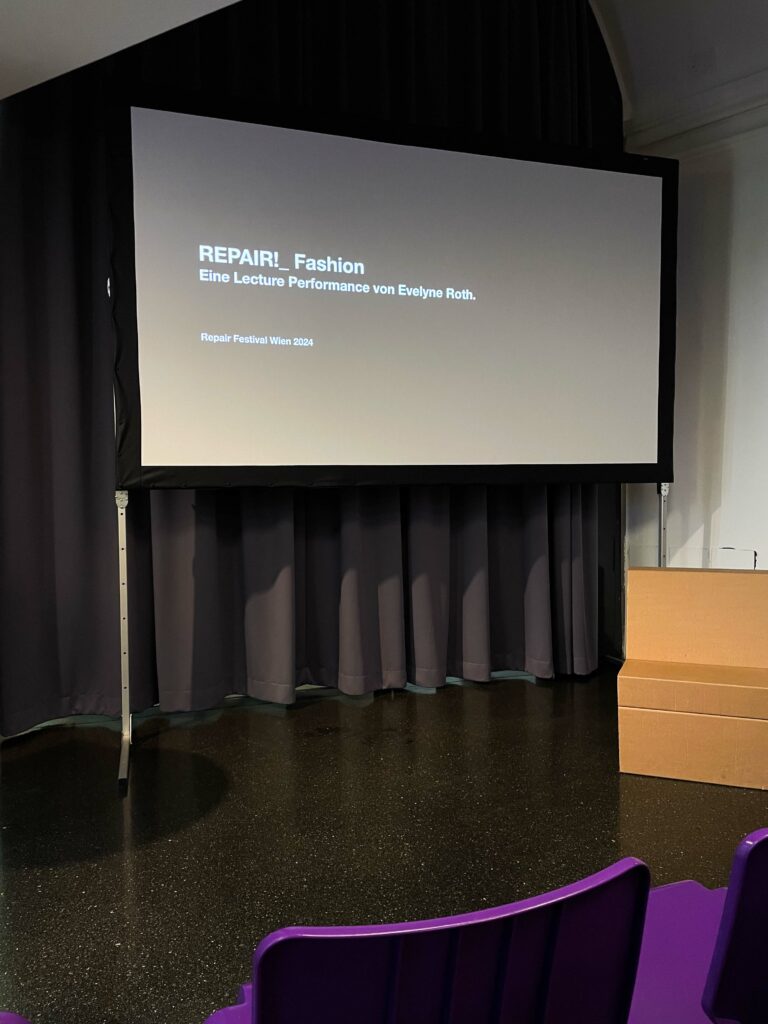
On the 27th of October, a lecture performance by designer Evelyn Roth took place as part of the program of the Vienna based “re:pair festival” 2024. The lecture performance dealt with the role of the repair process in the current fashion system. Under the title “REPAIR!_Fashion – The Relevance of Repair as an Act of Creativity in Circular Processes”, Roth engaged in an act of repairing a garment live on stage before elaborating on the role and the status of the act of visibly repairing and mending garments. Using the example of a blouse, Roth illustrated the repair process as a socio-political statement and creative act. Within the design context, the lecture discussed the possible future of design processes in circular workflows.

The focus of the talk was on the emerging hierarchical change in the structure of fashion: REPAIR!_Fashion aimed to be understood in the context of a systemic and structural change in fashion. Repairing fashion provokes an expanding aesthetic perception and a political positioning that the act of repairing as a design process entails.  In the words of Orsola de Castro, upcyclist, fashion designer, author and co-founder of Fashion Revolution: “Repairing your clothes can be a revolutionary act. “1

About Evelyn Roth

“Evelyne Roth is a designer and a lecturer on the BA in Fashion Design, the MA Master’s Studio ICDP and the cross-institute CoCreate programme of the FHNW Academy of Art and Design. She has held posts at a number of institutions as an expert in Design Thinking and Forecasting. Questioning common processes in the fashion industry, attempting to break with them and launching products that make a contemporary statement are all part of her holistic brief as a designer. Her practice and teaching in design focus on circular design, research, conception and materiality.”2

Key Takeaways

The main issue concerning the visible repair and resale of clothes Roth illustrated in her lecture is the uncertain legal status of reselling a visibly mended garment as a new or updated design under the name of the repairing designer. Roth highlights that for a long time, the goal of repairing was to make the repair process as invisible as possible. She mentioned brands like the luxury fashion house Hermès, who have a dedicated repair program for their bags. The goal of their repair strategy is to “reset” the products to their original state as well as possible, without leaving visible traces of the repair process. Roth postulates that the act of repair should be reconsidered as a creative act of its own which is allowed to leave traces. Through her example of a blouse however, she illustrates what the challenges for such a recontextualization can bring. In her performance, Roth visibly mended a blouse which was originally designed by Dries van Noten. If she wanted to resell the blouse as her own design, there would be a legal argument for copyright infringement because of the protections on the original design. The entire discussion went into more detail, illustrating that within fashion, copyright is a complicated question in general. Some aspects of fashion designs are protectable by copyright, like pattern designs. Certain other aspects however, cannot be protected by copyright, such as silhouettes for example. The copyright question does not come up when a garment is sold without visible mending manipulations as a second hand item attributed to the original designer, which begs the question – when does a repair become visible enough to be relevant and what are the rights of the visible mender in this process.

My impression of the talk was that this issue is certainly interesting and seems to be quite complicated. I personally do not quite see the visible repair of garments and the resale of them on a large scale as an issue that reach dimensions where it will really disrupt the fashion system. However, I of course have not done extensive research on this and can therefore only state my first impression and general opinion in this case. 
As for the relevance to my research topic – I believe digital fashion faces a similar issue of copyright and especially ownership. These topics will be discussed further in a future regular blog post.  


1Programm – Re:Pair Festival 10.-27.10.2024. October 27, 2024. Re:Pair Festival. https://repair-festival.wien/programm/?date=2024-10-27.
2FHNW. “Evelyne Roth.” Accessed November 11, 2024. https://www.fhnw.ch/en/people/evelyne-roth.

Sources

“Evelyne Roth,” FHNW, accessed November 11, 2024, https://www.fhnw.ch/en/people/evelyne-roth.

Programm – Re:Pair Festival 10.-27.10.2024, October 27, 2024, Re:Pair Festival, October 27, 2024, https://repair-festival.wien/programm/?date=2024-10-27.

All Images © Helene Goedl 2024

IMPULSE #3 | Open House: Die Angewandte – Fashion Department and University Library

At their yearly Open House, the Angewandte (University of Applied Arts Vienna) opens its doors to everyone who wants to get to know the courses on offer at the university or is just interested in taking a look behind the scenes. At the Open House, the studios, workshops and departments of the University of Applied Arts are open to visitors. Students and teachers share insights into everyday university life. Information stands on site and online provide the opportunity for further exchange about the study programmes.1 This year, I seized the opportunity to visit the fashion department at the Angewandte Open House.  

Why was the Open House relevant for my Thesis?

Fashion study programs, fashion design education and their curricula are excellent indicators of where the fashion scene is headed at a given time. Sometimes, these study programs are on the pulse of current developments, sometimes they lag behind for one reason or another. My main objective in visiting the open house was to explore where the fashion department at the Angewandte stands on the role of digital fashion design, whether this development is incorporated into the education and if there are projects already on display that might show the status on this question. Additionally, I made use of the opportunity to take a tour of the Angewandte university library to explore the possibility of using it for my Master’s thesis research.

The Fashion Department

The fashion department at the Angewandte is one of the most successful fashion design education programs in Europe. The admission is highly selective, only taking on between 5 and 10 students each year. The program is currently headed by fashion designer Craig Green.

“London-born designer Craig Green MBE established his namesake label in 2012 shortly after graduating the Fashion Masters course at Central Saint Martins. He has since carved out a unique position amongst the industry’s most innovative talents and continues to earn both critical and commercial success globally.”2

The head of department position is re-staffed in short intervals in order to provide the students with exposure to different approaches during their 5 year study period. The degree program is a diploma, which means it is not divided into a bachelor’s and a master’s degree.

The Fashion Design programme highly values the development of a distinctive creative style and artistic vision in their students.  In close guidance from the professors, “students explore the critical potential of fashion between materiality, corporeality, and concept.The curriculum comprises traditional pattern cutting and construction skills alongside digital skills and techniques. Students benefit from a state-of-the-art, industry-standard sewing atelier, knitting atelier and a spacious studio with a personal work space for each student. Students are given the possibility to work in professionally equipped studio spaces and workshops both within the Fashion Department and other departments of the University of Applied Arts.”3

The department has seen many highly acclaimed professionals in the lead position, such as l Karl Lagerfeld, Helmut Lang, Jil Sander, Raf Simons, Vivienne Westwood, Viktor & Rolf, Bernhard Willhelm, Hussein Chalayan, Lucie and Luke Meier and  Grace Wales Bonner to name a few.3

“Graduates of the Fashion Department have founded their own labels, such as Bless, house of the very island’s, Wendy Jim, Petar Petrov, Femme Maison, Sagan Vienna, Kenneth Ize, and others. Others occupy leading positions in the fashion industry, working for brands such as Balenciaga, Andreas Kronthaler for Vivienne Westwood, Alexander McQueen, Lanvin, OAMC, Prada, Comme des Garçons or Maison Margiela.”3

With regard to digital fashion, I was able to find out that CLO3D is taught in the curriculum as an industry standard program. In terms of digital fashion collections or digital garment developments, I was not able to find any significant presence, suggesting that while the aspect of digital fashion has a place in the curriculum, it is not a focus of the program. The focus is still very much on physical tailoring and traditional skills in the fashion design process, which I believe is a good and solid approach and the successes of the graduating designers prove this. 

The Library

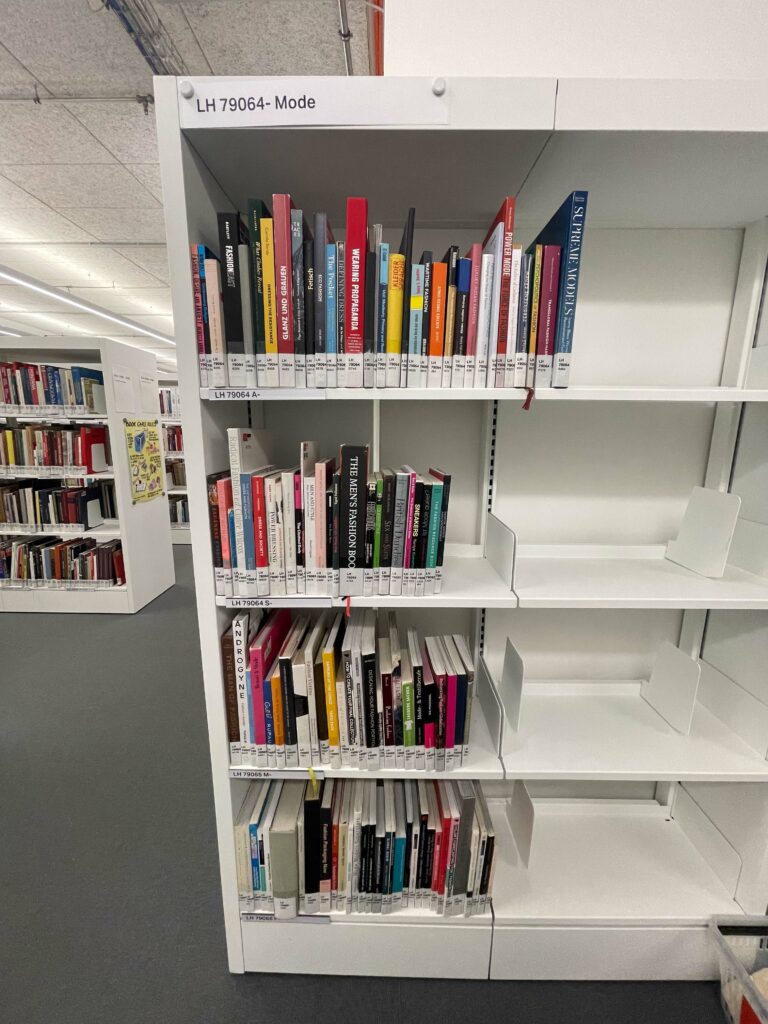
Since the Angewandte has a fashion department, their library catalog naturally is much more extensive than the one at FH Joanneum with regard to this design discipline. I took a guided library tool and created a library account for external students and will be making use of the resources for my thesis. 

Images


1“Angewandte Open House 2024.”
2Craig Green. “About.” Accessed November 11, 2024. https://craig-green.com/pages/about.
3“Fashion – dieAngewandte.”

Sources

“About,” Craig Green, accessed November 11, 2024, https://craig-green.com/pages/about.

“Angewandte Open House 2024,” Angewandte Open House 2024, October 14, 2024, accessed November 11, 2024, https://openhouse.uni-ak.ac.at/en/.

“Fashion – dieAngewandte,” accessed November 11, 2024, https://www.dieangewandte.at/fashion.

All Images © Helene Goedl 2024

IMPULSE #2 | Event: “ORF Lange Nacht der Museen” – Mode Wien Pop Up Museum

On Saturday, October 5, 2024, this year’s “ORF Lange Nacht der Museen” (“night of museums”) took place throughout Austria. For the 24th time, the event allowed visitors to explore a large number of museums with just one ticket. Once again this year, numerous museums and galleries participated in the event and opened their doors from 6.00 pm to midnight.

In addition to varied exhibitions, many exciting special events were part of the evening. Visitors could choose their personal highlights from the wide range on offer and visit all participating museums and events with just one ticket. The participating museums offered a wide range of experiences, from small, curious and eccentric locations to large, renowned cultural institutions.1

I decided to explore the “long night” in Vienna this year, and one of the participating institutions I selected for one of my visits was of special interest to my thesis topic and my research into digital fashion.
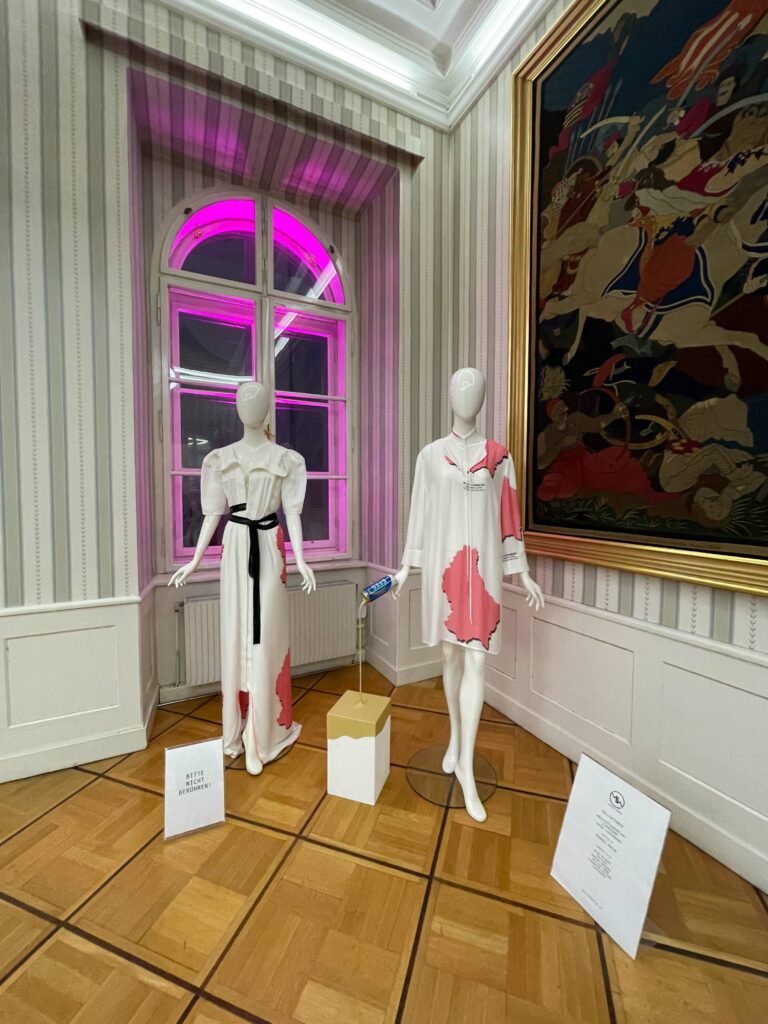
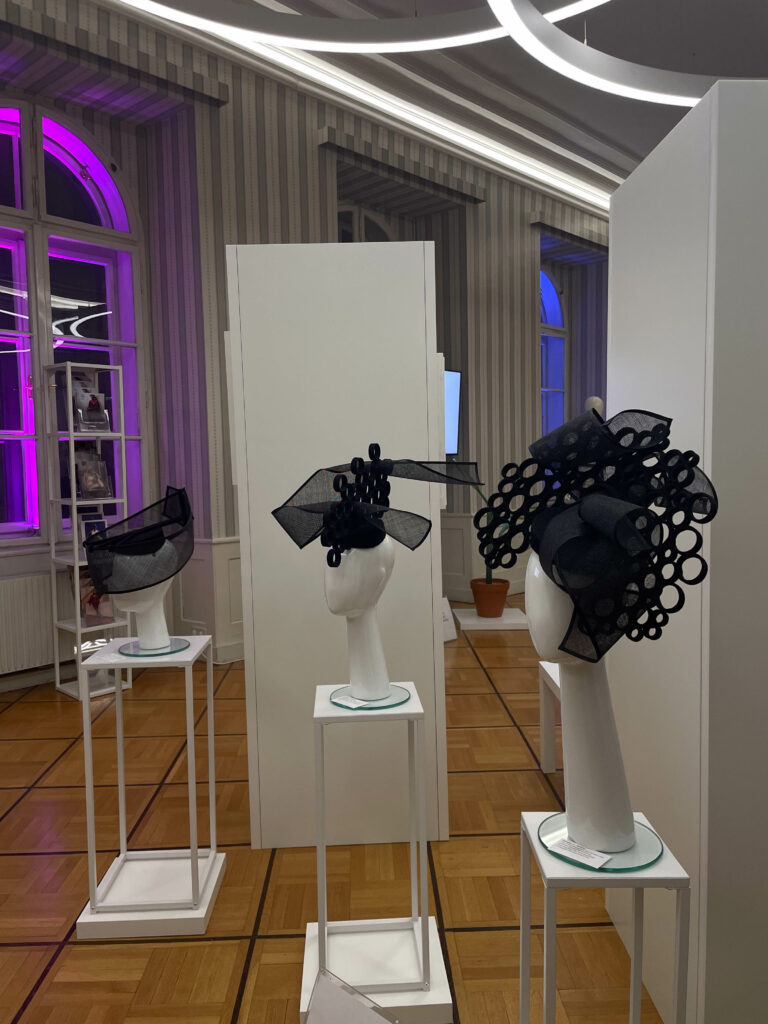
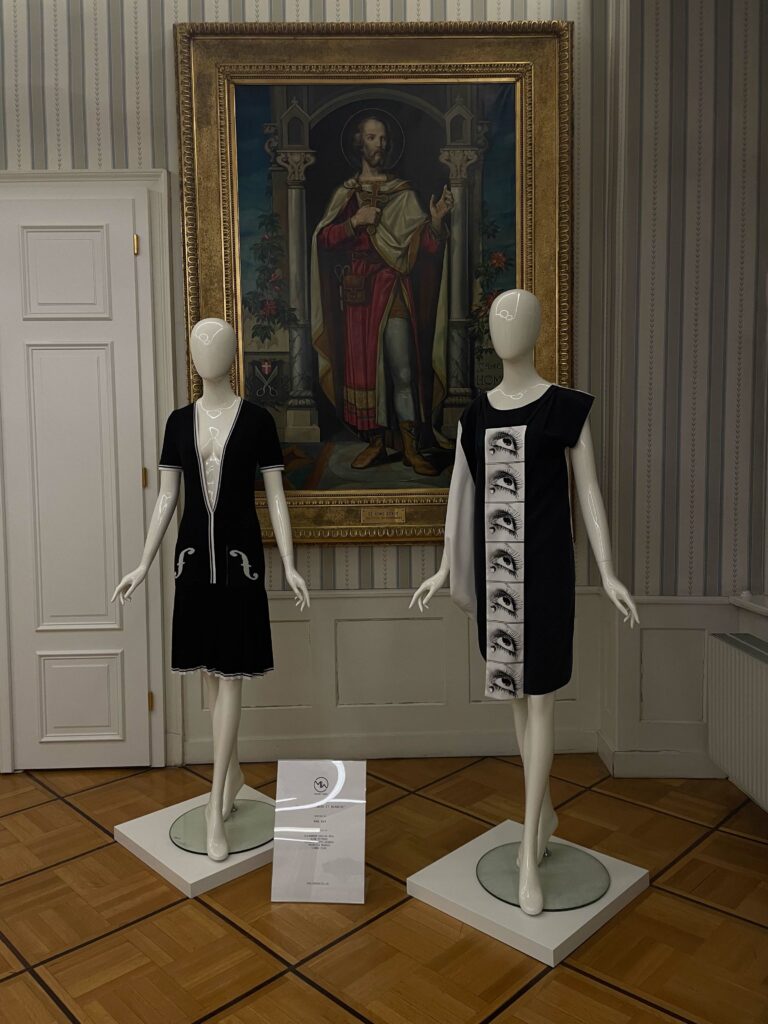
The PopUp Museum of Mode Wien in the Guild House of Viennese Fashion Makers was located in the historic center of Vienna. The site used to serve as an accommodation for itinerant garment makers. The exhibition “Symbiosis”, which was on display during the “long night” pays tribute to the creative energy and craftsmanship of the Viennese fashion scene.2

Why was this Exhibition relevant for my Thesis?

In my research into fashion design, one component of interest for my research is the way fashion is displayed in museum exhibitions. Fashion has a long history of “fighting” to be viewed as an art form, often times being perceived as lesser than classic artistic disciplines such as painting, sculpture or even literature and music. The idea that fashion is more trivial as an artistic discipline certainly has many underlying causes, not least of which is the aspect that fashion was and is to this day perceived as a female domain as well as a part of pop culture, which lowers its merit in the eyes of certain fractions of the art scene. Interest in fashion is not often equated to other interests in the arts, often being dismissed as something mundane and trivial. In recent years however, the perception of fashion has shifted and the artistic merit of the craft as a discipline of art is finally gaining more traction. Along with this tension of fighting for its place in the art cannon, exhibiting fashion can be a challenge because fashion usually depends to a certain extent on the incorporation of movement, body and the context of being worn. This makes it a challenge to exhibit in an engaging way.

Exhibition Review

The space in the guild house was divided into sections. In one of the rooms, the exhibition “Symbiosis” was displayed. This exhibition featured designs from Viennese fashion designers in correspondence with artworks by local artists, all elaborating on the same topic. The correspondence between the garments and the art pieces created an interesting dialogue and extended and re-contextualized the designs on display. The overall exhibition design however, was unfortunately not quite as successful as it could have been. Since the “long night” always attracts a large number of visitors, the exhibition was quite crowded and the space did not provide good opportunities for easy crowd guidance, resulting in a rather hurried exhibition experience. 

The other section of the space was dedicated to a pop up shop where some local designers had the opportunity to sell some of their designs and give insights into their design process. The designers were present and this provided an opportunity to ask further questions about their creations which was a nice component. Overall however, I would have preferred if they could have dedicated the whole space to the exhibition concept in favour of a better visitor flow and a more pleasant overall visiting experience. It became quite clear that the exhibition was likely more of an afterthought and the pop up shop spatially took priority over it, which was a pity. Although I understand the overall concept and I appreciate the approach with the correspondence to other art disciplines, I must say that I have seen fashion exhibited in more engaging ways in other museums, such as the exhibition “Dressing the Body” at the Disseny Hub Barcelona. 

Images


1ORF Lange Nacht Der Museen. “Info,” 2024. https://langenacht.orf.at/info.
2ORF Marketing & Creation GmbH & Co KG. “ORF Lange Nacht der Museen Booklet.” Press release, 2024.

Sources

“Dressing the Body. Silhouettes and Fashion (1550-2015),” Disseny Hub Barcelona, December 12, 2023, https://www.dissenyhub.barcelona/en/exhibition/dressing-body-silhouettes-and-fashion-1550-2015.

“Info,” ORF Lange Nacht Der Museen, 2024, https://langenacht.orf.at/info.

ORF Marketing & Creation GmbH & Co KG, “ORF Lange Nacht der Museen Booklet,” Press release, 2024, accessed November 11, 2024.

All Images © Helene Goedl 2024

IMPULSE #1 | Film: “Notebook on Cities and Clothes”

About the Film

In his 1989 film “Notebook on Cities and Clothes”, Wim Wenders documents Japanese fashion designer Yohji Yamamoto’s journey through developing a collection for a fashion show in Paris. Although Wenders previously expressed a disinterest in fashion, he accepted the commission to create a film on Yamamoto when he was approached by the Centre Pompidou in Paris for the production.
In the film, Wenders intercuts interviews with Yamamoto with documentary scenes shot in his atelier while he develops a collection with his team. In the process, Wenders finds appreciation and understanding for the process of fashion design by finding parallels to his own creative practice. Wenders labels this project as a “diary film”, shooting primarily without a team and filming most of the material himself.1 

About his approach to fashion before making the project, Wenders says in his voiceover in the film: “The world of fashion… I am interested in the world, not in fashion. But maybe my judgement was premature. Why shouldn’t I try to approach the topic without prejudices. Why not look at fashion like any other industry, the film industry for example?”

“Filmmaking…should sometimes just be a way of life. Like going for a walk, reading a newspaper, writing something down, driving a car, or making this film. From day to day it writes itself, driven by the curiosity for the topic.2

About Yohji Yamamoto

Yohji Yamamoto was born on the 3rd of October 1943. He is among the most notable modern Japanese fashion designers. Yamamoto is based in Tokyo and Paris. Noted as a masterful tailor, his brand identity is marked by his avant-garde tailoring which also incorporates Japanese design aesthetics.3

Why is this Film an Impulse for my Thesis?

In the course of my research, it is becoming more and more clear that my thesis will deal at least in part with an exploration of the material component of fashion and clothing, the role materiality plays in our relationship to clothing and the challenges this poses for extending the fashion design discipline into the digital world. 

In the film, director Wim Wenders mentions his starting point for his exploration into the world of fashion design – a jacked he owned that gave him a special feeling when he wore it. The piece was by Yohji Yamamoto.2 This is an example for the importance of materiality in fashion design, especially in how the wearer builds a relationship to garments. 

Wenders and Yamamoto connect over the famous August Sander photo documentary work “People of the 20th Century” in which Sander “documented” everyday people in their environments through portraits (The word “documented” is in quotations because we know today that some of the images were staged by Sander and are not truthful to the real circumstances of the portrayed people). While Wenders admires it as an iconic work of photography, Yamamoto is fascinated by the clothes and demeanour of the portrayed people. Yamamoto appreciates how clothes back in that time reflected and communicated a lot more about a persons circumstances in life.2
This can be seen as positive or negative. Clothing as a tool of social stigmatisation is also a common occurrence throughout history. 


Personal Key Moments from the Film: 

  • Digital craftsmanship – Wim Wenders interjects the elaborations of Yamamoto on Sander’s work by questioning the value of digital craftsmanship in comparison to classical craftsmanship. Especially connected to the people depicted in Sander’s portraits. Wenders essentially questions whether digital processes will ever be able to compare to the value of physical craftsmanship.
From: Notebook on Cities and Clothes (1989).
  • Craftsmen’s morals – “[…] in short, to find the essence of a thing through the process of fabricating it”.2 – Another instance of an argument in favour of the importance of physical process. 
From: Notebook on Cities and Clothes (1989).
  • Designing time – Yamamoto postulates that if he could design anything, it would be time. He says some materials are alive, they age and the true finished garment is a product of time.2 Here, we see another component of the analog fashion’s life cycle that cannot be translated into digital space. Or does digital fashion have the ability to age? What would digital aging look like? Will digital fashion age through outdated formats, low resolution, outdated shading and 3D modelling conventions?
From: Notebook on Cities and Clothes (1989).
  • Importance of collaboration – fashion as a collaborative art form is brought up in the final scenes of the film. Yamamoto and his team come together to review the collection shown at Paris fashion week and celebrate. Wenders acknowledges the importance of each of their contributions – does this collaboration get lost in the digital fashion design process?

1“Notebook on Cities and Clothes | Wim Wenders Stiftung.”
2 Notebook on Cities and Clothes.
3 Wikipedia contributors, “Yohji Yamamoto.”

Bibliography:

“Notebook on Cities and Clothes | Wim Wenders Stiftung,” n.d., https://wimwendersstiftung.de/en/film/notebook-on-cities-and-clothes/.

Notebook on Cities and Clothes. 35mm Color, 1989. https://www.primevideo.com/detail/amzn1.dv.gti.52af787f-a727-4c08-92cd-19e1ac0a8357.

Wikipedia contributors. “Yohji Yamamoto.” Wikipedia, November 5, 2024. https://en.wikipedia.org/wiki/Yohji_Yamamoto.

IMPULS 1: Ausstellung „IN*VISIBLE x RAUM FÜR ERREGUNG“

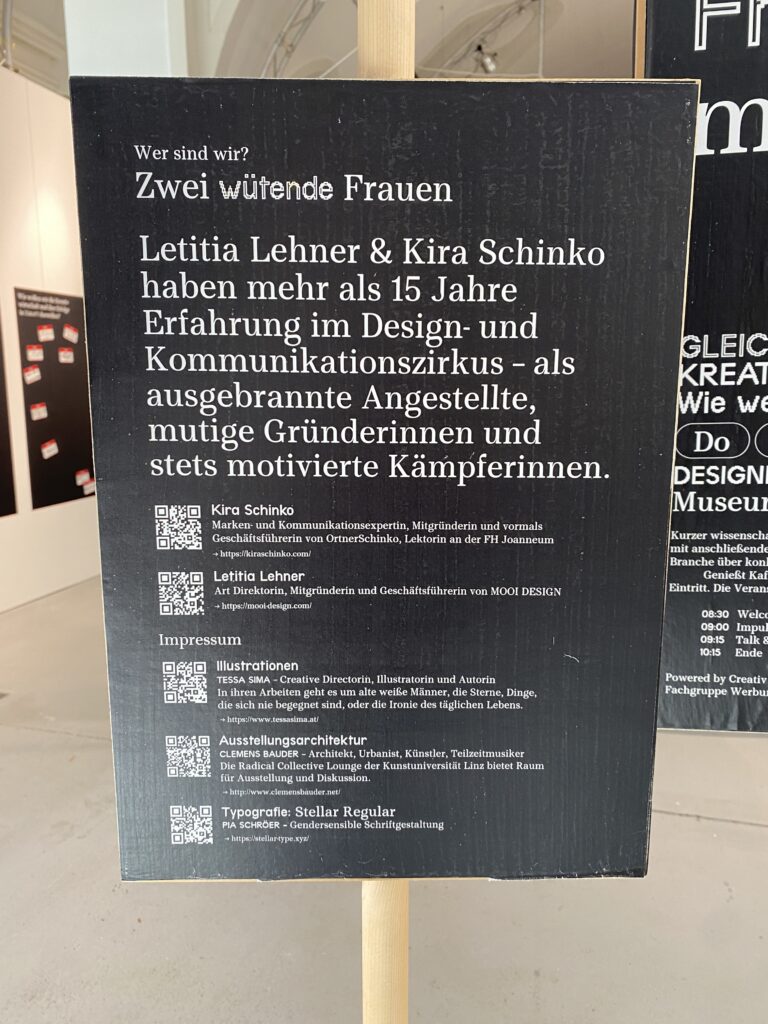
Anfang Oktober besuchte ich die Ausstellung „IN*VISIBLE x RAUM FÜR ERREGUNG“ in Wien. Bei einem Videodreh bin ich mit Lisa Hopf auf mein Masterarbeitsthema zu sprechen gekommen. Ich wurde von Lisa auf die Ausstellung „Raum für Erregung“ von Kira Schinko und Letitia Lehner aufmerksam gemacht. Kira Schinko hielt in unserem Bachelorstudiengang Informationsdesign eine Vorlesung, wo wir über den Umgang mit Kund*innen sprachen. Diese Lehrveranstaltung war sehr spannend für mich und ich wurde hellhörig als Lisa Hopf ihren Namen im Zusammenhang mit meinem Thema aussprach. Noch am selben Tag informierte ich mich über diese Ausstellung und fuhr bei der nächsten Gelegenheit nach Wien, um diese zu besuchen.

Die Ausstellung „IN*VISIBLE x RAUM FÜR ERREGUNG“ fand vom 19.09.2024-10.11.2024 im designforum Wien, Museumsplatz 1 Hof 7 statt. Montag bis Freitag war die Ausstellung von 10:00 bis 18:00 geöffnet und am Wochenende von 14:00 bis 18:00.1

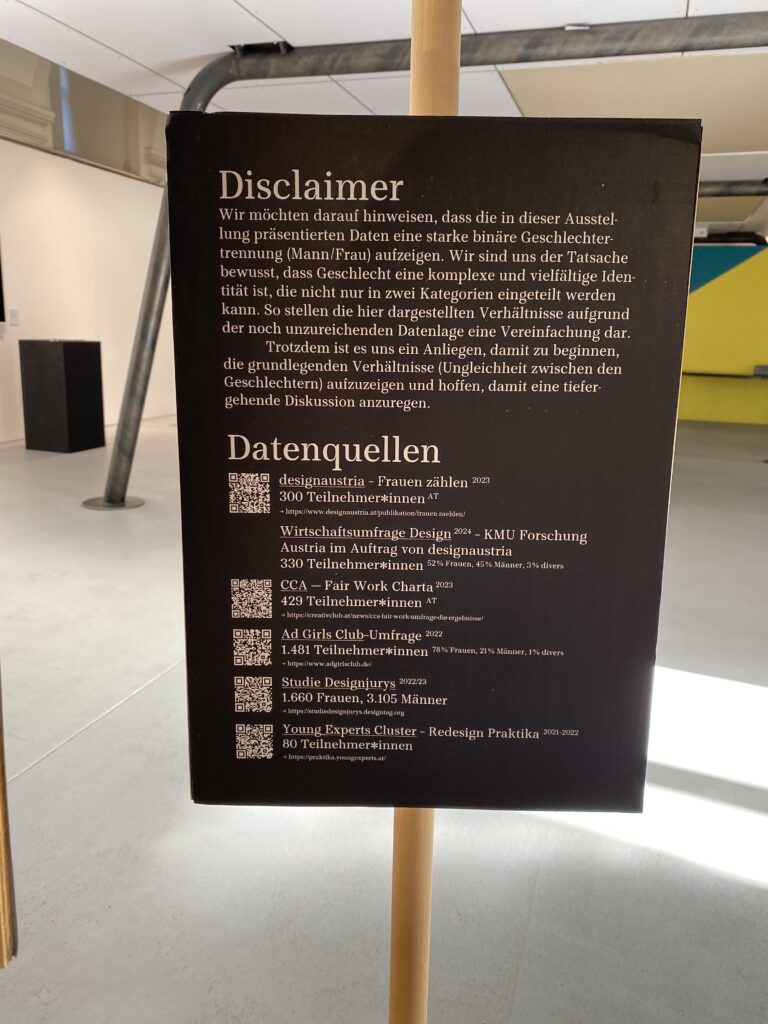
Johanna Wicht und Christine Poplavski setzen sich mit „IN*VISIBLE“ für Gleichberechtigung in der Kreativbranche ein. Sie beschäftigen sich mit der Frage, ob in der Designbranche Gendergerechtigkeit gelebt wird. Die Ausstellung kritisiert die progressive Positionierung der Kreativbranche. Sie wird als Vorreiter gesehen, wenn es um Veränderungen in der Arbeitswelt geht. Mit der Ausstellung beweisen Wicht und Poplavski, dass dies nicht Realität entspricht. Den beiden Frauen geht es darum diese unsichtbaren, genderspezifischen Probleme mit ihren Exponaten aufzuzeigen. Sichtbarkeit ist der erste Schritt in Richtung Besserung, denn unsichtbare Missstände können nicht behoben werden. Christine Poplavski und Johanna Wicht studierten gemeinsam im Master an der Fachhochschule Salzburg und teilen das Interesse an feministischen Inhalten. Im Jahre 2023 wurde „IN*VISIBLE“ vom Art Directors Club Germany ausgezeichnet. Die Ausstellung erhielt einen bronzenen und einen goldenen Nagel.2

„RAUM FÜR ERREGUNG“ beschäftigt sich mit dem Fakt, dass die Anzahl an Frauen in der Kreativbranche immer mehr zunimmt. Diese positiv erscheinende Entwicklung bring Veränderungen mit sich, die zu einer Entwertung dieser Branche führen könnte. Kira Schinko und Letitia Lehner haben über 15 Jahre in der Kreativbranche gearbeitet. Sie waren in Angestelltenverhältnissen und selbstständig tätig. Die Ausstellung bietet Raum für Reflexion über den Gender Pay Gap, die mögliche Entwertung der Branche, mangelnde Vielfalt und überholte Führungsstile.3

In der Ausstellung „IN*VISIBLE x RAUM FÜR ERREGUNG – ZUR GLEICHSTELLUNG IM DESIGN“ wurde gezeigt, dass der Lohn in Berufsfeldern sinkt, sobald Frauen in ihn einsteigen. „Eine Langzeitstudie der US-Census-Daten zeigt: Sobald Frauen in ehemals männlich dominierte Berufe eintreten, sinken Gehälter und Prestige drastisch – um bis zu 57 %.“ 4 Dieses beschriebene Phänomen geht auch in die andere Richtung. Demnach steigt der Gehalt, wenn in weiblich dominierte Berufsfelder Männer einsteigen. Als Beispiel nannte die Ausstellung die IT-Branche. Diese wurde in ihren Anfängen von Frauen dominiert. Programmieren galt als einfache Aufgabe und erst mit dem Einstieg der Männer in diese Branche, stieg auch der Gehalt und das Ansehen rapide an. In den USA sind aktuell 26 der 30 Jobs, mit dem höchsten Gehalt, von Männern dominiert. 23 der 30 Jobs mit der schlechtesten Bezahlung sind im Gegensatz dazu zum Großteil von Frauen besetzt. Den Daten zufolge handelt es sich daher um ein strukturelles Problem. Die Arbeit von Frauen wird geringer entlohnt und geschätzt. Selbst wenn Frauen in den gleichen Positionen und Berufsfeldern arbeiten, die von Männern dominiert werden, liegt ihr Gehalt systematisch unter dem der Männer. Laut der Ausstellung verdienen Frauen um 34 % weniger in der Kreativbranche und um 13 % weniger in der Medienbranche.

Sauerei

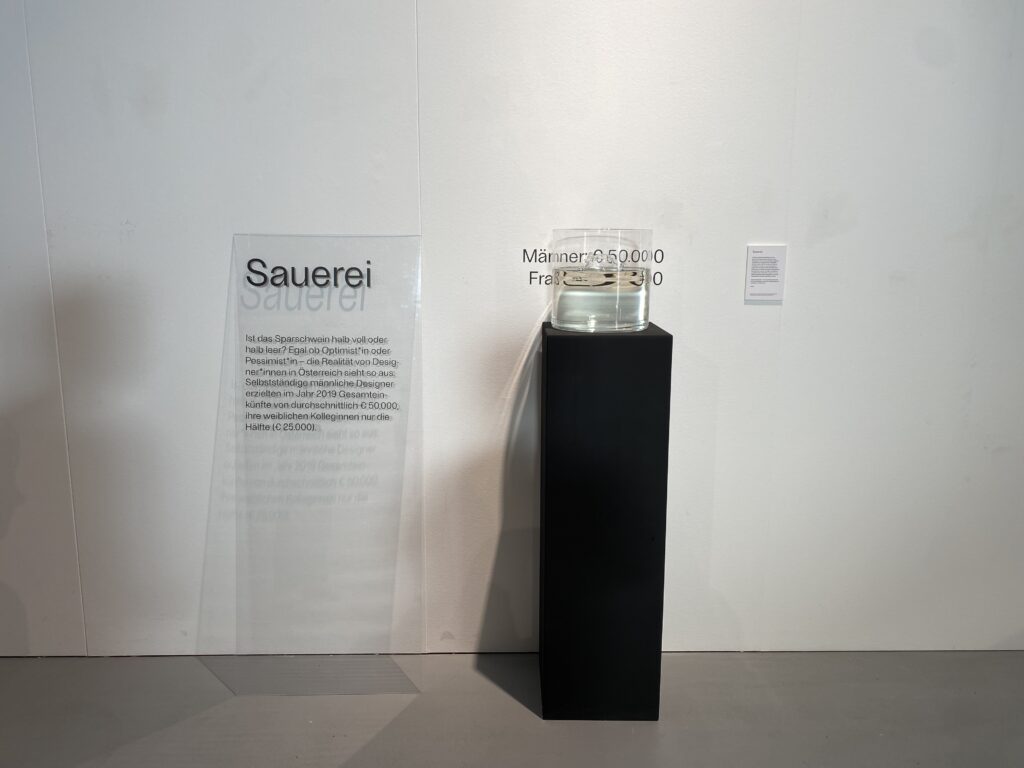
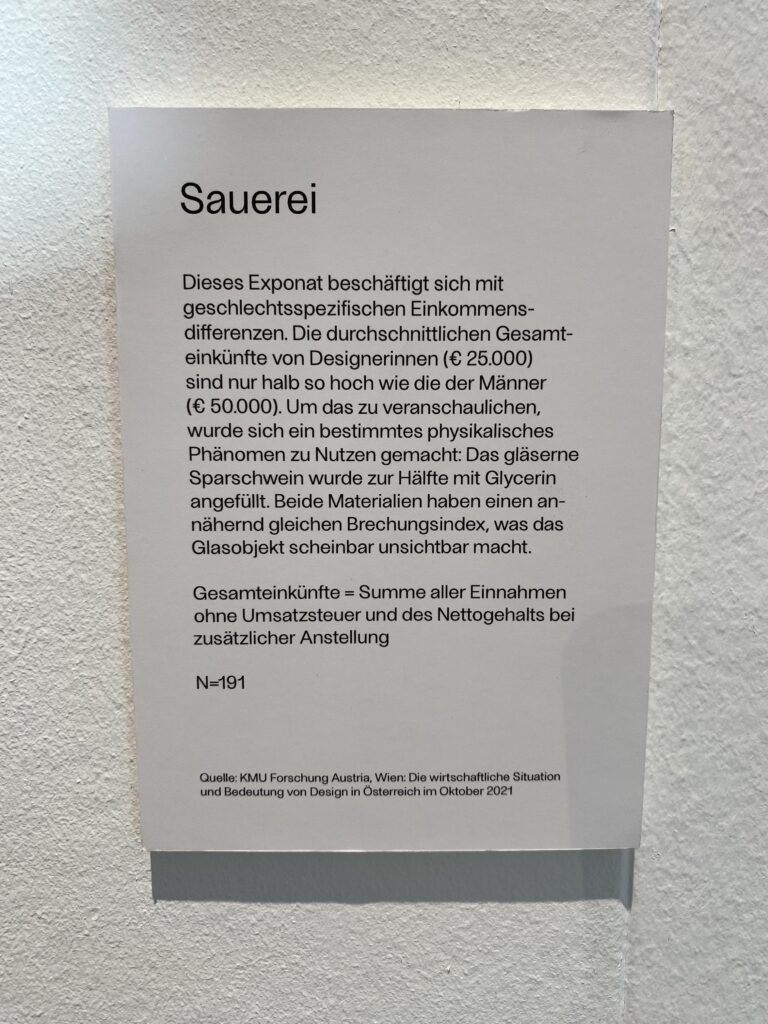
Das Exponat „Sauerei“ zweigt ein halb volles bzw. halb leeres Gefäß, in welchem ein Sparschwein schwimmt. Dahinter steht in schwarzen Buchstaben „Männer: € 50.000“ und darunter steht „Frauen: € 25.000. Die Installation soll zeigen, dass Männer, die selbstständig als Designer arbeiten, im Jahr 2019 durchschnittlich 50 000 € an Gesamteinkünften verdienten, Frauen hingegen nur 25 000 €.6

Zahlen und Fakten

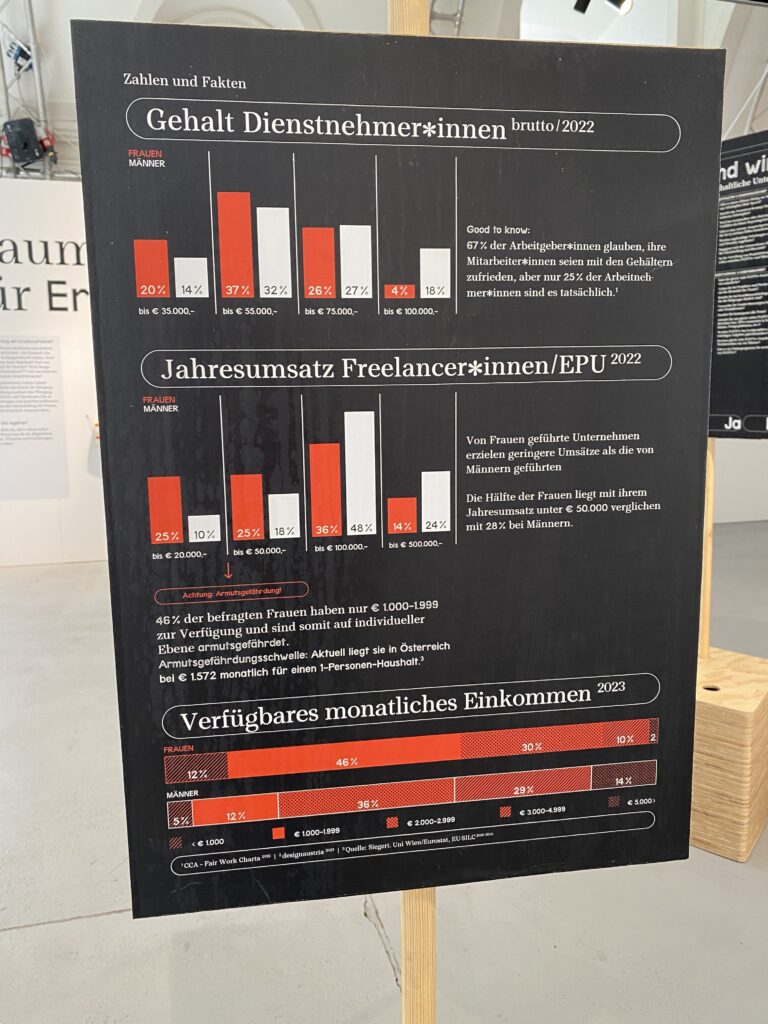
Das Exponat „Zahlen und Fakten“ zeigt den Jahresumsatz von Freelancer*innen (Ein-Personen-Unternehmen EPU) im Jahr 2022. Die Grafik wurde in Frauen und Männer unterteilt. Die Hälfte der weiblichen Freelancerinnen liegen mit ihrem Umsatz unter 50 000 €. Bei Männern sind es nur 28 %. Mit 46 %, fast der Hälfte der Frauen haben 1000-1999 € monatlich zur Verfügung. Die Armutsgefährdungsschwelle wird in Österreich aktuell mit 1572 € pro Monat in einem 1-Personen-Haushalt angegeben.7

Männer sind häufiger in der höchsten Gehaltsklasse, Frauen in der niedrigsten – das gilt sowohl für Dienstnehmer*innen als auch für Selbstständige. 8

Laut designaustria sind in der Kreativbranche Frauen häufiger in einem Angestellten Verhältnis (25 % der Frauen, 15 % der Männer). Trotzdem ist der Anteil an Frauen in Führungspositionen mit 11 % Frauen im Gegensatz zu 32 % Männern erheblich geringer.9

Die Ausstellung gab mir einen erschreckenden Einblick in die Thematik. Meine Motivation über Frauen in der Selbstständigkeit zu schreiben, ist durch diese Ausstellung maßgeblich gesteigert geworden.

1 (vgl. designaustria 2024)

2 (vgl. designaustria 2024)

3 (vgl. designaustria 2024)

4 (IN*VISIBLE x RAUM FÜR ERREGUNG 2024)

5 (vgl. IN*VISIBLE x RAUM FÜR ERREGUNG 2024)

6 (vgl. IN*VISIBLE x RAUM FÜR ERREGUNG 2024)

7 (vgl. IN*VISIBLE x RAUM FÜR ERREGUNG 2024)

(IN*VISIBLE x RAUM FÜR ERREGUNG 2024)

(vgl. IN*VISIBLE x RAUM FÜR ERREGUNG 2024)

Literaturverzeichnis

designaustria (2024): IN*VISIBLE x RAUM FÜR ERREGUNG. ZUR GLEICHSTELLUNG IM DESIGN. In: designaustria, https://www.designaustria.at/veranstaltung/invisible-x-raum-der-erregung/ (zuletzt aufgerufen am 11.11.2024)

IN*VISIBLE x RAUM FÜR ERREGUNG. ZUR GLEICHSTELLUNG IM DESIGN. (2024) Kuratiert von Wicht, Johanna u.a. designforum Wien, Wien, 19.09.2024-10.11.2024

1.Impuls: Pixel Vienna 2024

Am vergangenen Freitag besuchte ich die Pixel Vienna 2024, ein Event, das für seine kreative Vielfalt und seine inspirierende Atmosphäre bekannt ist. Obwohl ich aktuell noch unentschieden bin, welchen genauen Schwerpunkt ich in meiner Masterarbeit verfolgen werde, habe ich mich an die tollen Erfahrungen des Vorjahres erinnert. Schon damals hatte die Pixel Vienna mich motiviert, weshalb ich auch dieses Jahr auf der Suche nach neuen Impulsen und Denkanstößen wieder dabei war.

Die diesjährige Ausgabe bot ein breites Spektrum an Vorträgen, die verschiedene kreative Disziplinen und Herangehensweisen beleuchteten. Besonders eindrucksvoll waren die präsentierten Workflows und Prozesse der eingeladenen Speaker, welche zwar zum Teil sehr von meinem Feld der Interessen abweichen, jedoch trotzdem wirklich spannend waren.

Einer der Höhepunkte war der Vortrag von Jens Lindfors, Thomas Moor und René Vidra, den kreativen Köpfen hinter dem multidisziplinären Designstudio Power Pixel. Ihre Session „Navigating rough seas – how to run a small studio in international waters“ war eine tiefgehende und praxisnahe Darstellung, wie ein kleines Studio in einer wettbewerbsorientierten internationalen Branche bestehen kann. Besonders inspirierend fand ich ihren innovativen Tag-Team-Ansatz, mit dem sie ihre Projekte effizient und dynamisch umsetzen. Der Vortrag bot einen Blick hinter die Kulissen und zeigte, wie entscheidend Teamarbeit und Flexibilität sind, um in der Film- und Games-Branche erfolgreich zu agieren.

Power Pixel deckt eine Vielzahl an Dienstleistungen ab – von Concept Art, Illustration und 3D-Modellierung bis hin zu Animation und Rendering. Ihre Vielseitigkeit und ihr Fokus auf kollaborative Arbeitsmethoden boten mir interessante Einblicke, auch wenn die Inhalte nicht direkt zu meinem eigenen Forschungsthema passten.

Ein weiterer spannender  Vortrag kam von Carina Lindmeier, einer preisgekrönten Illustratorin aus Österreich. Ihre moderne, verspielte und farbenfrohe Kunst ist international bekannt, und sie hat bereits mit renommierten Marken wie Adobe und Red Bull Media House zusammengearbeitet. In ihrer Präsentation sprach sie über ihre Herangehensweise, in der sie alltägliche Momente, Popkultur und triviale Erlebnisse in ihre Arbeit einfließen lässt.

Ein weiterer Talk der mich interessiert hat war von Thomas Heschl, 3D-Artist bei Microbird Games. Er  präsentierte seine Arbeit am Action-RPG „Dungeons of Hinterberg“. Sein Vortrag beleuchtete die Entwicklung und Gestaltung der Spielwelt mit ihren vier unterschiedlichen Spezifikationen sowie die Herausforderungen, die es mit sich bringt, einen einzigartigen Artstyle zu erhalten und die Cel-Shading-Technik auf innovative Weise zu interpretieren. Auch wenn Game Design thematisch nicht zu meiner aktuellen Ausrichtung passt, fand ich es spannend zu sehen, wie viel Liebe zum Detail und wie viele kreative Entscheidungen in jedem Aspekt des Spieldesigns stecken.

Obwohl viele der Vorträge nicht direkt mit meinem Masterarbeitsthema verbunden waren, war es äußerst inspirierend, die unterschiedlichen Herangehensweisen und Workflows der Speaker kennenzulernen. Die Pixel Vienna 2024 zeigte erneut, wie wertvoll der Austausch mit kreativen Köpfen und das Aufgreifen neuer Ideen sind. Dieser Besuch hat mir geholfen, meine eigenen Gedanken zu erweitern und potenzielle neue Richtungen für meine Masterarbeit zu erörtern. Die Vielfalt der Speaker und ihre Vielzahl an spannenden Projekten waren ein sehr guter  Impuls, um meine nächsten Schritte weiter zu definieren.

Frauen in der Selbstständigkeit am Beispiel des Berufsfeldes der Fotografie

Meine bisherigen Blogs haben von Dokumentationsfilmen, Porträtfotografie und Streetfotografie gehandelt. Mein Thema für die Masterarbeit wird sich nach wie vor auf Fotografie beziehen, allerdings bringe ich einen gesellschaftskritischen Aspekt hinzu, der mich selbst als Frau betrifft.

Mein erstes Gespräch, im Zuge der Lehrveranstaltung Design and Research, wurde dafür genutzt, mein neues Thema vorzustellen und einen Diskurs darüber zu starten.
Meine Masterarbeit wird sich mit dem Thema „Frauen in der Selbstständigkeit“ beschäftigen. Roman Pürcher und ich kamen zum Entschluss, dass es bei diesem Thema besonders wichtig ist darauf zu achten, wissenschaftlich zu bleiben und nicht mit losen Verallgemeinerungen und Zuschreibungen zu argumentieren. Zu diesem Thema haben mich meine eigenen Erfahrungen in der Selbstständigkeit, Gespräche mit Frauen aus der Kreativbranche und der Besuch einer Ausstellung bewegt. Die Ausstellung „IN*VISIBLE x RAUM FÜR ERREGUNG – ZUR GLEICHSTELLUNG IM DESIGN“ werde ich kurz in diesem Blog erwähnen. Da sie sehr inspirierend war, werde ich ihr auch einen IMPULS widmen.

Um das Thema „Frauen in der Selbstständigkeit“ weiter einzugrenzen, werde ich mich in den folgenden Blogs auf Frauen in der Selbstständigkeit am Beispiel des Berufsfeldes der Fotografie spezialisieren. Das Berufsfeld der Fotografie ist daher so spannend für mich, weil ich selbst ein Gewerbe in diesem Bereich führe. Innerhalb dieser Branche möchte ich herausfinden welche Herausforderungen sich besonders für Frauen ergeben, wie sie sich selbst im Vergleich zu ihren männlichen Kollegen Positionieren und selbst präsentieren.

Mir ist bewusst, dass Geschlechteridentitäten sehr vielfältig sind und dieses Thema von einer Zweigeschlechtlichkeit ausgeht, die den tatsächlichen gesellschaftlichen Gegebenheiten nicht gerecht wird und für viele Menschen einschränkend sein kann. Diese Einteilung in weiblich und männlich gelesene Personen wird im analytischen Teil herangezogen, um die Thematik vergleichbaren zu machen.

Als Plattform zur Untersuchung der Selbstpräsentationen möchte ich mich auf Instagram fokussieren. Auf dieser Social-Media-Plattform möchte ich untersuchen, inwiefern sich die Selbstpräsentation zwischen selbstständigen Fotografinnen und Fotografen unterscheiden. In weiterer Folge könnte erforscht werden, wie die unterschiedlichen Selbstpräsentationen und die Positionierung der eigenen Marke, auf potenzielle Kund*innen wirken.

Außerdem wäre es spannend auf die Preisgestaltung der angebotenen Dienstleistungen einzugehen. Ich stelle die Hypothese auf, dass Fotografinnen tendenziell weniger für ihre Leistungen verrechnen als Fotografen. Ich wage zu behaupten, dass Frauen ihre Dienstleistungen unter ihrem Wert verkaufen. In der Ausstellung „IN*VISIBLE x RAUM FÜR ERREGUNG – ZUR GLEICHSTELLUNG IM DESIGN“ habe ich erfahren, dass der Lohn in Berufsfeldern sinkt, sobald Frauen in ihn einsteigen.

Eine Langzeitstudie der US-Census-Daten zeigt: Sobald Frauen in ehemals männlich dominierte Berufe eintreten, sinken Gehälter und Prestige drastisch – um bis zu 57 %. 1

Dieses beschriebene Phänomen geht auch in die andere Richtung. Demnach steigt der Gehalt, wenn in weiblich dominierte Berufsfelder Männer einsteigen. Als Beispiel nannte die Ausstellung die IT-Branche. Diese wurde in ihren Anfängen von Frauen dominiert. Programmieren galt als einfache Aufgabe und erst mit dem Einstieg der Männer in diese Branche, stieg auch der Gehalt und das Ansehen rapide an.2

Für meine ersten Literaturrecherchen nutze ich Keywords wie Selbstständigkeit, Entrepreneur, Fotografie, Frauen, Gleichberechtigung und Selbstpräsentation. Im Laufe der ersten Recherchen haben sich schon mögliche Forschungsfragen finden lassen. „Bieten Fotografinnen ihre Dienstleistungen günstiger an als Fotografen?“ Um diese Frage zu beantworten, könnte eine Analyse der individuellen Preisgestaltungen herangezogen werden. So kann herausgefunden werden, ob sich die Preise zwischen Fotografinnen und Fotografen unterscheiden. Eine weitere Forschungsfrage könnte sich um die Selbstpräsentation von Fotografinnen und Fotografen drehen. „Wie präsentieren sich Fotografinnen im Vergleich zu Fotografen auf Instagram?“ Die Beantwortung kann durch die inhaltliche Analyse von Instagram-Profilen erreicht werden. Die Selbstinszenierung, verwendete Hashtags und Häufigkeit von persönlichen Bildern könnten mögliche Kategorien sein.

Abschließend möchte ich meine Masterarbeit mit einer kleinen Ausstellung abrunden.
Es könnte eine Fotoserie geben, wo Frauen fotografiert werden, die selbstständig als Fotografinnen arbeiten. Für die Fotos werden keine Models gecastet. Die Authentizität wird durch die Abbildung von realen Fotografinnen gewahrt und erreicht. An dieses Projekt möchte ich sehr konzeptionell herangehen und die herausgefundenen Fakten in visuell erfassbare Bilder verwandeln. Selbstporträts könnten auch ein Weg sein, um zu authentischen Bildern zu kommen. Möglich wäre auch eine Ausschreibung dieser Challenge via Instagram. Fotografinnen könnten dazu aufgefordert werden, sich selbst in einem Porträt festzuhalten. Das Porträt könnte eine Herausforderung thematisch aufbereiten, die sie persönlich einschränken und das berufliche Schaffen erschweren. Eventuell könnte diese Intervention über Instagram gestartet werden und ihre Ergebnisse am Ende in einer Ausstellung präsentiert werden. Weiters soll diese Ausstellung Raum für Diskurse unter Gleichgesinnten bieten. Es ist mir ein großes Anliegen, dass sich alle die an der Veranstaltung teilnehmen als große Community sehen.

1 (IN*VISIBLE x RAUM FÜR ERREGUNG 2024)

2 (vgl. IN*VISIBLE x RAUM FÜR ERREGUNG 2024)

Literaturangabe:

IN*VISIBLE x RAUM FÜR ERREGUNG. ZUR GLEICHSTELLUNG IM DESIGN. (2024) Kuratiert von Wicht, Johanna u.a. designforum Wien, Wien, 19.09.2024-10.11.2024

21 | Proseminar Master Thesis | Task III – Evaluation of a Master Thesis

For this evaluation task, I have selected the master thesis “Digital fashion for sustainable change a strategy for digital fashion at Tommy Hilfiger” by Charlotte Joliijn Hoekstra. The thesis was submitted in March 2021 at Delft University of Technology for the completion of the masters degree in Strategic Product Design. The evaluation considers the following criteria:

  1. Level of Design The thesis is well designed and comprehensive owing to its employment of color coded layout and clearly structured chapter marking. The reading flow is easy and the overall appearance of the thesis is appealing. Graphics and statistics are also designed in a uniform way, which contributes to the cohesive appearance of the work.
  2. Degree of Innovation
    The topic of the thesis is quite innovative and new, especially for the time of publication. There research topic of digital fashion is not yet extensively researched in academic context at time of writing. Additionally, the concrete and precisely narrowed down scope of the thesis makes it a useful case study and an important reference basis for further research in this area of study.
  3. Independence
    The thesis demonstrates a high degree of independence and effort on the part of the researcher. The outcomes are tangible and underline the amount of independent research that was conducted for the paper.
  4. Outline and Structure
    The structure is extremely reader friendly and clear. The researcher provides a table of contents that includes an executive summary as well as a reading guide in the beginning of the text. The thesis is then divided into five main areas, titled “Discover”, “Why”, “How”, “What” and “Conclude” which each of the sections being color coded and further divided into subchapters. This is extremely helpful for readers in guiding their reading experience of the paper.
  5. Degree of Communication
    The degree of communication high, the manner of communication is effective and the research topic, though extensive, is well communicated. The author manages to relate the basis of the topic and the background information needed to understand the most important aspects of the research in a clear and understandable manner, enabling even readers who are unfamiliar with the research area to understand the thesis. 
  6. Scope of the Work
    The scope of this work appears to be quite extensive and becomes evident primarily in the discussion of the research objectives, the scope of the deliverables and the research methodology. The researcher employs various methodological tools, such as the Vision in Product design method on the design side and scientific research methods current state of the art evaluations and focus group research. The paper consists of 85 pages including the bibliography and title page, and I would evaluate this as a quite extensive scope for a paper at this level.
  7. Orthography and Accuracy
    Orthography and accuracy are on an appropriate level. No obvious mistakes in orthography, grammar or mistakes of any kind in the writing could be detected while reading the thesis. 
  8. Literature
    The author cites 44 sources, which I would classify as a number on the lower end of the scale especially in relation to the extensiveness of the work. However, the novelty of the topic and the limitations in existing research justify this quite low number of referenced works. The cited references are varied and diverse and draw from different categories of sources. Overall, the literature is satisfactory but could be slightly more extensive. 

Overall Evaluation
Overall, this thesis is very well written, has a clear and appealing layout, an excellent reading flow and demonstrates a high degree of innovation. The slightly low number of literature sources is compensated well by the extent of independent research conducted by the author. In the Austrian grading system, I would grade this thesis as a 1 (very good).

Source:
Hoekstra, Charlotte. „Digital fashion for sustainable change: A strategy for digital fashion at Tommy Hilfiger.“ (2021).