Impuls #7 – Schrift im Film

Ich habe mir vor kurzem Wicked im Kino angesehen und da ist mir bei der Titelsequenz aufgefallen, dass der Titel des Films ganz anders ausgesehen hat, wie im Trailer oder auf den Plakaten. Anstatt von den 3D-wirkenden Buchstaben, war der Titel nun in einer verspielten Script-ähnlichen Schrift mit Schlagschatten im Bild aufsteigend zu sehen. Im Gegensatz zum Titel des sonstigen Werbematerial wirkt diese Variante, weitaus altmodischer/ „klassischer“, aber auch viel sanfter und verspielt. Doch weshalb hat man sich umentschieden?

Nach dem Kinobesuch habe ich etwas Internet-Recherche betrieben. Da Wicked, die Vorgeschichte von der Zauberer von Oz ist, brauchte es nicht lange eine Antwort zu dieser Frage zu bekommen. Der Wicked Filmtitel im Film, orientiert sich am Titel des Zauberer von Oz Films (1939) (Auch habe sie eine textliche Einführung in die Materie gegeben). Diese Entscheidung, ist daher gelungen, da es Fans vom Zauberer von Oz sofort abholt und auch Ehre dem Ausgangsmaterial erweist.

Faszinierend dabei ist es, dass man allein durch die Auswahl und Platzierung von Schrift, extrem viel vermitteln kann. Deswegen habe ich nach ersten Impulsen zum Thema Schrift im Film gesucht und bin auf das YouTube-Video When the title font *really* matters vom Kanal Little White Lies gestoßen. In diesem Video erklärt die Typografin Marie Boulanger von MonoType wie Schrift dabei hilft Narrative vom Film zu unterstützen und auch welche Auswirkungen sie auf das Publikum haben können.

Schrift ist ein Material

Laut Boulanger ist Schrift nicht ein Werkzeug, sondern ein Material. Man könne mit Schrift spielen in dem man sie zum Beispiel verzerrt oder verformt. Durch diese Spielereien kann man verschiedenes ausdrücken. Deshalb findet man weitaus simplere, aber expressivere Schriften im Film. Beispielsweise kann man das bei Gone with the Wind oder Psycho sehen. Interessant bei Psycho war es, dass die der Titel des Plakates weitaus berühmter geworden ist, als der von der Titelsequenz, sodass für die weiteren Filme der Titel des Plakates auch für die Titelsequenz benutzt worden ist.

Die Auswahl der Schrift kann viel über den nachfolgenden Film aussagen. Deshalb ist es wichtig auch die Schrift richtig zu besetzen. Wie beim Aussehen von Figuren, kommen emotionale Assoziationen beim Publikum auf, wenn sie eine bestimmte Schrift sehen. So kann eine Schrift, welche dem Art Deco nachempfunden ist, beim Publikum Assoziationen wie retro und glamourös hervorrufen. Auch kulturelle, Gender und Genre spezifische Stereotype können Schriften bei den Betrachter:innen auslösen.

Verbindet man das Aussehen und die Erscheinung der Schrift mit der Semiotik kann man beispielsweise große Schriften als mächtig und kleine Schriften als zärtlich interpretieren. Oft macht man den Fehler, dass man Schriften spezifischen Gendern zuordnet und sich nicht überlegt, was es für andere Eigenschaften geben könnte, welche die Schrift beschreiben. Deshalb sollte man sich bei der Auswahl der Schrift zuerst intensiv mit der angedachten Intention, Stimmung der Schrift auseinandersetzen.

Früher waren die Mittel wie man mit Schrift umgehen konnte weitaus begrenzter als heutzutage. Nichts desto trotz, stehen die innovativen Lösungen, den heutigen in Nichts nach. Heutzutage sind die Titel viel komplexer aufgebaut. Hier ist die Schrift oft nur ein Element innerhalb der Titelanimation. Das Hauptaugenmerk liegt dabei oft auf der Ästhetik oder den VFX.

Lange Zeit war der Titel das Erste was einem beim Ansehen von einem Film begegnet ist. In den vergangenen Jahren wird die Verlagerung ans Ende immer populärer. Diese Entwicklung wurde hauptsächlich von den Superheldenfilmen losgetreten, da die vorkommenden Charaktere und Narrative dieser Filme eigentlich keine Vorstellung mehr brauchen.

Da Schrift als Branding-Element genutzt werden kann, ist es mittlerweile Standard, dass große Produktionen und Franchises individuelle Titel-Logos besitzen. Aber auch Regisseure können sich Schrift als Branding-Element zu nutzen machen, zum Beispiel benutzen alle Filme, welche Sean Baker bis jetzt veröffentlicht hat, alle dieselbe Schrift.

Fazit

Ich fand die Recherche zu Wicked interessant, da ich im Kino bereits, die Assoziation gemacht habe, dass es sich auf old Hollywood bezieht, doch mir war nicht bewusst, dass es direkt den Film referenziert (ich bin aber auch kein riesiger Zauberer von Oz Fan, als dass ich das wusste). Ich fand, aber diese Referenz als gelungen, da ich, wie ich aus anderen Impulsen gelernt habe, es als sehr gute Abholung der Fans empfinde.

Bei dem Video Essay, wurde mir noch mehr bewusst, wie wichtig und auch essentiell die richtige Schriftauswahl für einen Film sein kann. Vor allem die vielen Beispiele waren sehr interessant zu betrachten.
Weiterführende Links

https://www.fontbolt.com

IMPULS #03 Kreativ Kammerl Treffen

Für meinen nächsten Impuls Blog-Beitrag möchte ich eine Veranstaltung vom Kreativ Kammerl Graz nehmen. Das Kreativ Kammerl veranstaltet immer Stammtische, wo Leute jeglicher Art aus der Kreativbranche sich in Graz zusammentreffen, diesmal war es bereits der vierte Stammtisch im Jahr 2024.

Vierter Stammtisch 2024: Mittwoch, 27. November 2024 um 18:30 Uhr – After-Show-Party: ab 21:30 Uhr. Location: Circle Thalia.

Die Veranstaltung hatte dieses mal das Thema „Let’s talk about Cash Baby“ und drehte sich darum, warum viele Kreative zu wenig verdienen und ihre Arbeit oft nicht genug geschätzt wird. KundInnen zahlen immer weniger, erwarten aber trotzdem gute Ergebnisse und großartige Konzepte hinter den Projekt.

Themen des Abends:

  1. Wert kreativer Arbeit:
    • Unternehmen drücken die Preise, und Kreative arbeiten oft am Limit.
    • Schlechte Bezahlung führt zu schlechter Qualität, was sowohl Kreative als auch Kund*innen frustriert.
  2. Wie Preise festgelegt werden sollten:
    • Preise sollten genau berechnet und klar kommuniziert werden.
    • Schätzungen sind gefährlich, weil sie oft zu Verlusten führen.
  3. Tipps der ExpertInnen:
    • Philipp Schönauer (Werbefotograf)): Persönlich rät Philipp Tagessätze statt Stundensätze zu nutzen und direkt mit KundInnen zu sprechen, um Vertrauen aufzubauen. Darüber hinaus sollte zu Beginn das Budget erfragt werden und dann kann mit diesem Budget das Beste für ein Projekt rausgeholt werden.
    • Andrea Stanitznig (Inhaberin und Geschäftsführerin von Rodarich): Setzt auf klare Nutzungsrechte und die Optimierung von Leistungen, um den Wert kreativer Arbeit zu erhalten.
    • Isabella Graf (Head of Marketing ISS Österreich): Empfiehlt, dass Unternehmen ihre Budgets offenlegen, damit Kreative passende Angebote machen können.
  4. Probleme auf dem Markt:
    • Durch günstige Technik und Social Media gibt es immer mehr Konkurrenz, was die Preise drückt.
    • Der „Geiz ist geil“-Trend schadet sowohl Kreativen als auch Fachgeschäften.

Mein Fazit zu dem Panel-Talk:

Kreative müssen ihre Arbeit mehr wertschätzen und ihre Preise realistisch planen. Offenheit und gute Kommunikation mit KundInnen sind wichtig, damit beide Seiten zufrieden sind. Unternehmen sollten erkennen, dass gute kreative Arbeit ihren Preis hat und langfristig Erfolg bringt.

Fotografien

Ich wurde für dieses Event angestellt um Fotos vom gesamten Abend zu machen. Hier der Link zu meinen Bildern und dem Event: https://kreativkammerl.at/vierter-stammtisch-2024/

Eigentlich war es das erste Mal das ich ein Event dieser Art fotografisch festhalte. Denn ich habe noch nie mit Blitz wirklich wie ein Event-Fotograf jedes Bild für ein Event als Marketing und deren Werbung gemacht. Normal neige ich dazu Blitzfotografie zu vermeiden, außer es ist genau der Stil den ich anstrebe. Aber das Event und dieser Abend hat mir definitiv die Angst davor genommen und auch gleichzeitig vom Networken. Genau aus diesem Grund wollte ich dieses Event und diesen Job auch als Impuls zu meinen Blogbeiträgen hinzufügen.

Ich habe an diesem Abend sehr viel Networking betrieben und Personen aus der Kreativwirtschaft kennengelernt, gleichzeitig habe ich mich selbst als Selbstständige auf vermarktet. Es war wirklich jegliche Art von Kreativen dabei: Models, FotografInnen, VideografInnen, IllustratorInnen, Selbständige etc.

Das Connecten mit VideografInnen und FotografInnen habe ich auch als Impuls gesehen, dass für meine Masterarbeit zu nutzen. Denn auch wenn ich das Konzept selbst erstellen möchte und die meiste Arbeit daran, brauche ich Personen die mir potentiell bei dem Videodreh helfen und vielleicht auch Behind the Scenes Bilder aufnehmen, weil das möchte ich in jeglicher Art festhalten.

Kreativ Kammerl Website: https://kreativkammerl.at/

Kreativ Kammerl Instagram: https://www.instagram.com/kreativkammerl.at/

Impulse 6 – Expose

Als Vorbereitung sollten wir mit den bis her gesammelten Informationen und Recherchen ein erstes Expose erstellen, welches dann von 2 Kollegen reviewed wurde, um noch eine andere Sichtweise darauf zu bekommen.

In erster Linie hat mir vor allem die eigene intensive Beschäftigung damit viel gebracht. Die Gedanken zu dem Thema und die aufgearbeiteten Infos gebündelt zu definieren und zu kategorisieren. Da ich mein Thema etwas verändert habe und somit wieder “neu” anfangen musste war es für mich garnicht so einfach. Mir ist mein Thema klar und was ich behandeln will, aber ich finde es schwer diese Themen zu fokussieren, da ich im Moment selber noch in verschiedene Richtungen recherchiere, um etwaige Verbindungen noch zu finden bevor ich mich beschränke. Das ist sowieso mein größtes Problem – nicht zu weit zu denken und alles irgendwie mit rein zu bringen.

Durch die Vorlage beim Expose musste ich mich dann einschränken und eindeutig Gedanken machen, welche Themen ich behandeln will und was dabei herauskommen sollte, könnte.

Nach dem Abgeben wurde es von 2 Kolleginnen kontrolliert, die mir ihr Feedback dazu gegeben haben. Von beiden habe ich sehr gutes Feedback bekommen und nur ein paar Anstöße, die mir noch gefehlt haben – bzw Hilfestellungen zur Einschränkung. Alleine die genaue Auseinandersetzung mit ihrem Feedback und das erneute Überarbeiten des Exposes hat mir geholfen, da ich mich ganz anders damit beschäftigt habe.

Wie in dem letzten Impuls bin ich währenddessen noch darauf gestoßen, dass Stoffe die gleichen Vorraussetzungen und Produktionssprozesse haben wie Wolle – vor allem bei tierischen Erzeugnissen. Somit habe ich diese Einblicke auch noch mit einfließen lassen. Bis zur finalen Einreichung möchte ich hier noch mehr Eingrenzen bzw festlegen, was ich genau behandeln will und in welchen Aspekten.

Impulse 5 – Shopping Fabrics

As a big gift to myself, I bought my first sewing machine this Christmas. I wanted to explore another craft hobby and learn to repair and adjust my own clothing, as I often struggle to find items that meet my needs or are of good quality without being overly expensive.

Over the holiday break, I used my free time to shop for sewing tools and materials. My boyfriend and I planned a visit to a local sewing and fabric store near where I live. Before heading there, I did some online research to figure out what I wanted to make, the cost of fabrics, and other basics, as I had no prior experience in this field. We had a few ideas for beginner-friendly sewing projects, and while I had already received a brief introduction to my sewing machine at the store where I purchased it, I didn’t know much about materials. I was hoping the staff at the fabric store could guide me, as I felt overwhelmed by all the options. Online research doesn’t allow you to truly understand the texture and appearance of fabrics, so I needed in-person advice.

However, walking into the store turned out to be even more overwhelming than I had anticipated. I thought I knew what I needed and wanted, but I quickly realized I was far off. The store had a vast range of fabrics in different colors and fiber types. Thankfully, the owners—a helpful couple—quickly came to my aid. They patiently showed me fabric after fabric based on the projects I had in mind. Although it was challenging to make decisions, they were incredibly supportive and offered plenty of tips and tricks, including advice on choosing the right needle for different fabric types.

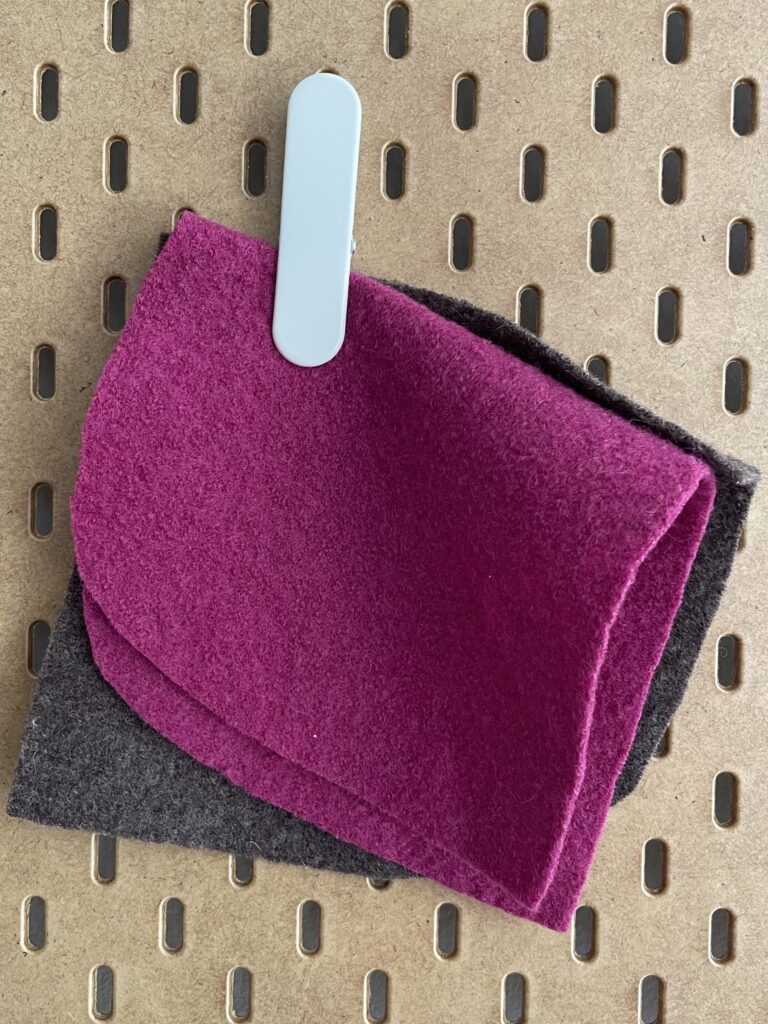
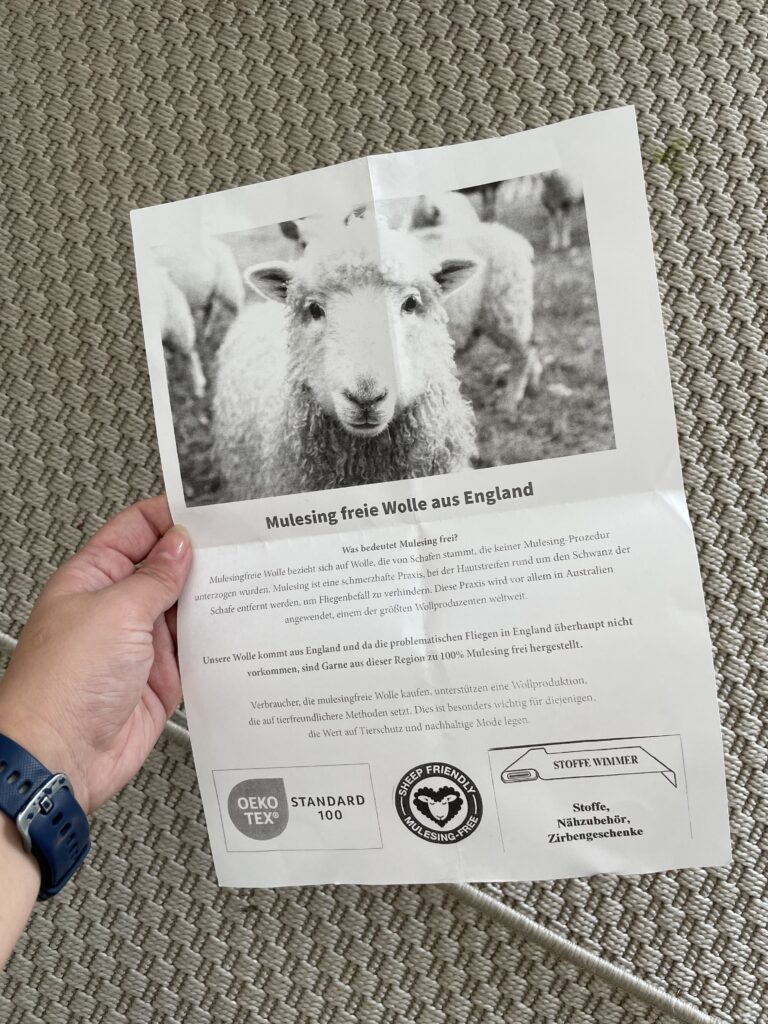
During our conversation, we also touched on the topic of wool fabric and the issue of mulesing—a cruel practice used to prevent parasites in sheep, particularly in the production of merino wool for knitting and crochet. The owner explained where they source their materials and their commitment to using fairly produced fabrics. I mentioned my master’s thesis topic, which also focuses on sustainable practices, and noted the parallels with fabric production. He generously gave me some fabric samples and a flyer with more information to use in my research.

This experience made me reflect on whether I should broaden my focus to include fabric production or stick primarily to knitting and crochet. Both fields share many similarities when it comes to materials and the environmental and ethical impacts of their production. I might explore the world of sewing and fabrics further, as it seems to complement my existing interests.

The shop owner was genuinely pleased that someone was interested in this topic and even offered to assist me in the future.

IMPULSE #8

The Long Night of Application: A Life-Changing Event for Job Seekers

On November 27th, 2023, I had the privilege of participating in the Long Night of Application (Lange Nacht der Bewerbung), an event that proved to be a turning point in my UX career. Hosted in Graz, this unique gathering felt like speed dating, but instead of looking for romantic connections, participants engaged in rapid-fire interviews with potential employers. The concept was simple yet powerful: give job seekers and companies a chance to meet, interact, and discover mutual opportunities – all in one night.

What Makes It Special?

The event is designed to connect job seekers with a wide array of companies, breaking down traditional barriers of recruitment. It’s fast-paced, dynamic, and highly engaging. For someone exploring career opportunities, it’s an unbeatable way to maximize exposure and connect with employers in a condensed timeframe.

In just a few hours, I had eight interviews with different companies. Each interaction provided a unique insight into the companies‘ cultures, expectations, and potential roles. This variety allowed me to refine my preferences and approach for future interviews. What’s more, the event isn’t just about ticking off interviews – it’s about genuine connections. Employers are there because they’re actively seeking talent, which creates a good opportunity for job seekers.

A Life-Changing Experience

Both my colleague Kathi and I walked away from the Long Night of Application with something extraordinary: job offers! It’s remarkable to think that one evening, filled with back-to-back conversations, could lead to such a significant outcome for both of us.

Tips for Future Participants

If you’re considering attending, here’s my advice:

  • Bring your portfolio on your laptop: Visuals can say more than words, especially if language is a concern.
  • Stay open-minded: You never know which company or role might resonate with you until you’ve had that conversation.
  • Prepare for a fast-paced evening: It’s exciting and intense, so bring your energy and focus.

Final Thoughts

The Long Night of Application isn’t just another job fair; it’s a transformative experience that can open doors you didn’t even know existed. Whether you’re a local or an international job seeker, this event is a must-attend for anyone looking to jumpstart their career.

https://www.langenachtderbewerbung.com/

IMPULSE #7

A Creative Evening: My Experience at the Vierter Stammtisch of Kreativ Kammerl Österreich

On November 29, 2023, I attended the Vierter Stammtisch, an event hosted by Kreativ Kammerl Österreich (KKO). It was a relaxed and friendly gathering where people from the creative industry came together to share ideas, stories, and enjoy some drinks.

What is KKO?

The idea behind Kreativ Kammerl Österreich is simple:
What if creatives could meet without the stress of work and just enjoy talking to each other over a cup of Glühwein?

From this thought, four professionals in the creative field built a platform for connection and conversation. KKO aims to bring together not only experienced professionals but also students and newcomers eager to learn and grow.

In an industry where schedules often clash and meetings are rushed, KKO offers a rare chance to meet others in a relaxed and informal setting.

The Evening’s Highlights

The Stammtisch was full of engaging conversations and a great exchange of ideas. Attendees ranged from seasoned professionals to students just entering the creative world. Topics covered industry challenges, creative trends, and personal experiences.

For me, this wasn’t just about meeting new people – it was a real opportunity to gain insights that connected with my academic work. As I’m working on my thesis, Developing the UX Playbook: A Research-Driven Approach to Optimizing Digital User Journeys, I saw strong parallels between the event’s goals and my research questions:

  1. How can a UX Playbook serve as a practical tool to bridge the gap between designers and stakeholders?
    • The Stammtisch reflected how important it is to have open, informal spaces for dialogue. This mirrors the need for UX Playbooks to act as a shared language between designers and stakeholders, fostering better understanding and collaboration.
  2. What are the key steps in a research-driven UX design process?
    • Hearing how other creatives approached problem-solving gave me valuable insights into their processes. It reinforced the importance of collaboration and user-centric approaches, two pillars of a strong research-driven UX methodology.

A Suggestion for the Future

One idea discussed during the event was to host future gatherings in English. While most conversations were in German, having an English option would make the event more inclusive for international creatives in Austria. This simple step could broaden the scope of conversations and invite diverse perspectives, much like how UX research benefits from a range of user inputs.

Final Thoughts

The Vierter Stammtisch was a fantastic experience, both personally and professionally. It showed me the value of community and the role that open conversations play in bridging gaps – whether between professionals in a room or designers and stakeholders in a project.

I left inspired and excited about the next steps in my thesis and the potential of future KKO events. Whether you’re a creative professional or just starting, I highly recommend joining these gatherings. Let’s continue building a more connected, collaborative creative community.

https://kreativkammerl.at/

https://www.facebook.com/kreativkammerl.at

#04 Literature Research 3

Wen, Jiqing u.a.: Visual Background Recommendation for Dance Performances Using Dancer-Shared Images. In: IEEE International Conference on Internet of Things (iThings) and IEEE Green Computing and Communications (GreenCom) and IEEE Cyber, Physical and Social Computing (CPSCom) and IEEE Smart Data (SmartData) 2016, S. 521-527, <https://doi.org/10.1109/iThings-GreenCom-CPSCom-SmartData.2016.120>

Survey: The document is a research paper titled „Visual Background Recommendation for Dance Performances Using Dancer-Shared Images.“ It discusses a system designed to recommend visual backgrounds for dance performances. The methodology focuses on using image content and social network data to predict dancers‘ preferences for stage backgrounds. The paper is a nice contribution to the intersection of arts and technology. The authors provide a detailed methodology grounded in content-based recommendation techniques, leveraging CNNs for feature extraction and preference modeling. The study demonstrates the effectiveness of the system through experiments on a Pinterest dataset, validating the hypothesis that images related to the same dance style share similar visual content.

Question: How does the proposed system work? What methodologies are used to analyze and recommend background images? How effective is the system compared to existing methods? What are the main contributions and limitations of this research?

Read:

  • Dance as narrative art, background essential for storytelling
  • Problem of information overload when choosing images.
  • System benefits amateur dancers using social platforms like Pinterest
  • Similarity Hypothesis: Images of same dance style share visual content.
  • Three Steps:
    • Predict top K images based on dancer preferences.
    • Remove dancer(s) to extract pure background images.
    • Recommend suitable backgrounds.
  • Data Source: Pinterest; over 12,000 images, six styles tested (ballet, street dance, tango, etc.).
  • Dancers preference using shared content

The Experiments and Results of them:

  • Comparison of methods:
  • Proposed system vs. Color-based and Nearest Neighbor methods.
  • Proposed system achieves 6x precision improvement.
  • Visualization: Confusion matrix and t-SNE clustering validate style-based similarity.
  • Effective Recommendations: Predict dancer preferences with precision
  • Limitations:
    • Pure background extraction not complete.
    • Social network influences (friends‘ preferences) not incorporated.

Recite:

Introduction: The paper addresses the difficulty dancers face in selecting stage backgrounds and proposes an automated recommendation system using social platform data.

Related Works: It reviews dance technologies and recommendation systems, highlighting the limitations of existing methods like collaborative filtering.

Similarity Hypothesis: Images of the same dance style share similar features, validated using CNNs and Pinterest data.

Methodology: The system extracts image features, builds dancer profiles, and recommends top K images that match their preferences.

Experiments: Testing on 437,000 Pinterest images shows the system outperforms color-based and nearest neighbor methods in precision.

Discussion: The system is effective but lacks pure background extraction and social interaction analysis.

Conclusion: This is the first system for recommending dance stage backgrounds, providing a strong basis for further research.

Some general Keywords:

  • Dance styles
  • content-based recommendation
  • projection mapping
  • background images

Review: The system is innovative in applying machine learning to a niche artistic domain. Its main contribution is proving the viability of content-based recommendations for dance stage designs. However, further development is needed to refine background extraction and incorporate social network dynamics. Overall, the article is a well-executed study that sets a foundation for further exploration into integrating artistic preferences with machine learning for practical applications in stage design.

Are the authors experts? Yes, the authors of this article are experts in their respective fields. They are affiliated with the HKUST-NIE Social Media Lab at the Hong Kong University of Science & Technology, which specializes in social media and computing technologies. Their work is also published in a reputable venue, the IEEE International Conference on Internet of Things (iThings), which underscores their credibility and expertise in this area. (https://ieeexplore.ieee.org/document/7917148/authors#authors)

How would you rate the structure of the text, the quality of the content, the style? The structure is systematic, beginning with an introduction to the problem and followed by a discussion of related works, methodology, experiments, and conclusions. The experimental results substantiate the superiority of the proposed method compared to baseline approaches, such as color-based and nearest-neighbor methods. However, some limitations, such as the lack of pure background extraction and the absence of social interaction data, are acknowledged in the discussion, with suggestions for future work.

Is the book/article useful for your purpose? If yes, which chapter % aspects? If not, why not? What is missing, what is inadequate? The article provides valuable insights into aligning visuals with dance styles and leveraging technology for visual storytelling, which are directly applicable to the projection mapping and thematic differentiation in my master thesis’ topic. However, for narrative development and cinematic techniques like color grading, additional sources focusing on film direction and storytelling are necessary and itself is not that useful for this perspective.

27 – Impuls 7: Ink Traps Using Corner Components

Mit Corner Components eine Schrift gestalten

Vor kurzem habe ich mir ein Video angeschaut, das die Verwendung von Corner Components zur Erstellung von Ink Traps in Schriftarten erklärt. Ink Traps sind kleine Aussparungen in Buchstabenformen, die ursprünglich dazu dienten, Tintenverläufe im Druck bei minderwertigem Papier auszugleichen, heute aber oft als stilistisches Merkmal eingesetzt werden. Das Tutorial war nicht nur informativ, sondern hat mir auch neue Ideen für eigene Projekte gegeben.

Corner Components: Eine praktische Lösung mit vielen Vorteilen

Ein zentrales Thema des Videos war die Effizienz, die Corner Components bei der Schriftgestaltung bieten. Diese Technik basiert darauf, einzelne Ecken von Buchstaben als wiederverwendbare Module zu gestalten. Anstatt jede Ecke manuell zu bearbeiten, wird eine Komponente erstellt, die dann auf alle relevanten Stellen angewandt wird. So bleibt das Design konsistent und Anpassungen lassen sich zentral vornehmen.

Besonders beeindruckend fand ich, wie vielseitig diese Methode ist. Zum Beispiel kann man die Größe oder Form eines Ink Traps in der Komponente anpassen, und die Änderungen werden automatisch auf alle Buchstaben übertragen, die diese Komponente verwenden. Dadurch lassen sich Proportionen oder Stilvarianten schnell und unkompliziert testen. Diese Flexibilität spart nicht nur Zeit, sondern minimiert auch Fehler – ein großer Vorteil bei der Arbeit an komplexen Schriftprojekten.

Ein weiterer Aspekt, den das Video hervorhob, ist die Präzision. Mit Corner Components kann man sehr feine Details wie die Übergänge zwischen geraden Linien und Kurven präzise steuern. Dies ist besonders wichtig, wenn man mit Ink Traps experimentiert, da diese oft sehr subtil in das Design integriert sind und dennoch einen großen Einfluss auf das Gesamtbild haben.

Meine Erkenntnisse und Anwendungsideen

Das Video hat mir gezeigt, wie ich Corner Components gezielt einsetzen kann, um sowohl funktionale als auch ästhetische Anforderungen zu erfüllen. Für mein aktuelles Projekt, eine variable Schrift mit Ink Traps, bietet diese Technik eine ideale Grundlage. Ich plane, verschiedene Formen und Größen von Ink Traps zu entwickeln und dabei die Vorteile von Corner Components voll auszunutzen.

Ein weiterer Gedanke, der mir kam: Diese Methode könnte auch für andere Details in der Schriftgestaltung nützlich sein, etwa für Serifen oder besondere Verzierungen. Die Möglichkeit, ein Element zentral zu bearbeiten und dessen Änderungen sofort in der gesamten Schrift zu sehen, eröffnet viele kreative Möglichkeiten.

Das Tutorial war eine wertvolle Inspiration und hat mir einen Einblick in moderne Techniken der Schriftgestaltung gegeben. Corner Components sind nicht nur eine zeitsparende Methode, sondern auch ein Werkzeug, das die Präzision und Konsistenz im Design verbessert. Gerade in Kombination mit Ink Traps bieten sie spannende gestalterische Möglichkeiten, die ich in meinen eigenen Projekten unbedingt ausprobieren möchte. Ich kann diese Technik jedem empfehlen, der sich mit Schriftgestaltung beschäftigt und nach effizienten, kreativen Ansätzen sucht.

Link

Road to M. A. 5: Medusa and female rage

Gen Z is unapologetic and has salvaged many things women have previously been shamed for, especially angst. This generation has taken female anger and frustration under its wing and wears these emotions with pride, using female rage edits on platforms like tiktok and instagram as a form of expression. 

Creators and consumers of these edits are proudly reclaiming insanity, obsession and being unhinged.

Women snap, and they get it. 

It is evident that madness and hiding your raw emotions are outdated concepts. With many seeking solace in these unhinged and frustrated women, the next step is to let this seep into society. Allowing women to express their true feelings, maybe not to the extent that are depicted in cinema, is on the checklist for Gen Z’s crusade. 

A wider acceptance and acknowledgement of women’s mental health and ill thoughts can only surely have a positive impact. Cinema has depicted women in this light for decades, but now, instead of it being suppressive, it is empowering. Many can relate and feel consoled. 

Female Rage in Mythology: Medusa

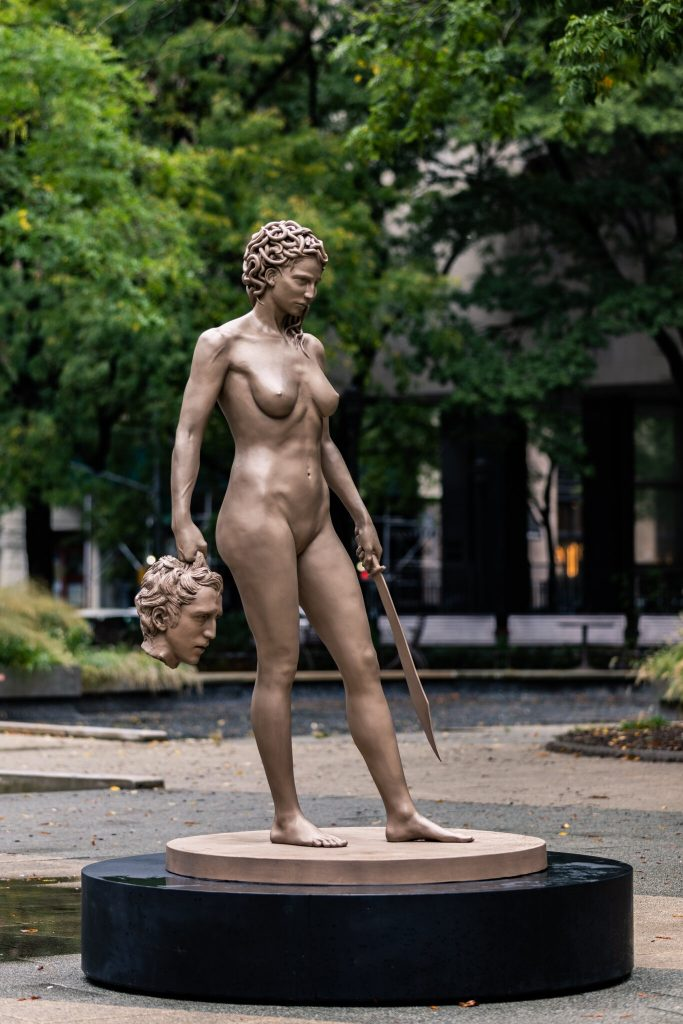
Medusa’s myth serves as a striking analogy for the suppression and weaponization of female rage. Blamed for her beauty and punished for her assault, Medusa’s story encapsulates a culture that demonizes women’s anger, independence, and sexuality. Her transformation into a monster symbolizes society’s attempt to silence and control powerful women by framing their strength as a threat.

This narrative resonates deeply with modern experiences, where women’s rage is often dismissed or vilified. Medusa’s punishment reflects the double bind women face today: expressing anger risks being labeled as dangerous or hysterical, while suppressing it reinforces societal expectations of passivity. In either case, female rage is deemed unacceptable, a challenge to the patriarchal order that must be subdued.

A feminist reinterpretation reclaims Medusa’s power, suggesting Athena’s actions were not a punishment but a gift. Stripped of the beauty that made her vulnerable, Medusa’s rage was externalized into a force of protection, turning her anger into a weapon against male entitlement. Her gaze became a metaphorical stand against those who sought to harm or control her.

Medusa’s story also highlights the endurance of the “angry woman” stereotype, often used to discredit female leaders. Figures like Hillary Clinton, Angela Merkel, and Theresa May have been compared to Medusa, their authority reduced to monstrous imagery that reinforces patriarchal fears of women’s power. This demonization of female rage underscores the enduring discomfort with women who challenge societal norms.

Ultimately, Medusa embodies both the struggle and the potential of female rage. Her story speaks to the transformative power of anger when channeled into resistance and resilience. From a monster to a symbol of protection, Medusa’s legacy reminds us of the strength found in confronting and reclaiming what society seeks to suppress.

sources: https://www.tupeloquarterly.com/editors-feature/her-rage-a-conversation-about-womens-anger-in-greek-myth-and-drama-by-andrea-applebee/

#1 Impuls: to be woman & the crazy bitch

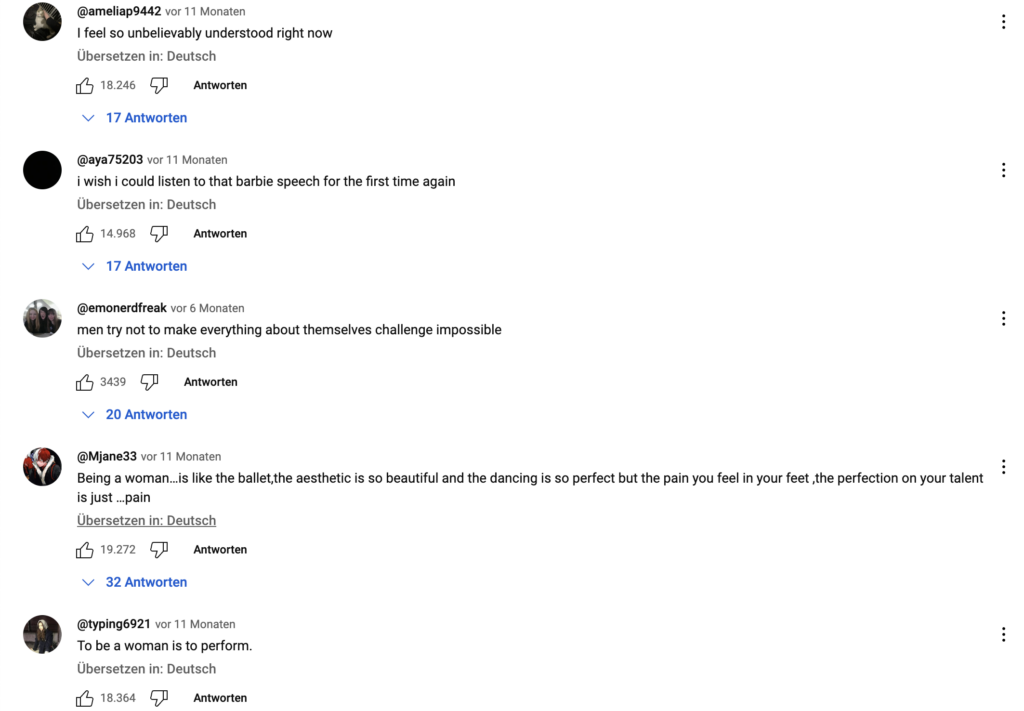
As I was looking for inspiration one day I came across this video. These types of videos are not a new way of editing or portraying female rage/ female experiences. These „Fan edits“ are video clips that are edited together in a video with an underlying message. In this case: the portrayal of what it means to a woman. These Fan often consist of recognisable dialogues from movies, as well as music that deals with the topic in its lyrics. If you scroll through tiktok and searhc female rage, you will stumble upon many videos that consist of these features. Dialogues from „Barbie“, „Black swan“, „Hidden Figures“ are often used to portray these feelings. There even is a whole genre that fits into these categories. Songs like „Labour“ by Paris Paloma or „Abbey“ by Mitski are often used for these edits.

Scolling through the comments under this video showed once more that this is not a individual phenomenon. Girls are raised in the patriarchy to become a woman. The idea of a woman in the patriarchy is an idea that no one can live up to. Therefore women often do not feel good enough.

Anya Taylor Joy is one of the many actors who spoke up about female age on set and film. She recons a scene in „The menu“ where she slaps her partner. This was not in the script – The script said that she sits silently while a tear is running down her face, even though her partner betrayed her and that would mean that she dies. More actors open up about their real feelings on set and let that also fit into their character on screen. Expressing emotions how they would feel is a way to change these norms and the scene.

THE CRAZY BITCH

One of the many trends on Tiktok as I said alfready id the rise of female rage. One of the starting points for this trend was a scene in the movie “Pearl” where the character played by Mia Goth gets rejected at an audition. Instead of claiming the rejection and leaving the stage she screams “Please! I’m a star!!!!!”. The edits of women in film in distress are flooding social media, espacially tiktok. They’re a series of clips compiled into a video where female characters are screaming venom through their tears. As the name suggests, they’re full of rage.

Often these emotional outbursts are a response to male characters or injustice.

These edits are followed by music like Lana Del Rey’s Pretty When I Cry, Mitski’s Liquid Smooth, Tchaikovsky’s Swan Lake. Music is one of the  key element in these edits that enhances the extreme emotions and blood-curdling screams. The most common films that appear in these edits are Pearl, X, Gone Girl, Jennifer’s Body, Don’t Worry Darling, and Thirteen – just to name a handful. 

The edits feature lines from these films that evoke strong emotions, such as: “It’s my life, you don’t get to take that from me,” “I work like a dog, day and night,” “Why are you leaving me if I didn’t do anything wrong? I don’t understand, I thought you liked me,” “What is wrong with me? What the fuck is going wrong inside my head,” “Where do you think I learned all this shit from?”

Extreme phrases like this would have once been shameful to relate to, yet now the comment sections are full of phrases like: “female rage is so powerful,” “she’s so me,” “I love women,” and “real.”

Sources: https://www.directhermag.co.uk/2024/05/31/female-rage-a-tiktok-trend-that-reclaimed-the-crazy-bitch-trope/