Impulse 08 // Electric Dreams

„Electric Dreams“ Kill All Others (Fernsehepisode 2018) – IMDb

For my final impulse blog post of the semester, I decided to re-watch one of my favourite episodes of the Philip K. Dick television series Electric Dreams, called Kill All Others, and analyse the role of technology and interfaces in this dystopia. The following is a short summary without spoiling too much, so you can still watch it yourself, which I highly recommend. The episode presents a future where mass media, consumerism and propaganda shape the perception of reality. It follows Philbert Noyce, a factory worker, in a world where a single political candidate dominates the media and spreads an ominous message: „Kill all the others“. While most citizens accept this statement without question, Philbert is disturbed. As he begins to notice disturbing details in his environment, such as the omnipresent holographic advertisements and growing social conformity, he realises that his scepticism makes him an outsider. His refusal to engage with voice-activated technology and his preference for tactile interactions highlight his resistance to blind conformity. But in a society where asking questions is dangerous, his refusal leads to his end. The episode explores themes of control through technology that are highly relevant to the study of Calm Technology and Tangible Interfaces. It presents an exaggerated version of our current digital landscape, offering valuable insights into the implications of technology in everyday interactions.

» Electric Dreams

In Kill All Others, consumerism is driven by holographic advertisements that are directly linked to products, creating an illusion of authenticity. These holograms interact with consumers as if they have real emotions, making the experience feel personal and engaging. However, these interactions are entirely artificial and designed solely to manipulate and persuade. This highlights a major problem with modern technology: the replacement of real human connections with simulated digital experiences.
Calm Technology aims to reduce this overwhelming presence of digital distractions by integrating technology more seamlessly into everyday life. Instead of bombarding users with aggressive notifications, advertising and emotional manipulation, Calm Technology prioritises subtle and meaningful interactions. Tangible interfaces could play a role in countering digital consumerism by encouraging real, physical engagement with products and services rather than relying on artificial digital interactions. For example, instead of a holographic assistant selling a product, a Tangible Interface could allow users to explore the features of an item through touch, movement or changes in texture, encouraging a more mindful and intentional relationship with technology.

In the episode, most of the world operates via voice-controlled routers, making interactions seamless but also impersonal. Philbert, however, continues to use tangible buttons, setting him apart from the majority. This reflects a critical discussion in interaction design: while voice control and other intangible interfaces offer convenience, they often remove the physical engagement that strengthens a user’s connection with technology. Tangible interfaces offer an alternative by maintaining the physicality of interaction. They provide feedback that is not only visual or auditory, but also tactile, giving users a greater sense of control. In the case of Kill All Others, Philbert’s reliance on tangible buttons can be seen as an act of defiance. He values the certainty that comes with physical interaction and resists the abstract nature of voice commands, which can be easily manipulated or misunderstood. This is closely related to Calm Technology, as tangible interactions allow users to remain in control without being overwhelmed by digital noise. A future designed with Calm Technology and Tangible Interfaces in mind could balance the convenience of voice control with the reliability of touch-based interactions. For example, rather than relying solely on voice assistants, smart home devices could incorporate physical interfaces that provide intuitive and non-intrusive ways to interact with technology.

One of the most striking ideas in Kill All Others is how Philbert is labelled „too tactile“, as if his preference for physical interaction is a flaw. His scepticism and reliance on touch makes him resistant to the influence of the media, as tactile perception is harder to fool. This reflects an important advantage of tangible interaction: it provides a direct and reliable form of engagement with technology.
In a world where digital information can be manipulated, a focus on tactile interaction could act as a safeguard against misinformation. For example, in Internet of Things (IoT) design, physical objects that translate digital messages into tangible experiences could help users process information in a more grounded and thoughtful way. Rather than overwhelming users with constant digital alerts, these interfaces could use subtle physical changes, such as changes in temperature or texture, to convey information. This would allow for a calmer, more meaningful interaction with technology, reducing the risk of mindless engagement and manipulation.

As is often the case, fiction can be a great source of inspiration and warning for many things in our time. So if you haven’t seen Philip K. Dick’s Electric Dreams series, I would strongly recommend that you do, because it visualises important issues and makes you think about what our future should look like.

Impulse #5

This semester I had the chance to work on a group project called Ghost Rider 2. It was one of the most fun and exciting projects I’ve been a part of, and it reminded me why I fell in love with the Unity game engine in the first place.

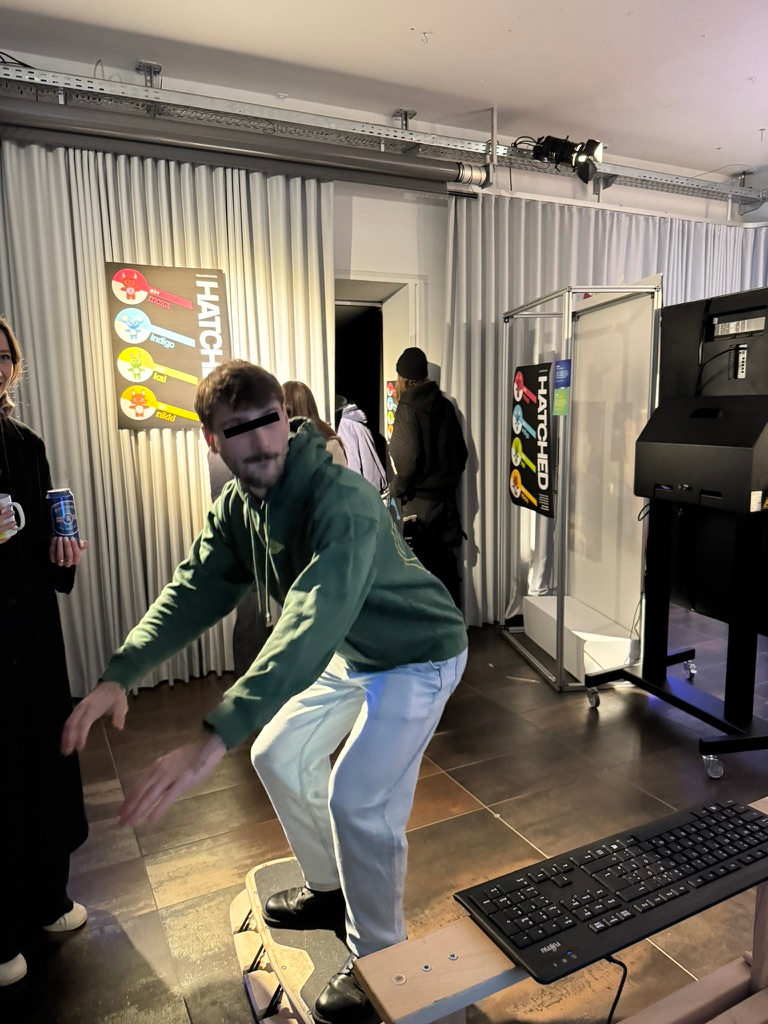
Ghost Rider 2 is an endless runner game set in a futuristic, dystopian city inspired by Tokyo’s neon-lit streets. The game has a low-poly art style, which gives it a unique and visually striking look. But what makes it really special is the way players control the game: instead of using a traditional controller or keyboard, they stand on a wooden board with an Arduino sensor built into it. This physical interaction adds a whole new layer of immersion and makes the experience feel fresh and innovative.

Our main goal with Ghost Rider 2 was to create a game that looked stunning and felt polished. Since it was going to be displayed at the semester exhibition, we knew players wouldn’t have much time to learn complicated controls or mechanics. We focused on keeping the game simple and intuitive, while still making it visually impressive and fun to play. It was all about tone and polish—making sure the game felt good to play, even in short sessions.

This project was especially meaningful to me because it was a sequel to Ghost Rider 1, a game I worked on earlier. The first version was more of a typical “student project”—rough around the edges and not as polished. But with Ghost Rider 2, we were able to take everything we learned from the first game and create something much more refined and professional. It was amazing to see how far we’ve come as a team and how much we’ve improved our skills.

The development process was a lot of fun. Working with Unity again reminded me how powerful and versatile the engine is. From designing the cityscape to programming the Arduino integration, every step of the process was challenging but rewarding. Seeing the game come together, piece by piece, was incredibly satisfying.

I’m really proud of what we achieved with Ghost Rider 2. It’s not just a game—it’s a testament to the power of teamwork, creativity, and iteration. It’s also a reminder that sometimes, the best projects are the ones where you focus on the basics and make sure every detail feels right.

IMPULSE #5 – CoSA – Center of Science Activities

One day when I had free time, I decided to visit CoSA – Center of Science Activities in Graz, as it’s a great source of inspiration for presenting information in an engaging and interactive way. CoSA is an interactive science center that offers an exciting experience by combining science, technology, and creativity. The museum is designed to spark curiosity and a spirit of exploration among visitors of all ages, though it is primarily tailored to children. Its exhibitions encourage active participation through hands-on activities and experiments. The museum’s spaces are divided into thematic areas such as sustainability, biology, physics, and technology. What stood out to me was the diversity of exhibits and the numerous forms of interaction. Some are simpler than others, but all are equally fun and engaging. After consulting with my professor at my home university, I decided to steer my thesis topic toward children and nature-based education.

CoSA_Sustainability

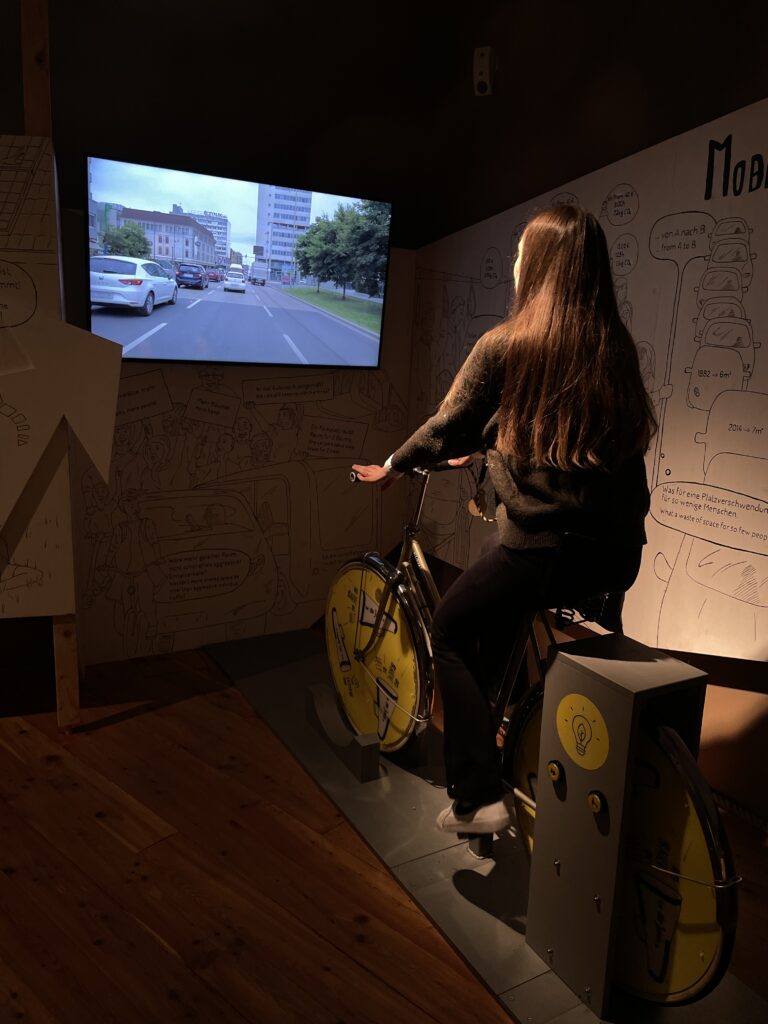
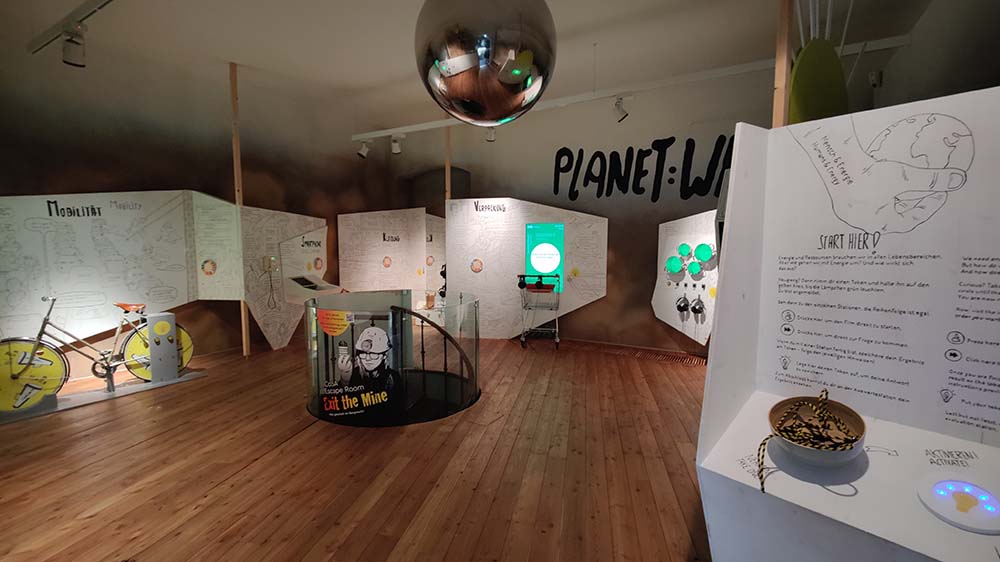
The first area I visited was CoSA_Sustainability, where visitors can learn about climate, resources, and sustainability. At the start, each visitor takes a „card“ on which they can collect results and information throughout the exhibition. The space features seven stations that provide information through games, informative videos, and audio recordings, covering topics such as energy, mobility, smartphones, clothing, packaging, nutrition, and leisure activities. After gathering information at each station, visitors have the option to answer questions based on their personal actions. For example, one question asks whether you mostly buy new clothes or second-hand, and you record your response. At the end of the exhibition, you scan your card with all your answers, and the system provides an overview of how your actions impact the environment and why. It also allows you to compare your results with those of others.

I found this approach particularly interesting, even though I already knew much of the information presented. The exhibition helped me reflect on how to present information, especially to children. I really liked the concept of comparing your actions to their environmental consequences and what is considered optimal behavior. Often, people feel attacked when told that their actions are harmful and need to change, but this method allows them to draw their own conclusions and independently decide whether they want to continue their habits or make changes. I concluded that this „play – decide – learn – compare“ approach could also be highly effective in nature-based schools as a method for fostering critical thinking.


CoSA_Experimentarium & Technology

The other two sections – experiments and technology – immerse visitors in a wide range of diverse interactions. The section on experiments was particularly captivating, as it covered various topics in physics. For instance, there’s an activity where you strike a large drum to observe the movement of air, alongside exhibits on color theory, perception, and types of electromagnetic radiation. It’s fascinating how such an approach can draw people into topics they might not initially find interesting. One example that stood out was an exhibit where visitors could learn about the essential parts of a car and how they fit together. The room features a car frame, and participants must place all the components in the correct spots, such as headlights or steering wheels. Once assembled, the car can be driven in a simulation. This interactive and tangible approach provides both a sense of accomplishment and a deeper understanding of the topic. I believe the combination of digital screens and physical experiences in this museum was perfectly balanced. The museum manages to blend technology with hands-on activities in a way that makes learning both immersive and enjoyable. It truly invites you into a world of discovery and exploration.

CoSA is a world unto itself, where time seems to stand still. This experience left a strong impression on me, inspiring me to think about the learning process in new ways. It also made me reflect on the story my design will tell and the world it will create for users. Much like the museum, I want my projects to be engaging, surprising, and capable of transporting users into another world.

IMPULSE # 8: Insights from Jeff Sutherland’s Scrum Framework

IMPULSE # 7: Lessons from Tony Fadell’s TED Talk on Design

IMPULSE #6 : Practical Applications of Lean UX

In practical terms, I’ve already started incorporating these Lean UX strategies into my research. This ensures that every iteration of ONTEC’s UI reflects real-world usage patterns and solves actual problems faced by its users.

https://jeremybird276.medium.com/implementing-lean-ux-in-the-real-world-8aa7ca880e54

IMPULSE # 5: Building Value Through Lean Product Development

IMPULSE 4#: Insights from the AVL 2025 Sales Conference

Throughout the conference, I had the opportunity to speak with several salespeople who use ONTEC in their day-to-day work. Their feedback was invaluable in shaping my understanding of the app’s strengths and areas for improvement. Here are some of the insights I gathered:

Impulse #07: CoSA

CoSA Energy Space
Links

CoSA: https://www.museum-joanneum.at/cosa-graz

All or Nothing: Tottenham Hotspur – IMPULS #7

Ich analysiere die erste Episode der Dokumentarfilmserie „All or Nothing: Tottenham Hotspur“ von Amazon Prime Video aus dem Jahr 2020. Was kann ich aus der Dokumentarfilmserie für meinen eigenen Dokumentarfilm mitnehmen?

Hier sind meine Learnings:

  • Positive und negative Momente am Anfang zeigen, um Spannung aufzubauen.
  • Erkenntnis: Man kommt fast nicht um einen Sprecher oder eine Sprecherin herum. Sonst können die Zuschauenden dem Geschehen schwer folgen.
  • Idee: Ein Training lang mit Zeitraffer das Spielfeld filmen.
  • Das Team im Nachhinein zu den Spielen zu interviewen, um ihre Kommentare dann über das Footage vom Spiel zu cutten.
  • Ein Shot, wie die Spielerinnen durch die Umkleide bzw. den Gang nach draußen gehen.
  • Ein Shot, wie die Spielerinnen Pause machen (Wasser trinken).
  • Idee: Einen Sonnenuntergang am Spielfeld filmen.