Evaluation of Master’s Thesis

Evaluation of Master’s Thesis related to own research area ( UX, Eye tracking, User testing, improving conversion rates)

Title: The Role of Visual Attention and Eye Movements in Product Purchases on Websites
Author: Tommaso Ceroni
University: Utrecht University, Department of Social and Behavioral Sciences
Master’s Degree Course: Applied Cognitive Psychology

  1. Level of Design: The design is straightforward and effective but lacks creativity and complexity, which might have added interest or depth to the reader. The structure is clear and has predictable composition which may feel overly simplistic and even a bit dry for readers familiar with the field. The design quality could be significantly enhanced by incorporating more detailed schemes and sketches, which could increase its visual appeal.
  2. Degree of Innovation: The research is original to the extent that it goes further with how visual attention and decision making has been researched previously by looking at e-commerce situations. Nevertheless, the contribution could be increased by including different consumer characteristics (for example: how used they are to shopping online) or by manipulating other web page elements beyond product labels.
  3. Independence: The thesis shows a high level of of independence, as the author has designed the study, collected data, analyzed results, and interpreted findings. The author demonstrates the ability to manage the research process and and make reasoned deductions from the results obtained.
  4. Outline and Structure: The thesis is well-organized and follows a clear, logical structure. It includes all essential sections (introduction, methods, results, discussion) and maintains coherence throughout, and there is no inconsistency that would make it difficult to follow the content.
  5. Degree of Communication: The author communicates ideas effectively, with clarity in the description of methods and findings. Pertaining to the relationship of cognitive psychology to eye tracking, relevant concepts are well covered, however some terminologies used in this area (i.e. fixation duration, AOI) might require more explanations and/or pictures.
  6. Scope of the Work: The study scope is appropriate for a master’s thesis, focusing on a specific aspect of consumer behavior through a manageable experiment. In as much as the sample is rather small, the research scope is in harmony with the goals of the project and provides relevant information.
  7. Orthography and Accuracy: The thesis has a few minor grammatical errors. Despite these minor issues, the thesis demonstrates overall good orthographic standards and accuracy.
  8. Literature: The author draws on a strong foundation of relevant literature, particularly focusing on studies related to eye-tracking, attention, and decision-making. The references are appropriate and support the research questions, although including more recent studies on e-commerce or consumer behavior would strengthen the review.
STÖCKEL_Blog Entry for U.Lagger-Course

Evaluation of master’s thesis – Create a blog entry

Evaluate critically a master’s thesis/diploma thesis from your own research area submitted to a foreign or Austrian university/university of applied sciences (no thesis written at FH JOANNEUM).

Evaluate the thesis according to the following criteria: 
1. Level of design 
2. Degree of innovation 
3. Independence 
4. Outline and structure
5. Degree of communication 
6. Scope of the work
7. Orthography and accuracy 
8. Literature

Evaluation der Thesis

Begründung der Auswahl

Nach mehr als fünf Jahren im Rettungsdienst und Krankentransport war meine Sensibilität für Senior:innen und insbesondere dem Alterungsprozess und dem damit verbundenen degenerativen Muskelverfall und schwindenden Allgemeinfitness schon früh geweckt. Dementsprechend fand ich dann später auch in meiner Ausbildung zur Fitnesstrainerin dieses Thema besonders interessant. Aktuell arbeite ich daher als Nebenjob in einem Fitnessstudio, in dem vermehrt ältere Damen trainieren, wodurch für mich einmal mehr das Thema sportliche Aktivität und deren Einfluss auf den Alterungsprozess relevant wurde. Daher habe ich mich auch schon im ersten Semester, während meiner Themenfindung und Recherche zum Master, mit dem Thema beschäftigt, wie ältere Personen spielerisch und sanft zum Kraftsport motiviert werden können, insbesondere dann, wenn sie bereits körperliche Einschränkungen aufzeigen. Aus diesem Grund habe ich mich nun auch für die Aufgabe der Evaluation einer Masterthesis, die an einer anderen österreichischen Uni oder Hochschule als der FH Joanneum eingereicht wurde, für die Diplomarbeit „Motivationale und volitionale Prozesse zu sportlicher Aktivität bei älteren Menschen im Altersheim und deren Veränderung durch ein Krafttrainingsprogramm“ entschieden, die 2013 von Verena Nadlinger, im Rahmen ihrer Magistra der Naturwissenschaften (Mag.rer.nat.), verfasst wurde. 

Evaluation

  1. Level of design 
    Da es sich bei der Diplomarbeit um eine wissenschaftliche Arbeit handelt, die weit vom Designbereich entfernt ist, ist auch die gestalterische Ausarbeitung dementsprechend „wissenschaftlich“ gehalten. Der Aufbau der Inhalte jedoch ist gut strukturiert und schlüssig. Insbesondere positiv aufgefallen ist mir beim Aufbau das Kapitel „Begriffe“, in dem zu Beginn der Thesis alle relevanten Begriffe einmal genau definiert werden, um so sicherstellen zu können, dass alle Lesenden das gleiche Verständnis dessen haben, was ein Begriff bedeutet, wie auch die Autorin selbst.
    Zudem stellt die Autorin eine ausführliche und klare Forschungsfrage auf und führt anschließend eine Untersuchung durch, anhand derer sie ihre Forschungsfrage belegt und die Ergebnisse wissenschaftlich untermauern kann.
  2. Degree of innovation 
    Die Arbeit ist innovativ in ihrem spezifischen Fokus auf motivationale und volitionale Prozesse im Kontext von älteren Menschen, die in Altersheimen leben und an einem Krafttrainingsprogramm teilnehmen. Diese Perspektive ist in der wissenschaftlichen Literatur weniger erforscht, da der Schwerpunkt oft auf jüngeren oder gesünderen Bevölkerungsgruppen liegt. Durch die empirische Analyse spezifischer motivations- und willensbezogener Prozesse trägt die Arbeit dazu bei, eine Lücke im Wissen über Gesundheits- und Bewegungsförderung in Altersheimen zu schließen. Die Verfasserin verwendet das Active-Ageing-Programm als innovativen Rahmen, um die Einflussfaktoren und Herausforderungen für die sportliche Betätigung dieser spezifischen Gruppe zu untersuchen. Dies ist besonders relevant in Hinblick auf die zunehmende Bedeutung von Gesundheitsförderung im Alter und der Verlängerung der Selbstständigkeit im hohen Alter.
  3. Independence 
    Die Arbeit zeigt eine hohe Eigenständigkeit, besonders im Bereich der empirischen Forschung. Die Verfasserin hat nicht nur eine eigene Forschungsfrage formuliert, sondern auch einen spezifischen Fragebogen entwickelt, der auf die Bedürfnisse und Gegebenheiten der Zielgruppe älterer Menschen in Altersheimen abgestimmt ist. Sie hat alle Phasen des Forschungsprozesses – von der Konzeption über die Durchführung der Befragungen bis hin zur Analyse der Daten – eigenständig gestaltet und durchgeführt. Die detaillierte Beschreibung des methodischen Vorgehens, einschließlich der Datenerhebung und -analyse, zeigt, dass die Autorin in der Lage war, eigenständig eine wissenschaftliche Untersuchung durchzuführen und die Ergebnisse zu interpretieren.
  4. Outline and Structure
    Die Arbeit ist gut strukturiert und folgt einem klaren und logischen Aufbau. Sie beginnt mit einer Einführung in das Thema, gefolgt von einem umfassenden Überblick über theoretische Konzepte und Modelle, die für das Verständnis von Motivation und Volition im sportlichen Kontext relevant sind. Nach der Darstellung des theoretischen Hintergrunds werden die Zielsetzung, die Forschungsfragen und das Design des empirischen Teils präzise beschrieben. Die Ergebnisse sind systematisch in Kapitel gegliedert und folgen einer logischen Abfolge, die auf die unterschiedlichen Phasen des Trainingsprogramms Bezug nimmt. Die Interpretationen sind ebenfalls strukturiert und bieten klare, nachvollziehbare Schlüsse basierend auf den Ergebnissen. Die Arbeit endet mit einer Schlussfolgerung, die auf die praktischen Implikationen der Ergebnisse hinweist. Die Struktur unterstützt den Leser darin, der Argumentation und den Forschungsfragen durchgehend zu folgen.
  5. Degree of Communication
    Die sprachliche Darstellung ist sachlich und präzise, was der wissenschaftlichen Qualität zugutekommt. Fachbegriffe, insbesondere aus der Psychologie und den Sportwissenschaften, werden gut erklärt, was zeigt, dass die Verfasserin ihre Leser in die Lage versetzen möchte, den Inhalt unabhängig von deren Fachkenntnissen zu verstehen. Die wissenschaftliche Ausdrucksweise bleibt konsistent, und die Verfasserin zeigt ein hohes Maß an Sorgfalt im Umgang mit Sprache und Fachterminologie. Die komplexen Prozesse rund um Motivation und Volition werden anschaulich und verständlich dargestellt, wobei sie theoretische Konzepte gut in Bezug zum praktischen Kontext der Zielgruppe setzt. Insgesamt wird ein hohes Maß an wissenschaftlicher Kommunikation erreicht, das sich durch Klarheit und Zugänglichkeit auszeichnet.
  6. Scope of the Work
    Die Arbeit umfasst eine breite und tiefe Untersuchung, die sowohl theoretische als auch empirische Aspekte des Themas abdeckt. Die Verfasserin beleuchtet umfassend die psychologischen, sozialen und motivationalen Faktoren, die ältere Menschen beeinflussen, wenn es um ihre sportliche Betätigung geht. Der empirische Teil erstreckt sich über mehrere Themenbereiche und analysiert sowohl die individuellen Motivationen als auch die gruppendynamischen Aspekte innerhalb des Trainingsprogramms. Dabei werden verschiedene Modelle (z.B. Rubikon-Modell, MoVo-Modell) genutzt, um die Prozesse zu verstehen und zu beschreiben. Die detaillierte Auswertung des Fragebogens und die sorgfältige Interpretation der Ergebnisse zeugen von einem hohen Anspruch an die wissenschaftliche Tiefe und Genauigkeit. Der Umfang ist daher angemessen für das Thema und bietet eine differenzierte Sicht auf die Problematik der sportlichen Aktivität im Alter.
  7. Orthography and Accuracy
    Die Arbeit ist weitgehend frei von Rechtschreib- und Grammatikfehlern, was auf eine sorgfältige Korrektur hindeutet. Fachterminologie wird korrekt verwendet und präzise definiert. Die Genauigkeit der Darstellung zeigt sich auch in der korrekten Zitation und dem strukturierten Quellenverzeichnis, das den wissenschaftlichen Standard erfüllt. Die Verfasserin hat mit hoher Genauigkeit gearbeitet und sowohl methodische Schritte als auch empirische Ergebnisse nachvollziehbar dokumentiert. Orthografische und grammatische Sorgfalt tragen wesentlich zur Lesbarkeit und Professionalität der Arbeit bei.
  8. Literatur
    Die Arbeit stützt sich auf eine breite und fundierte Auswahl an Literatur aus verschiedenen relevanten Fachgebieten, insbesondere aus der Motivationspsychologie und der Sportwissenschaft. Die Verfasserin hat sowohl klassische als auch aktuelle Quellen verwendet, um ein umfassendes theoretisches Fundament zu schaffen. Die Zitation ist korrekt und vollständig, und die Quellen werden gezielt eingesetzt, um die Argumentation zu stützen. Das Literaturverzeichnis ist gut strukturiert und beinhaltet sowohl wissenschaftliche Bücher und Zeitschriftenartikel als auch relevante Studien und Forschungsergebnisse. Dies zeigt, dass die Verfasserin sich intensiv mit dem Thema auseinandergesetzt und die relevanten wissenschaftlichen Arbeiten in ihre Analyse integriert hat. Die umfassende Berücksichtigung der Literatur trägt dazu bei, die theoretische Tiefe der Arbeit zu sichern und sie im wissenschaftlichen Diskurs zu verankern.

Fazit

Die Diplomarbeit von Verena Nadlinger zeigt eine umfassende und methodisch solide Analyse motivationaler und volitionaler Prozesse bei älteren Menschen in Altersheimen, die an einem Krafttrainingsprogramm teilnehmen. Durch ihren innovativen Fokus auf diese spezifische Zielgruppe und das gezielte Einsetzen empirischer Methoden, schließt die Arbeit eine bemerkenswerte Forschungslücke. Die Verfasserin hat die Thematik klar strukturiert und fundiert aufgearbeitet und sich dabei intensiv mit den individuellen und sozialen Einflussfaktoren auf die sportliche Aktivität im Alter auseinandergesetzt. 

Die eigenständige Durchführung des Forschungsprojekts und die Entwicklung eines maßgeschneiderten Fragebogens zeigen ihre Selbstständigkeit und das wissenschaftliche Niveau ihrer Arbeit. Die Ergebnisse sind nicht nur für die wissenschaftliche Forschung im Bereich Motivation und Gesundheitsförderung im Alter relevant, sondern liefern auch wertvolle praktische Ansätze zur Unterstützung älterer Menschen bei der Überwindung von Hürden im Bereich sportlicher Betätigung. 

Insgesamt beeindruckt die Arbeit durch ihre sprachliche Präzision, inhaltliche Tiefe und Sorgfalt und bietet einen wertvollen Beitrag zur Erforschung der Gesundheitsförderung und Selbstständigkeit älterer Menschen in Heimen.

Evaluation of Master Thesis – Down the Rabbit Hole: Visualizing Linguistic Distance and Relationships with Alice in Wonderland

Author: Yi-Chia Cheng
TitleDown the Rabbit Hole: Visualizing Linguistic Distance and Relationships with Alice in Wonderland
Publication: Boston, November 2019
Institution: Northeastern University, Department of Art + Design
Study Program: Information Design + Visualization


Level of Design:
The design of this thesis stands out for its attention to detail and creativity. She uses visually appealing elements like color-coded charts and phonetic mappings, which help make complex linguistic ideas feel approachable. 

Degree of Innovation:
I find the topic very innovative, as Cheng goes beyond traditional ways of visualizing language relationships, such as family trees, and creates new visual methods. Using Alice in Wonderland as a shared text across different languages adds a unique touch and gives a clear reference point for the comparisons.

Independence:
Cheng clearly worked independently, especially with the custom visual tools and color-coded notation system they developed for the analysis. This creative approach goes beyond the standard methods and shows Cheng’s ability to think critically and come up with their own solutions.

Outline and Structure:
The structure of the thesis is clear and flows well. It starts with an introduction and research background, then moves into a case study that breaks down the language comparisons. Each section logically builds on the previous one, making it easy to follow. However, I think some of the visuals could use a bit more explanation to make them clearer for readers who aren’t familiar with linguistics.

Degree of Communication:
Overall, she communicates their ideas well. I like that they use Alice in Wonderland to make the research more accessible and relatable. 

Scope of the Work:
The scope feels ambitious, covering both phonetic and syntactic comparisons across ten languages. This is impressive, but focusing on fewer languages might have allowed for a deeper analysis of each. Still, Cheng does a thorough job within the chosen scope.

Orthography and Accuracy:
The writing seems polished, with no obvious spelling or grammar errors, and Cheng uses technical terms accurately. I did feel that a bit more explanation of certain terms could make the thesis easier for non-expert readers.

Literature:
Cheng includes a solid range of literature, drawing on sources in linguistics and language visualization. I noticed a good mix of both older foundational works and more recent sources. However, adding some more recent studies on visual communication might have given additional depth.

Source: https://repository.library.northeastern.edu/files/neu:m0455c25q/fulltext.pdf

Evaluation of Master Thesis

„Was kaufen wir da eigentlich?“

Bachelorarbeit von Frau Helena Seel

Thema: „Beeinflussung der Kaufentscheidung durch den Einsatz von Bildbearbeitung im Bereich Lebensmittel“ 

  1. Gestaltungshöhe: Die Arbeit zeichnet sich durch eine klare Struktur aus. Die grafischen Elemente und Diagramme unterstützen die Analyse der Konsumentenentscheidungen, könnten jedoch visuell ansprechender gestaltet sein, um die Ästhetik der Forschungsarbeit zu erhöhen.
  2. Innovationsgrad: Die Arbeit bearbeitet ein relevantes Thema im Bereich Konsumentenverhalten und Bildbearbeitung. Auch wenn das Thema praxisrelevant ist, bleibt der Innovationsgrad begrenzt, da vorwiegend bestehende Theorien und bekannte Methoden zur Anwendung kommen.
  3. Selbstständigkeit: Die selbst durchgeführte Online-Befragung sowie die Auswertung mittels EFS Reporting zeugen von einem selbstständigen Ansatz und einem klaren Forschungsziel.
  4. Gliederung und Struktur: Die Arbeit ist logisch gegliedert. Der theoretische Hintergrund und die empirische Untersuchung werden klar voneinander getrennt und übersichtlich dargelegt.
  5. Kommunikationsgrad: Die Arbeit ist sprachlich gut verständlich und vermittelt die Inhalte anschaulich. Gelegentlich könnten Fachbegriffe weiter ausgeführt werden, um auch Leser ohne Vorwissen im Bereich Konsumentenverhalten anzusprechen.
  6. Umfang der Arbeit: Mit etwa 50 Seiten entspricht der Umfang einer typischen Bachelorarbeit. Die Arbeit behandelt alle relevanten Aspekte, könnte jedoch um weitere empirische Details ergänzt werden, um eine tiefere Analyse der Ergebnisse zu ermöglichen.
  7. Orthographie, Sorgfalt und Genauigkeit: Die Arbeit ist überwiegend sorgfältig geschrieben, weist jedoch einige Rechtschreibfehler auf.  Stellenweise könnten die Formulierungen jedoch präziser sein, um Missverständnisse zu vermeiden.
  8. Literatur: Die Literatur ist umfassend und deckt die zentralen Werke zum Thema Konsumentenverhalten ab. Einige aktuelle Studien hätten jedoch ein stärkeres Gewicht auf den neuesten Stand der Forschung gelegt.

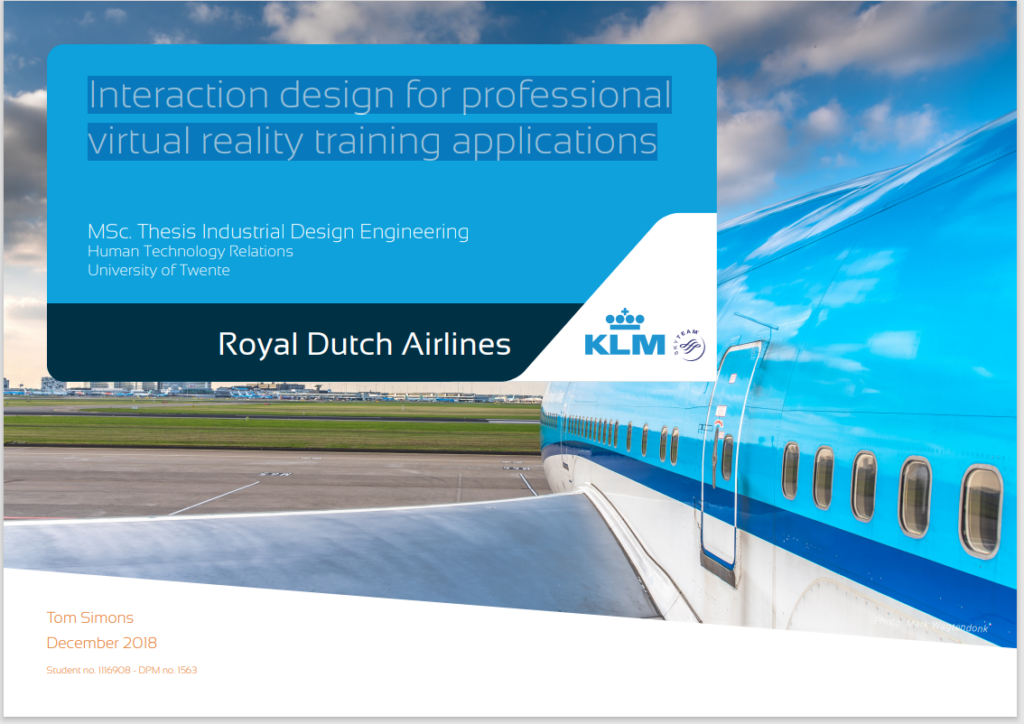
Evaluation of the “Interaction design  for professional virtual reality training  “ MSc. Thesis Industrial Design Engineering Human Technology Relations University of Twente

Thesis Overview

Author: Tom Simons

Title: Interaction design for professional virtual reality training applications

The world of professional training is evolving, and Virtual Reality (VR) stands at the forefront of this transformation. In my exploration of good solutions that suits my thesis, I came across an intriguing master’s thesis by Tom Simons, which focuses on the application of VR in training KLM Royal Dutch Airlines’ cabin crew. This research not only shows the way for a more immersive training environment but also sets a benchmark for future training technologies.

 Level of Design:

Simons’ thesis demonstrates a meticulous approach to interaction design, focusing on optimizing the user experience in a virtual environment. By developing a VR model specifically tailored for cabin crew training, Simons highlights the potential of VR to enhance learning outcomes through realistic, engaging scenarios that mirror actual in-flight challenges. For your UX in AR training, emphasizing user feedback loops and iterative design could be beneficial, particularly in adapting AR interfaces to user needs in real-time, enhancing learnability and usability.

    Degree of Innovation:
    The project stands out for its innovative use of VR technology to simulate training environments that are logistically challenging and costly to replicate in real life. Simons’ work introduces a shift from traditional methods to a virtual setup where trainees can practice and master their skills in a controlled, replicable, and safe environment, showcasing a significant leap in training technology.

    Outline and Structure:
    The thesis is well-structured, meticulously detailing each phase of the project from the initial orientation of VR within KLM to the final testing and future implications. This clear, logical structure not only aids in comprehending the complex technologies involved but also in appreciating the systematic approach taken to achieve the project goals.

    Clarity in Communication

    Simons excels in communicating complex ideas clearly and effectively, making extensive use of diagrams, prototypes, and real-world testing scenarios to ensure that the concepts are easily understandable. This level of clarity is crucial when dealing with advanced technologies like VR, where the ease of understanding can significantly impact the technology’s adoption.

    Independence:
    What impressed me about Simons‘ work is the level of independence in the execution of his project. From conceptualization to the final testing phase, Simons displayed profound initiative and leadership, guiding the project towards a successful implementation

    Scope and Depth

    The scope of Simons’ research is ambitious yet focused, addressing specific training needs within KLM and exploring the broad capabilities of VR in professional training. The project not only assesses the current state of VR training but also explores its future potential, providing a comprehensive overview of its application in professional settings.

    Orthography and Accuracy:
    With few typos or grammatical errors, the thesis exhibits a high degree of orthographic accuracy. Proofreading with attention to detail demonstrates a dedication to academic rigor. To guarantee the highest level of professionalism, a final review that concentrates on technical terminology and consistency in language use would be helpful.

    Literature and Research Depth

    Simons’ research is underpinned by an extensive review of relevant literature, providing a solid theoretical framework for the project. This robust foundation is crucial for validating the research outcomes and positioning the study within the wider context of VR technology advancements.

    Tom Simons’ thesis not only contributes valuable insights into the use of VR in training but also inspires further research in this field. As I embark on my own journey to explore UX in AR training within the industrial sector, the lessons drawn from Simons’ research will undoubtedly influence my approach, encouraging a user-centric design and innovative application of emerging technologies.

    I have learned about the tools in Virtual Reality. What is the biggest challenge for creating interaction for those technologies. Even if my topic is more on AR something different from VR; Those technologies are quite similar as they mostly involve immersion. Seingg Simon’s work gave me a hint on how o structure my own work and also know some use cases to refine my topic.

    Source : https://essay.utwente.nl/77093/1/Simons_MSc_ET.pdf

    21 | Evaluation of master’s thesis

    IMPACT #2

    UX Workshop with E1, 15.10.2024

    About the Event

    In unserem UX Workshop mit E1 hatten wir drei verschiedene Themen zur Auswahl. Nachdem wir uns in Kleingruppen für ein Thema entschieden hatten, durften wir an unseren Themen arbeiten. Mit Hilfe verschiedener Designmethoden erarbeiteten wir unterschiedliche Lösungen für die gestellten Designprobleme.

    Bei unserem Thema ging es darum, dass der Installationsprozess von Solaranlagen für den Kunden kompliziert und undurchsichtig ist. Teilweise müssen die Kunden bis zu 3 Monate warten, ohne zu wissen warum. Ziel des Workshops war es daher, eine Lösung zu entwickeln, diesen Prozess transparenter zu gestalten.

    Outcome

    Our approach is therefore to develop a diagram that makes it clear from the very first contact between the customer and E1 which steps are necessary both directly at the customer’s premises and in the background in order to install a solar system. In addition to a diagram, an explanatory video or a podcast would also be conceivable, with which the details can be visualized and explained even better, so that as few questions as possible remain unanswered for the customer from the outset.

    We also want to optimize communication with the customer by automatically informing them by e-mail as soon as a new step begins. Conversely, if the customer needs to contact E1, it should be as easy as possible for them to get in touch with support. The scheme described above should take the customer directly to the right contact person. They can either use a button to contact the right person or report a problem online.

    In summary, we want to optimize the entire customer communication process to such an extent that the customer no longer sees the need to contact support, as they no longer have any unanswered questions. The only source of information should be the website/web app, which everyone involved can access, keeping communication and support as simple as possible.

    Reflection/ Key Takeaways

    The most exciting thing about this workshop for me was to see once again how much you can achieve in such a short time. Apart from that, I also found it exciting to see how different the results of the individual groups were, despite the fact that we were all given very similar starting situations. This shows me once again how differently each and every one of us thinks and how important it is to exchange ideas and visions in a team. This is particularly important in the design process, as you can build on each other’s ideas and find solutions by combining the ideas of everyone involved that you would never have seen as an individual.

    Another exciting point for me was to see what came out of the visualization of our ideas. We had already talked about our ideas for a few hours, but when it came to recording them, we were amazed to realize that we all had different “pictures” in our heads. This showed me once again how important prototypes are to make sure that everyone is on the same page and really talking about the same thing.

    Translated with www.DeepL.com/Translator (free version)

    Impact on my Thesis

    My takeaway from this workshop for my thesis is that more than one person is often useful for the design process. Many design methods simply don’t work alone. Since I will be writing my thesis alone, it would therefore be worth considering getting feedback from fellow students from time to time and/or organizing small group-internal “workshops” in which everyone can bring their current problem and then try to find a solution together.

    Links

    IMPULSE #1

    Summer School Retail Design @Uni Hasselt

    About the Event

    As part of this program, around 20 students from the FH Joanneum, the Politecnico di Milano and the University of Hasselt had the opportunity to implement a retail design project together with the cooperation partner, the local clothing brand Hympala from Hasselt, in four small groups as part of the one-week “Retail Design” course.

    The course was mainly taught by Prof. Dr. Katelijn Quartier, who is an expert in retail design. Among other things, she founded the Retail Design Lab, a knowledge center at the Faculty of Architecture and Art at the University of Hasselt. Through the lab, she advises large and small retailers on how to create better and more experiential stores – including in the summer school. She was supported by her colleague Dr. Elisa Servais, also from Hasselt University, as well as Frederica Gaurnieri from Politecnico and Sigrid Bürstmayr from FH Joanneum.

    Over the course of the week, we not only received exciting input on the topic of retail design, we also learned about new methods, such as the bubble plan, which are used in retail design and were then able to apply them ourselves in our small groups.

    In addition to our classes, we went on several excursions. For example, one afternoon we visited the Hympala store in Hasselt, which we had to redesign as part of the summer school.

    On another day, we went on a retail safari to Antwerp. Here we were able to gather inspiration in various „showcase stores“ of well-known and lesser-known brands. Like at Hympala, it was often less about the products for sale and more about giving the customer a real shopping experience. Here are a few pictures showing my personal highlights:

    Outcome

    The goal of the week was to redesign the store of the local streetwear store Hympala. Hympala is a young company that wants to give young people a place to meet and talk about their hobbies and style. They already have a small coffee corner, but it gets lost in the current store design. They would like to expand this corner and are also thinking about different workshop concepts that they would like to bring more into focus.

    Therefore we have placed great emphasis on the Hympala workshop area and improved the general in-store-concept and the customer journey.

    Our concept was based on offering young creative wear enthusiasts a space where they can meet and exchange ideas. To this end, we placed great importance on Hympala’s first impression. We digitized the shop window and created a way for customers to interact with the brand.

    This „Mix&Match„-interaction gives customers the opportunity to digitally put together an outfit from all the items they can buy in the store and then try it on online. The outfit is then mapped to the customer using an AI and the customer has the option of having a Polaroid printed out of this digital outfit, sharing it online for rating in order to provide inspiration for other customers or having the outfit picked out by staff during opening hours and trying it on in real life or add them to your shopping cart on the Hympala website if the store is closed.

    Improved Hympala Shop Window | try Mix&Match yourself

    The outfits that are released for selection online can be rated. Once a month, the outfit of the month is chosen and is then displayed in the newly designed entrance area of the store, on the Hympala platform.

    View Final Presentation

    Reflection/ Key Takeaways

    Impact on my Thesis

    • New methods that can be applied
    • Design thinking also important here, general validity
    • here too, the focus during the design process is on the user

    Links

    Impulse #2 // World Usability Congress // Websites and Apps for Everybody – Making Accessibility Easy, Mari-Ell Mets

    On the second day of the World Usability Congress, the talk “Websites and Apps for Everybody – Making Accessibility Easy” by Mari-Ell Mets was the most interesting for me. Accessibility plays a major role in design – and probably also for my master’s thesis topic. The talk emphasised once again how important it is to integrate accessibility into the design of websites, apps and other digital interfaces. Accessibility is not just about usability, but also about creating an inclusive experience that accommodates users with different abilities. In this blog post, I will focus on the 10 key accessibility rules, which were presented, that address 80% of the most common issues in digital design and highlight their importance in creating a more inclusive user experience.

    The Importance of Accessibility

    Accessibility is vital for ensuring that digital products and services are usable by everyone, regardless of their abilities. An inaccessible website can lead to unhappy users, legal risks, and damage to a brand’s reputation. In contrast, accessible websites enhance usability, improve user satisfaction, and provide a better overall product. In my research, accessibility plays a key role in designing adaptive systems that meet the needs of all users, including those with permanent, temporary, or situational disabilities.

    The 10 Accessibility Rules to Fix 80% of Issues

    These 10 rules provide a practical framework for addressing the most common accessibility issues in digital design.

    1. No Moving Content
      Avoid animations or autoplaying sounds that users cannot stop. Moving content can be distracting and disorienting. Provide a stop button for any moving elements.
    2. Contrasted Colors
      Ensure sufficient contrast between text and background. Use at least 4.5:1 contrast for regular text and 3:1 for large text. This improves readability for users with visual impairments.
    3. Adapt to User’s Settings
      Respect user settings like font size or color scheme. Use relative font sizes (e.g., ems) and avoid overriding browser settings to give users more control over their experience.
    4. Support Keyboard Navigation
      Ensure your website or app can be fully navigated using just a keyboard. Avoid actions that require a mouse, such as drag-and-drop, and maintain a logical focus order.
    5. Make Focus Visible
      Always make the focus visible when navigating with a keyboard, so users can easily track where they are on the page. Avoid hiding focus styles.
    6. Specify Language in the Code
      Define the page’s primary language in the HTML code. If the language changes (e.g., a section in another language), update the code to reflect that.
    7. Info & Relationships
      What is visually presented must be structured in the code. Use proper heading tags, table tags, and list tags to ensure that screen readers convey content effectively.
    8. Name, Role, Value
      Properly label interactive elements (buttons, links) with name, role, and value to ensure screen readers can understand their purpose.
    9. Text Alternatives for Images
      Provide alt text for informative images to ensure users with visual impairments can understand the content. Decorative images should be marked appropriately to be ignored by screen readers.
    10. Clear Error Messages
      When users make errors, provide clear error messages with explanations on how to fix them. Ensure these messages are visible and readable by screen readers.

    Best Practices and Tools

    In addition to these 10 rules, regular testing with screen readers, keyboard-only navigation, and color contrast checkers is essential to ensure accessibility. Be cautious with accessibility overlay plugins, as they often provide only a superficial solution and may not fully address the needs of users. Instead, integrate accessibility directly into the design and development process.

    Conclusion: Accessibility is Fundamental

    The principles outlined in the 10 accessibility rules have significantly influenced my research on what can influence the interaction with interfaces, helping me focus on crucial factors such as user settings, keyboard accessibility, and color contrast. By applying these principles, I can design flexible and inclusive interfaces that meet the needs of diverse users while ensuring that the systems I develop are not only legally compliant but also empathetic to all users. Accessibility is fundamental for creating digital experiences that are usable by everyone, regardless of ability. These rules provide a strong foundation for improving usability, especially for users with disabilities, and will continue to guide my research on adaptive interfaces. By integrating accessibility into the design process, designers can create inclusive, adaptable systems that make the digital world a better place for all, ensuring a more comprehensive and enriching user experience for everyone.

    Links

    https://worldusabilitycongress.com
    https://www.twn.ee/en
    https://www.linkedin.com/in/mari-ell-mets/?originalSubdomain=ee