IMPULSE #5

Recently, I watched four TED Talks that all explored different aspects of storytelling. As someone interested in how interactive storytelling and design can help raise public awareness about complex issues, these talks were especially relevant to my research. Each speaker approached storytelling from a different angle, but they all underscored one powerful truth: stories have the ability to shape how we perceive the world, connect with others, and inspire action.

In this blog post, I’ll reflect on the key insights I gained from these talks and how they are influencing my thoughts on storytelling in education, empathy, and public engagement.

1. Salma Abdelrahman: „Empathy Through Storytelling“
Salma Abdelrahman’s TED Talk was deeply personal and focused on how storytelling can be used to create empathy, especially for marginalized groups. She recounted her experiences of discrimination as a Muslim American and explained how her involvement in the Student Voices panel, where students shared personal stories about discrimination, inspired her to take action. These stories grounded abstract issues like Islamophobia and homophobia into real, emotional experiences that resonated with her audience.

Abdelrahman’s main point was that storytelling has the power to bring difficult, often invisible struggles into the spotlight. It’s not enough to know what discrimination is in theory—when you hear someone’s personal experience, it humanizes the issue in a way that numbers or statistics never could. Her video project, Fabula Rasa, continues this work by collecting and sharing stories from diverse voices.

For my own research, this talk really reinforced the idea that empathy is central to storytelling. Whether I’m designing an interactive exhibit or thinking about ways to raise awareness about animal welfare, the goal should always be to create an emotional connection. If people can feel a personal link to an issue, they’re much more likely to take action. Abdelrahman’s emphasis on empathy will be a guiding principle as I continue developing my ideas for interactive storytelling.

2. Guy Godfree: „Storytelling: Empathy in Narrative Point of View“
Guy Godfree, a cinematographer, spoke about how narrative perspective can shape the way audiences experience a story. His TED Talk highlighted the importance of understanding whose story you’re telling, whose perspective it’s being told from, and the biases of the storytellers themselves. Godfree shared examples from his own work in film and television, explaining how these choices affect everything from camera angles to audience emotions.

One of the most compelling points Godfree made was when he discussed how changing a story’s perspective can completely alter its impact. He used the example of the classic Christmas movie Home Alone, suggesting how different it would feel if told from the perspective of the two burglars rather than the young boy defending his home. Suddenly, the villains might become sympathetic, and the story itself takes on a different tone.

This idea of perspective has sparked some new questions in my own research. Who is telling the story of animals in captivity? Is it the zookeepers, the conservationists, or the animals themselves? If we can shift the perspective to allow people to see the world through the eyes of animals, would that change how they view the ethics of captivity? Godfree’s talk reminds me that how we frame a story—whose voice we prioritize—can make all the difference in how people respond to it.

3. Mark Grimmer: „What’s Next for Immersive Storytelling?“
Mark Grimmer’s talk focused on the future of immersive storytelling and how technology is opening up new possibilities for narrative experiences. He shared how his design studio created immersive exhibitions, including one about David Bowie and another commemorating the Apollo 11 moon landing. What stood out to me was how Grimmer described the “collision of ideas” that happens when different disciplines—like architecture, music, and film—come together to create an immersive story.

Grimmer emphasized that while technology plays a big role in creating these experiences, the heart of the story should always come first. Technology is a tool to enhance the narrative, not the narrative itself. He also mentioned that immersive storytelling can bring people together, allowing them to feel like they’re part of something larger than themselves. The Apollo 11 exhibition, for example, recreated the scale and spectacle of the moon landing in a way that felt emotionally powerful, reminding audiences of a moment of collective achievement.

This talk inspired me to think about how immersive storytelling could be used in zoos, aquariums, or museums to help visitors connect more deeply with animals. What if visitors could experience the world from an orca’s perspective, moving through a vast ocean instead of seeing the animal in a small tank? Grimmer’s talk reminded me that by blending disciplines and using technology creatively, we can create powerful experiences that feel real and evoke strong emotions.

4. David JP Phillips: „The Magical Science of Storytelling“
David JP Phillips’ TED Talk was both entertaining and insightful, focusing on the neuroscience behind storytelling. He explained how storytelling can trigger the release of neurotransmitters like dopamine, oxytocin, and endorphins, which make us more focused, empathetic, and creative. Phillips referred to this combination of chemicals as the “angel’s cocktail,” contrasting it with the stress-inducing “devil’s cocktail” that we experience when we’re overwhelmed or anxious.

What fascinated me about Phillips’ talk was how deliberate storytelling techniques can actually manipulate our brain chemistry. For example, by building suspense or creating empathy for a character, we can increase dopamine or oxytocin levels, making the story more engaging and memorable. Phillips even shared practical tips on how to apply these techniques in everyday communication, from public speaking to presentations.

This talk got me thinking about how I can use functional storytelling in my own projects. Whether I’m designing an interactive exhibit or creating content to raise awareness about animal welfare, understanding how storytelling affects the brain could help make my messages more impactful. If I can build emotional connections between people and animals through storytelling, it might help foster more empathy and inspire positive change.

Conclusion: Storytelling as a Tool for Empathy and Engagement
Watching these TED Talks reminded me of just how powerful storytelling can be. Whether we’re trying to create empathy for marginalized groups, change people’s perspectives, or use technology to build immersive experiences, storytelling lies at the heart of it all. Each of these speakers highlighted a different aspect of storytelling, but they all shared a common belief: stories connect us.

As I continue my research, I’ll be thinking about how to apply these lessons to my own work. Whether it’s using empathy to raise awareness about animal captivity, experimenting with immersive technology to create more engaging experiences, or leveraging the neuroscience of storytelling to connect with audiences on a deeper level, these talks have given me a lot to think about.

Watch the talks here:
Empathy Through Storytelling | Salma Abdelrahman | TEDxYouth@Miami
Storytelling: Empathy in Narrative Point of View | Guy Godfree | TEDxPugwash
What’s Next for Immersive Storytelling? | Mark Grimmer | TED
The magical science of storytelling | David JP Phillips | TEDxStockholm

IMPULSE #1.6

Genealogy is a funny thing. We all say we want to know where we came from, but when it comes to actually documenting it, life gets in the way. That, and the realization that some of our ancestors weren’t as glamorous as we hoped. 

As part of my master’s thesis research, I sat down for a private conversation with my partner, Esad to discuss family stories, legacy, and how technology fits into it all. This was a personal discussion meant solely for research, and while I won’t be sharing the transcript or audio, I’ve gathered key insights that will help shape the genealogy app prototype I’m designing.

Given that Esad is a developer, I expected a pretty technical take on things, but what I got was a mix of pragmatism, nostalgia, and an interesting critique of current genealogy platforms. His thoughts confirmed some of my ideas, challenged others, and — most importantly — helped me refine what a modern family storytelling app should look like.  

The Digital Side of Family Legacy

Esad is as comfortable with technology as one can be — he literally builds digital tools for a living. When I asked if he’d be interested in preserving his family’s legacy, he didn’t hesitate: “Yes, but I don’t have time.” That, right there, is probably the biggest barrier for most people. We care about our history, but finding a way to document it in a meaningful way? That’s another story.

His approach to family history so far has been mental storage plus occasional notes. He started creating a partial family tree but never got around to completing it, mostly because there wasn’t a system that fit his needs. This was my first major takeaway:  

People don’t just need a place to store family history — they need an intuitive, engaging system that makes them WANT to do it.

Esad’s preference? A graphical family tree where clicking on a person reveals photos, stories, and personal memories. He wants a structured yet interactive way to engage with family history, not just a database filled with dates and names.  

Where Existing Genealogy Apps Fall Short

I asked if he had ever used MyHeritage or Ancestry, and his answer was a solid “Nope.” Not because they aren’t useful, but because they focus too much on DNA and historical records rather than actual storytelling.  

He pointed out two major flaws in these platforms:  

1. They overemphasize genetic data. While he appreciates the science behind DNA testing, he isn’t comfortable sharing biometrics with companies. Family history should be personal, not just another data point in a corporate archive.

2. They lack emotional connection. Genealogy isn’t just about tracing ancestors — it’s about preserving who they were, what they did, and the stories that made them unique. Most apps don’t provide enough space for personal anecdotes, traditions, or those little quirks that make families special.  

For Esad, the ideal genealogy app wouldn’t just store information — it would tell a story. MyHeritage gives you names and birth dates; he wants to click on a relative and see their favorite quotes, listen to a recorded story, or view old letters and recipes.

This was another key insight:  

A successful family history app should be more than a research tool—it should be a digital time capsule.

Accessibility and the “Grandma Factor”

We talked a lot about how different generations engage with technology, and this led to some interesting thoughts on accessibility.

When I asked if it was important for an app like this to be user-friendly for older generations, his response was clear: 

“It’s important, but I don’t see elderly people starting a family tree on their own.” 

Fair point. He believes younger and middle-aged users would drive the content creation, but there should still be an easy way for older family members to contribute. Instead of expecting them to build an entire profile from scratch, he suggested a simpler approach  like sending them a link where they can upload a photo or record a voice message without needing to navigate a complex layout.

This led me to a design realization:  

Make it easy for older family members to contribute, but don’t force them to use an overly simplified app that sacrifices functionality for younger users.

One fun idea? Customizing the user interface based on age. A younger user could have a full-feature experience, while an older user gets a streamlined layout focused on consuming and contributing stories in the simplest way possible — but that could be very tricky to implement.

Social Features vs. Privacy: Striking a Balance  

One of the more interesting points he raised was about not turning the app into Facebook.

While he likes the idea of tagging family members in photos or stories, he doesn’t want a system that pushes social interaction too aggressively. He prefers a passive discovery model, where he can click on a category (e.g., “Photography”) and see which relatives share that interest, rather than getting notifications that say, “Hey, your cousin also likes photography! Send them a message!”

Another big privacy concern? Direct messaging. He’d rather have a simple “request contact” feature instead of a built-in chat. This prevents the app from turning into yet another messaging platform while still allowing family members to connect.  

Key takeaway: Balance discovery with privacy — people should be able to find shared interests without feeling like they’re on a social media app.

Final Takeaways: What This Means for My App Prototype

This conversation was incredibly valuable for shaping my thesis and the genealogy app prototype I’m building. Esad’s insights confirmed that genealogy tools shouldn’t just be about archiving the past — they should make history feel alive.

Here’s what I’m taking forward into my design:  

1. Make storytelling a priority. A good family history app shouldn’t just collect names — it should preserve personalities.  

2. Simplify contribution for older generations. Offer an easy way for them to add stories without forcing them through a complicated tech process.  

3. Focus on engagement, not just data. A visual, interactive family tree makes history feel more dynamic and approachable.  

4. Keep privacy in mind. Avoid unnecessary social media elements and let users control how much they share.  

5. Use smart reminders. Instead of generic notifications, send personalized prompts based on family events or birthdays to encourage interaction.  

Conclusion

This wasn’t just a research interview — it was a conversation about what family history really means in a digital world. Esad’s thoughts helped me see where genealogy app prototype succeeds, where they fail, and how I can build something that truly matters. 

Ultimately, preserving family stories isn’t just about recording the past — it’s about creating meaningful connections in the present and future. The goal isn’t just to document history, but to bring families closer, one story at a time. 

And hey — if my app prototype helps people avoid the frustration of tracking down great-grandpa Johan’s *actual* last name, I’d call that a success.  

Selbstmarketing

In diesem Blog schreibe ich erstmals über Inhalte aus dem Buch „Anbieten ohne Anbiedern – Selbstmarketing für Kreative“ von Alina Gause. Alina Gause spricht in ihrem psychologischen Ratgeber über Selbstmarketing. Sie ist darstellenden Künstlerin. Über dreißig Jahre war sie als Schauspielerin und Sängerin berufstätig und absolvierte ein Psychologiestudium. Seit 2009 ist sie als Beraterin für Künster*innen tätig. Durch ihre einzigartige Biografie gibt sie einem einen neuen Blick auf die Selbstpräsentation von Selbstständigen Personen in der Kreativbranche. Schon nach dem Vorwort war ich von Gauses Werk fasziniert. Das Buch hat einen angenehmen Schreibstil, ist gut verständlich und trotzdem wissenschaftlich. 

Alina Gause spricht kreativen Personen eine hohe „affektive Schwingungsfähigkeit“ zu.1

Laut dem Arzt und Wissenschaftler Univ. Prof. Dr. med. Lukas A. Huber ist damit die Fähigkeit eines Individuums gemeint, ihre Stimmung und ihre Gefühle zu verändern und so auf Situationen zu reagieren.2

Gause macht diese hohe affektive Schwingungsfähigkeit neben positiven Effekten auch für Selbstsabotagen verantwortlich. Das Individuum stellt sich selbst in den Weg und entfaltet nicht sein volles Potenzial. Häufig tritt dieses Phänomen auf, wenn es um Selbstmarketing geht. Um auf Selbstmarketing einzugehen ist wichtig zu berücksichtigen, in welcher Beziehung kreative Personen zu dieser Thematik stehen.

„Selbstmarketing ist eng verbunden mit allen anderen Aspekten im Leben eines Künstlers oder einer Künstlerin. Man könnte sagen: Ohne Selbst kein Marketing.“4

„Ohne Selbst kein Marketing.“

Um eine eigene Marketingstrategie aufzubauen ist es wichtig beim Fundament anzufangen. Mit dem Schornstein zu beginnen ist laut Gauses Metapher nicht sinnvoll. Die persönliche Einstellung zum Selbstmarketing herauszufinden, bildet die Grundlage. Widerstände werden sichtbar gemacht und eine Grundhaltung entwickelt sich. Laut Gause braucht es eine stabile Grundhaltung, die einem selbst zum „partner in crime“ macht. Laut Alina Gause gibt es Strategien und Regeln, die einem zum persönlichen Erfolg verhelfen.5

Was ist Selbstmarketing?

Selbstmarketing bedeute laut Gause, dass man sich selbst und seine Kunst mit der Welt teilt und sie anbietet.

Der Einblicke in die Arbeits- und Lebensbedingungen in dieser Branche sind ausschlaggebend dafür, welches Marketing sinnvoll ist. Gause spricht von vielen positiven Entwicklungen in der Kreativbranche, seit sie 1985 in diese eingestiegen ist. Als positive Punkte nennt sie die bessere Vergütung für Musicalsänger*innen, das Vorhandensein von Intimacy-Coaches an Filmset und das Internet. Letzteres schafft eine Plattform für Künster*innen, um sich sichtbar zu machen und ihre Produkte zu verkaufen, ohne Konzerne dahinter. Viele Dinge stagnieren allerdings immer noch. Laut Gause können Kunstschaffende nur selten von ihren Einkünften leben. Außerdem sind sie besonders bedroht von Altersarmut. Erschöpfung und Labilität, was eigentlich Folgen von Überlastung sind, werden als Bestandteil des Künster*innenlebens gesehen. Demnach wird nicht gegen diese vorgegangen. Im Hochleistungssport bekommen Athlet*innen ein kompetentes Team zur Verfügung gestellt. Dadurch wird der Erfolg und die Leistung der Athlet*innen perfektioniert. Kreativschaffende müssen selbst ihr Team sein oder aus eigener Hand eines zusammenstellen. Strategisches Denken und Selbstfürsorge sind dabei von großer Bedeutung.7

Das Konzept der drei Persönlichkeitsanteile Kreativer

Kreative Menschen bringen laut Gause ein persönliches Kernteam mit. Es besteht aus der Privatperson, dem Künstler-Ich und der dritten Person. Sind Szenarien weder klar dem privaten noch dem künstlerischen Bereich zuzuordnen, schaltet sich die dritte Person ein. Laut Gause zählen dazu alle Themen, die sich um Selbstmarketing drehen. Als Beispiel wird eine Geburtstagsfeier genannt, auf welcher sich den Sitznachbar als potenzieller Kunde entpuppt. In diesem Moment verabschiedet sich die Privatperson und die dritte Person übernimmt. Dem Konzept der drei Persönlichkeitsanteile Kreativer zufolge, aktiviert jeder Persönlichkeitsanteil, andere Kompetenzen und Bewusstheitszustände. Für erfolgreiches Selbstmarketing ist es wichtig die Stärken und Schwächen der drei Personen zu kennen und mühelos zwischen ihnen wechseln zu können, ohne dabei Verunsicherung zu erfahren.8

Die dritte Person macht den meisten Kreativen Probleme. Dieser Persönlichkeitsanteil lässt Personen Hilflosigkeit, Ohnmacht und Inkompetenz spüren. Wird von der Privatperson zur dritten Person gewechselt, verliert das Individuum innerhalb von Sekunden Zugriff auf Kompetenzen, die ihnen sonst zu einer guten Kommunikation verhelfen. Dazu zählen beispielsweise Humor, Charme und Überzeugungskraft. Für Gause ist es nachvollziehbar, warum die dritte Person oft die Schwachstelle ist.9

„Kreative werden in der Regel nicht Künstler und Künstlerinnen, weil sie es lieben zu verkaufen.“10

Die dritte Person wird daher vernachlässigt und nicht vorbereitet. Sie wird von nicht mit notwendigem Wissen versorgt. Die dritte Person ist es, die sich dann mit Klagen rächt. Vorwürfe wie: „Das war peinlich!“, oder „Das Leben ist ungerecht“, sind einige Beispiel, die angeführt werden können.11

1 vgl. Gause 2021, S.VIII

2 vgl. Huber 2023

3 vgl. Gause 2021, S.VIII

4 Gause 2021, S. VIII

5 vgl. Gause 2021, S.VIIIf

6 vgl Gause 2021, S.IX

7 vgl. Gause 2021, S.2

8 vgl. Gause 2021, S.2f

9 vgl. Gause 2021, S.4

10 Gause 2021, S.4

Lieske, Alina. Anbieten Ohne Anbiedern – Selbstmarketing Für Kreative: Ein Psychologischer Ratgeber. Berlin, Heidelberg: Springer Berlin / Heidelberg, 2021.

Huber Lukas A. (2023): Affektive Schwingungsfähigkeit. In: balumed, https://balumed.com/medizinlexikon/affektive-schwingungsfaehigkeit (zuletzt aufgerufen am 30.01.2025)

Licht und Emotion

Zu einer gelungenen Transportierung von Emotionen in Animationsfilmen gehören nicht nur Bewegungsabläufe alleine, diese werden vor allem durch die richtige Inszenierung von Licht in Szene gebracht. Um zu verstehen, welche Wirkung verschiedene Lichtsetzungen auf die Auswirkung von Emotionen haben, muss zuerst analysiert werden, welche Unterschiede und Merkmale es gibt, insbesondere im Vergleich zur Realität

Unterschiede zwischen 3d zu 2d

Ob in Filmen oder Video, bei Bildern, die mit einer Kamera aufgenommen werden,  werden die Motive zu einem zweidimensionalen, flächigen Bild reduziert. Dadurch verschwindet oftmals die Tiefe des Bildes, die wieder eingebaut werden muss. Hierbei kommen Licht, Perspektive und Größe ins Spiel. Der menschlichen Seherfahrung zufolge, wirft Licht Schatten abhängig von der Größe, Position, Form und Oberfläche eines Objektes. Durch die dunkleren Stellen eines Motives wissen die ZuschauerInnen, dass es weiter entfernt ist. Je heller, desto näher erscheint es dem Publikum. Die Illusion von Plastizität wird durch die richtige Einstellung der Lichtreflexe geschaffen.  Bei einer Beleuchtung mit einem Scheinwerfer bei gleichbleibender Höhe und Achse der Kamera wirkt das Ergebnis flach. Verstellt man die Position von der Kamera weg, so kann mehr Plastizität erzeugt werden, indem sich Reflexionen auf den Objekten bilden. Je kürzer der Schatten auf der gegenüberliegenden Seite, desto höher ist die Position des Lichtes. Ein hartes Licht erzeugt zudem mehr Plastizität als weiches Licht, da Schatten- und Lichtseite deutlicher voneinander getrennt sind. 

Wie beeinflusst das Licht die Bewegungsabläufe

Durch die verschiedenen Lichteinfälle wird die Wahrnehmung von Bewegung beeinflusst, sie kann dadurch realistischer, dramatischer oder dynamischer wirken. Das Timing, die genauen Bewegungsabläufe einer Bewegung und die emotionale Wirkung einer Szene wird dadurch verstärkt und kann besser wahrgenommen werden.

Movie College (o. D.): Plastizität – Lichtführung. Verfügbar unter: https://www.movie-college.de/filmschule/licht/lichtfuehrung/plastizitaet (Zugriff am 28. Januar 2025).

Klarheit der Bewegung

Bewegungen werden durch Licht verstärkt, wenn wichtige Körperteile oder auch Aktionen hervorgehoben werden sollen, vor allem wenn der Fokus auf eine bestimmten Aspekt einer Bewegung gelegt werden soll. Dafür bietet sich das Key Lighting in der Animation sehr gut an. Das Gegenlicht oder gerichtetes Licht wird oft dafür genutzt, um Silhouetten hervorzuheben, dadurch bleibt die Bewegung sehr gut erkennbar, auch in generell dunkleren Lichtszenen. In Actionszenen wird vor allem auf Motion Blur zurückgegriffen, gut erkennbar sind die Lichtverhältnisse vor allem im Film “Spider-Man: Into the Spider-Verse”.

Timing

Wie schnell oder langsam eine Bewegung erscheint, wird ebenso vom Licht mitbestimmt. Dazu bieten sich Schatten als Indikator für die Bewegungsgeschwindigkeit an. Lange und weiche Schatten vermitteln langsamere und sanfte Bewegungen. Im Gegensatz dazu stehen kurze und harte Schatten für Geschwindigkeit und Energie. Wechselnde oder bewegte Lichtquellen geben einer Szene mehr Räumlichkeit und Rhythmus.

Emotionale Wirkung

Nicht nur die physische Wahrnehmung der Bewegung wird verändert, sondern auch die emotionale. Helles, direktes Licht ist ein Indikator für aktive und dynamische Bewegungen und zeichnet entweder Action oder fröhliche Momente aus. Ein diffuses oder gedämpftes Licht steht meist für Ruhe oder Traurigkeit. Für dramatische Effekte oder um Spannung zu erzeugen, werden Blitzlicht-Effekte eingesetzt. 


Fazit
Licht ist ein essenzielles Gestaltungselement und trägt maßgeblich zur emotionalen Wirkung einer Szene bei. Es beeinflusst nicht nur die Wahrnehmung von Bewegung, sondern auch die Plastizität und Tiefe eines Bildes. Durch gezielte Lichtsetzung lassen sich verschiedene Stimmungen erzeugen.
Die Unterschiede zwischen 2D- und 3D-Animation zeigen, dass Licht eine entscheidende Rolle dabei spielt, räumliche Tiefe und Realismus zu vermitteln. Harte oder weiche Schatten, Reflexionen und die Position der Lichtquelle beeinflussen, wie plastisch ein Objekt wirkt. Besonders in bewegten Bildern verstärkt das Licht die Klarheit und Lesbarkeit von Bewegungsabläufen. Key Lighting hebt gezielt Körperteile hervor, während das Gegenlicht für Silhouetten wichtig ist und somit für eine starke visuelle Wirkung sorgt. Zudem beeinflusst Licht das Timing von Bewegungen: Lange, weiche Schatten vermitteln sanfte Bewegungen, während kurze, harte Schatten Dynamik und Schnelligkeit vermitteln. Darüber hinaus trägt es zur emotionalen Gestaltung einer Szene bei. Die bewusste Inszenierung von Licht ist daher ein entscheidendes Mittel, um Animationen sowohl visuell als auch emotional wirkungsvoller zu gestalten.

IMPULSE #8 – Unity tutorial for AR

I wanted to improve the learning experience and make it more interesting for children, so they would engage more. While researching photos and reference examples, I found the use of Augmented Reality (AR) in education and realized that I could use this for my thesis project. That’s why I decided to watch a series of YouTube videos called „Unity AR – Augmented Reality Tutorial“ by lightsandclockwork. I watched 10 lessons, and I will explain what I learned from each one. This tutorial series gave me a good introduction to the possibilities of AR applications in Unity.

Lesson 1 – AR Simulation

The first step in AR development is setting up AR simulation in Unity. I had never used Unity before, so I had to learn a little about the software. The video explained that Unity allows testing AR interactions inside the editor, without needing a mobile device. This makes the development process faster. I installed AR Foundation, a package for AR applications, which allowed the scene to recognize virtual surfaces and objects without using a real device.

Lesson 2 – AR Tracked Image

This lesson teaches how to track images, which means the app can recognize specific pictures and place 3D objects on them. I used AR Tracked Image Manager, which lets you add images to a database and display objects when the camera detects them. This is often used in education, catalogs, and interactive guides. In my case, it could be interesting to scan a plant and see an animated version of its growth.

Lesson 3 – AR Placement Interactable

In this lesson, I learned how to place virtual objects in AR space. The user taps the screen, and a virtual object appears on a real surface. The tutorial used AR Placement Interactable, which makes positioning objects easier. This could be used to show animals in a real forest environment, but I think this would be better for adults than children.

Lesson 4 – AR Placement with Visuals

This lesson adds a visual preview before placing an object. The object appears as a transparent model, so the user knows where it will be placed. This helps with better user experience (UX) because it allows more precise placement. This could be useful for children, but I’m not sure if it would work well. If I use this, I would need to test it with different age groups.

Lesson 5 – AR Placement with Grid

The fifth tutorial adds a grid, which helps users see where objects can be placed. This makes positioning more precise and helps visualize flat surfaces and object proportions in real space. Grids are often used in interior design and navigation apps, but in my case, they could be used to show virtual elevation lines in nature or to simulate how landscapes looked 100 years ago.

Lesson 6 – AR Placement Restriction

This lesson explains how to prevent objects from being placed in the wrong locations. It allows objects to be placed only on certain surfaces or inside specific zones.

Lesson 7 – AR Object Scaling

In this lesson, I learned how to make objects bigger or smaller using pinch-to-zoom gestures. This is useful for 3D modeling and educational AR apps, where users can adjust the size of an object to explore details.

Lesson 8 – AR Object Rotation

This tutorial shows how users can rotate AR objects using swipe gestures. The system detects touch movements and rotates the virtual object accordingly. This is useful for education because it lets users view objects from all angles.

Lesson 9 – AR Object Removal

This lesson explains how to delete objects from the AR scene after placing them. This feature could be used for interactive learning, for example, showing what happens when part of a natural ecosystem is removed.

Lesson 10 – Build for Android Mobile

The final lesson covers building an AR application for Android devices. It explains how to set up build settings, activate ARCore (Google’s AR framework), configure the camera, and run the AR app on a real mobile device.

29 | IMPULSE #8 – Conducting Interviews

After conducting interviews with three very different individuals, I’ve gained a much clearer understanding of how people approach sustainability – and how those differences impact their needs, challenges, and openness to digital tools like an app. These conversations made it clear that not every group is equally suited for a sustainability app, especially one designed to promote long-term behavior change through gamification.

Here’s a breakdown of what I discovered, how I interpreted the insights, and why I decided to focus on one specific target group for the app.

My first interview was with a social worker who shared insights about people experiencing homelessness or struggling with severe financial challenges. For this group, sustainability is not a priority in daily life, it’s a secondary concern compared to meeting basic needs like housing, food, and security.

Many sustainable behaviors (like using public transportation or reusing items) occur out of necessity rather than intentional environmental consciousness. However, there’s little to no active interest in environmental topics or a willingness to invest time in learning about them. Trust in technology and systems is also quite low in this demographic, which would make it hard to engage them with a digital tool like an app.

While this group has a unique relationship with sustainability, the barriers – such as lack of interest, technology skepticism, and the need for significant external incentives – are too high. Building an app for this audience would require substantial financial resources (e.g., offering monetary rewards like vouchers), and the long-term impact on behavior would likely be minimal.

The second interview was with a university student who represents a digitally savvy, younger audience. This group already has some baseline awareness of sustainability, often influenced by news, social media, and conversations with friends. However, they frequently struggle with barriers like time constraints, financial limitations, and the temptation to choose convenience over more eco-friendly options.

What stood out is this group’s openness to apps and digital solutions. They’re familiar with using apps to track habits, manage their lives, and even make sustainable choices (e.g., shopping second-hand or calculating carbon footprints). They’re not perfect in their sustainable behavior, but they’re willing to engage if the app fits easily into their daily routines and offers practical, actionable advice or tools.

This group has a strong foundation to build on. Their openness to technology, combined with a moderate level of intrinsic motivation, makes them an ideal audience for a sustainability app. An app targeting them could bridge the gap between awareness and action by offering low-effort, engaging features to encourage small but meaningful behavior changes.

The third interview was with someone already deeply committed to sustainable living. This person actively seeks out ways to reduce their carbon footprint, follows a vegan lifestyle, and consciously avoids overconsumption. For them, sustainability is already fully integrated into their values and daily decisions.

While they appreciated the idea of a sustainability app, they don’t need that much external support or motivation. They’re already doing the work and are unlikely to benefit significantly from gamification or basic tips. However, they did express interest in features that could connect them with like-minded individuals or deepen their existing knowledge and also being rewarded for already living sustainably is a plus too.

While this group is aligned with the mission of sustainability, they don’t need an app to motivate them. They’re more likely to use an app as an optional tool to share knowledge or connect with others rather than as a primary driver of behavior change.

Based on the interviews, the group that stands out as the most promising for a sustainability app is young adults who already have some awareness of sustainability but struggle to act on it consistently. This group strikes the perfect balance between interest, accessibility, and potential for impact. Here’s why:

  1. This group is familiar with using apps for self-improvement and is comfortable with technology, making it easier to design a digital solution that resonates.
  2. While external barriers like convenience and cost exist, they’re open to developing a deeper, more intrinsic motivation if the right tools and incentives are provided.
  3. This group is large, diverse, and at a transitional stage in life where habits are still forming. By helping them make small, consistent changes now, the app could create long-term ripple effects in their behavior.

While the other two groups offered valuable insights, they aren’t ideal primary audiences for this app.

  • Socially Disadvantaged Individuals
    The challenges of reaching and engaging this group would require a very different approach, such as offline initiatives or significant financial incentives, which fall outside the scope of this project.
  • Sustainability Enthusiasts
    This group doesn’t need basic support or motivation. While they could be secondary users in a later phase (e.g., as community contributors), they don’t represent the best starting point for achieving widespread impact.

Knowing that young adults with a basic awareness of sustainability are the target group allows me to focus on features that address their specific needs and challenges. Here are some initial ideas:

  1. Gamification: Points, badges, and progress tracking to make small sustainable actions feel rewarding and fun.
  2. Low-Effort Tips: Simple, actionable suggestions that fit seamlessly into their busy routines – like swapping products or reducing food waste.
  3. Personalized Goals: Tailored recommendations based on their habits, interests, and barriers (e.g., budget-friendly options for students).
  4. Community Features: Opportunities to connect with peers, share progress, and get inspired by others’ sustainable choices.

The interviews have given me a clear direction for the app: focus on young, tech-savvy adults who are open to change but need a little help getting there. By designing a tool that’s easy to use, motivating, and relevant to their daily lives, I believe this app has the potential to make a real impact – not just for individuals, but for the environment as a whole.

“ontextC” – Technical Diary 10

What happened so far?

For the exhibition, I set up an interface with a parameter slider with values relative to the actual value. I set up the software so the reference audio alternates between a stretch factor of 110 and 25 every time someone saves their result, to get an idea of how good the recognition resolution is at higher values. I noticed in my testing stage with myself that in the last third of the values, my own guesses strayed a bit further from the actual parameter value, whereas in the lowest third they were usually very accurate.

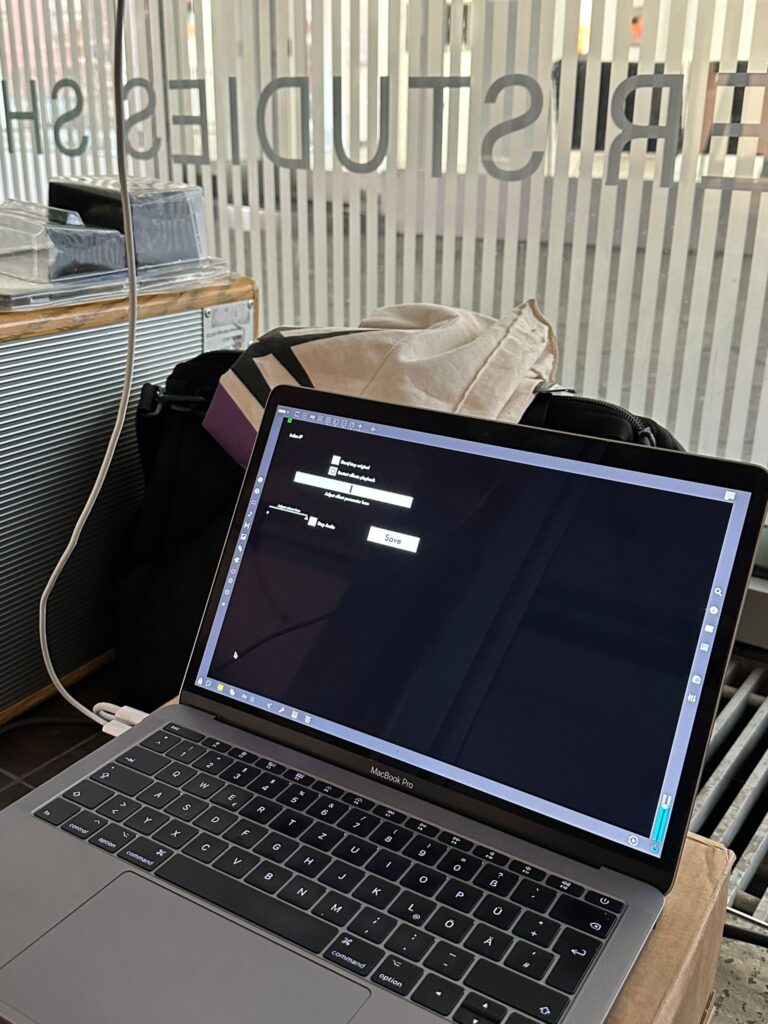
The final exhibition setup in presentation mode (Picture credit: Mahtab Jafarzadehmiandehi)


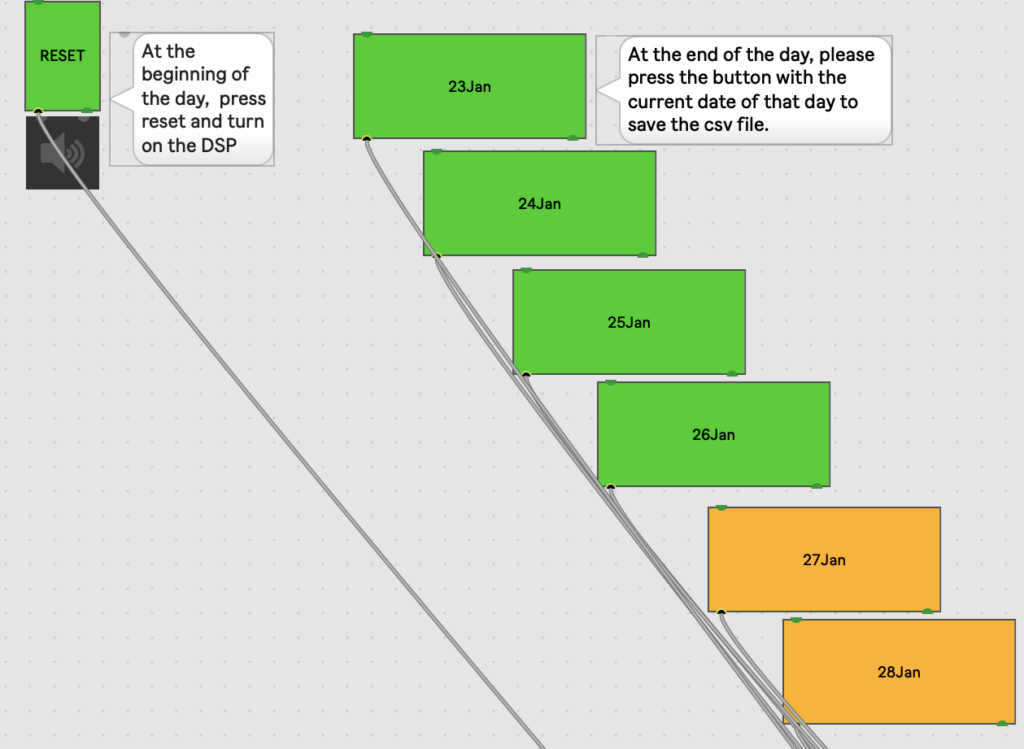
Since I would not be able to be present for the opening myself, I added a minimal interface in the patching mode so my colleagues would be able to save the data at the end of the day.

Max interface for saving the collected data

For the exhibition setup, I rented an iPad, a laptop, and an iPad stand, and I ran Cycling’74’s Mira app on the iPad with guided access enabled. Like this, I could pretty much maintain the GUI I had set up in Max’s presentation mode already, with some minor changes (e.g.: changing slider objects into Mira-compatible live.slider objects). Initially, I wanted to try connecting the laptop and iPad via Wi-fi to be more flexible with the placement of the laptop on site, but ultimately connecting the two devices via USB was a safer option, especially since I also had to consider the ease of setup for my colleagues on site.

Building the test setup for the exhibit at home

I also fastened a hook onto the iPad stand using zip ties to be able to hang a pair of headphones there. On-site, a white box with a hole in the middle for the cables was put over the laptop to protect it and give the exhibit a clean look. I recorded a video of myself explaining and turning the exhibit on and off in advance, so my colleagues could have it as a reference when setting up.

When I returned, I found that there had been some issues with turning the exhibit off and on some days, and some of the data was unfortunately lost because it had been overwritten in my absence. Luckily, the data for two days remained available, leaving me with a total of 31 test results (16 for the factor of 110 and 15 for the factor of 25). As expected, the results were a little bit all over the place, since of course an exhibition is also an informal setting that can (and should) invite people to primarily explore, but I was also able to detect some subtle trends of the nature that I had observed with myself. Of course, with this small sample size and setting it is not recommended to come to fixed conclusions, since there are just so many uncontrolled variables, but it was still interesting to see how some people seemed to have used the tool and that they did in fact try it out.

Ongoing

Now it is time to properly discuss and evaluate the test setup and the data results, as well as reflect on the overall process of creating the Max4Live device. There is still some work that I want to do for the GUI, and I also want to clean up the cord connections in my Max patch to make them easier to trace for others in case I ever do decide to share the patch. Lastly, I would like to prepare sound examples to show during the presentation in advance.

Results and Reflection

The exhibition setup was definitely a new experience for me, since it forced me to articulate my process in a way that could be understood by any other person, and I also needed to provide documentation that would enable people to use the setup regardless of me being available on site or not. Of course, it was unfortunate that I missed out on the larger amount of data from the opening, but I am glad that there is at least some data from days when I received confirmation that the exhibit worked as intended – the whole process really added a new layer of learning outcomes to the project for me. Not only did I have to figure out data collection in the Max environment, but I also learned about an application I had been unfamiliar with before, thought about setup considerations in a real location (safety, cable management, exhibit design) and took mental notes on how the process of saving data could be simplified for other projects.

Objectives for Next Time (= the final presentation)

  • Document project implementation
  • Finalise GUI
  • Prepare presentation

The 12 Principles of Animation: Foundations of Movement and Emotion

Die „12 Principels of Animation“ wurden in den Walt Disney Studios entwickelt um die Qualität der Bewegtanimation zu standardisieren und zu verbessern. Diese Prinzipien sind auch heute noch ein Fundament, wenn es um die Kreation von expressive, lebensechte und emotionale Charakterentwicklung geht. Sie bieten AnimatorInnen ein Framework, um dynamische und fesselnde Geschichten zu entwickeln. 

Squash and Stretch

Diese Technik ist eine der wichtigsten Prinzipien in der Animation, sie unterstreicht die Elastizität von Objekten und Charakteren, um die Bewegungen, vor allem das Zusammenziehen und Ausdehnen im realen Leben, nachzuahmen. Es gibt den Objekten ein Gewicht und Flexibilität und gleichzeitig bleibt das Volumen des Objektes gleich. Anhand der klassischen Bouncing Ball Animation ist diese Technik sehr gut erkennbar. Der Ball wird, wenn er den Boden trifft, horizontal auseinandergezogen – squash und beim hinauf fliegen wieder vertikal – stretch. Diese Technik gibt Charakteren in Filmen mehr Persönlichkeit,  wie beispielsweise übertriebene Gesichtsausdrücke oder das Biegen der Gliedmaßen bei dynamischen Bewegungen. Es ist nicht nur eine technische Entscheidung, diese Technik anzuwenden, es lässt die sonst statistischen Zeichnungen lebendig und pulsierend erscheinen.

Anticipation

Diese Technik bereitet das Publikum auf eine Aktion vor und stellt sicher, dass Bewegungen klar und glaubwürdig erscheinen. Bevor eine Figur eine Aktion ausübt, gibt es eine vorbereitende Bewegung, beispielsweise das Zurückziehen des Armes, bevor es zum eigentlichen Wurf eines Gegenstandes durch den Charakter kommt. Die Technik signalisiert dem Publikum auch, um welche Aktion es sich handelt und ahmt dabei Bewegungen des realen Lebens nach. Ohne sie erscheinen Bewegungsabläufe abrupt und mechanisch, durch diesen Aufbau verbessern die AnimatorInnen Klarheit und steigern das Engagement.

Staging

Diese Technik konzentriert sich vor allem auf die klare Darstellung von Ideen, Handlungen und Emotionen für das Publikum. Staging aus der Tradition des Theaters sorgt dafür, dass die Haupthandlung oder -emotion nicht durch Ablenkungen überschattet wird. Die Position der Figuren, der Einsatz von Licht und die Wahl des Blickwinkels tragen zum Staging bei. So kann beispielsweise eine Silhouette eine Bewegung deutlicher machen, während eine Nahaufnahme den Gesichtsausdruck einer Figur hervorheben kann. Eine gute Anwendung von dieser Technik stellt sicher, dass der Kern der Geschichte immer klar ist, um den Fokus des Publikums zu lenken und die emotionale Wirkung zu maximieren.

Straight Ahead Action and Pose-to-Pose

Bei dieser Technik gibt es zwei Ansätze für die Animation von Szenen: „Straight Ahead Action“ und ‚Pose-to-Pose‘.

Bei Straight Ahead Action wird Bild für Bild animiert, was zu einer spontanen und fließenden Bewegung führt. Diese Methode wird häufig für chaotische oder unvorhersehbare Szenen verwendet.

Bei der Pose-to-Pose-Methode hingegen werden zunächst die wichtigsten Posen, also die Key Frames, geplant und die Übergangs Bewegungen eingefügt. Dieser Ansatz bietet mehr Kontrolle und Präzision und ist daher ideal für komplexe oder emotionale Sequenzen.

Die Kombination dieser Methoden ermöglicht es AnimatorInnen, eine Balance zwischen Spontaneität und Struktur in der Charakterentwicklung zu schaffen und so für Klarheit und Energie in der Geschichte zu sorgen.

Follow Through and Overlapping Action

Diese beiden Techniken verhindern, dass die Figuren in der Animation steif wirken, indem sie nachahmen, wie sich verschiedene Teile des Körpers oder Objekts zu unterschiedlichen Zeiten bewegen. Wenn eine Figur beispielsweisel aufhört zu laufen, bewegen sich ihre Haare oder ihre Kleidung für eine kurze Zeit weiter. Ähnlich zu dieser Technik, spiegeln überlappende Aktionen wider, wie sich verschiedene Körperteile unabhängig voneinander bewegen können. Die beiden Techniken vermitteln ein Gefühl von Schwere/Körpergewicht, Flüssigkeit und Realismus, was die Glaubwürdigkeit der animierten Figuren erhöht.

Slow In and Slow Out

Bewegungen beginnen oder enden nicht abrupt in der Realität. „Slow In and Slow Out“ ahmt diese natürliche Beschleunigung und Verlangsamung nach und schafft so sanfte Übergänge zwischen verschiedenen Aktionen. Durch das Hinzufügen weiterer Frames am Anfang und am Ende einer Bewegung lassen AnimatorInnen die Bewegungen flüssiger und organischer wirken. Wenn eine Figur beispielsweise winkt, verlangsamt sich ihre Hand, bevor sie ganz zum Stillstand kommt. Dieses Prinzip hebt auch wichtige Posen hervor und lenkt die Aufmerksamkeit des Publikums auf Schlüsselmomente in einer Szene.

Arcs

Die meisten natürlichen Bewegungen folgen einer geschwungenen Linie und keiner geraden. Das Prinzip der Arcs sorgt dafür, dass Gesten, Schritte und andere Aktionen flüssig und lebendig wirken. Der Armschwung eines Charakters oder die Flugbahn eines Balls bei einem Wurf folgen aus diesem Grund einem Bogen. Geradlinige Bewegungen können sich mechanisch und unnatürlich anfühlen, während Arcs dafür sorgen, Realismus zu zeigen.

Secondary Action

Diese Technik beinhaltet kleinere, unterstützende Bewegungen, die die Haupthandlung ergänzen. Dadurch wird den Aktionen mehr Tiefe und Persönlichkeit verliehen. Eine Figur, die geht, kann zum Beispiel ihre Arme schwingen oder pfeifen, um ihre Stimmung zu unterstreichen. Sekundäre Handlungen dürfen allerdings die Hauptbewegung nicht überschatten, sie dienen nur zur Verstärkung. Wenn sie wirkungsvoll eingesetzt werden, wirken die Szenen vielschichtiger und fesseln dadurch das Publikum mehr an die erzählte Geschichte.

Timing

Timing bestimmt die Geschwindigkeit und den Rhythmus einer Animation. Die Anzahl der Bilder, die für eine Aktion verwendet werden, beeinflusst, wie sie wahrgenommen wird. Weniger Bilder erzeugen schnellere Bewegungen,im Umkehrschluss verlangsamen mehr Bilder das Geschehen. Die Technik zeigt ebenso Charaktereigenschaften und Emotionen der Figuren. Eine träge Bewegung kann Faulheit oder Traurigkeit suggerieren, während schnelle Aktionen Energie oder Aufregung signalisieren.

Exaggeration

Diese Technik hebt Gefühle oder Handlungen hervor, um sie lebendiger und einprägsamer zu machen und sorgt für mehr Dynamik. Das Prinzip verzerrt die Realität nicht, sondern hebt ihr Wesen hervor. Eine verängstigte Figur kann beispielsweise ihre Augen übertrieben weit aufreißen oder einen dramatischen Sprung nach hinten machen, um ihre Angst greifbarer zu machen. Mit dieser Technik können auch in einfachen Formen Handlungen und Emotionen deutlich werden.

Solid Drawing

Diese Technik bezieht sich auf die technische Fähigkeit, Figuren und Objekte zu schaffen, die dreidimensional wirken. Dazu gehört das Verständnis von Gewicht, Anatomie und Gleichgewicht. Dabei muss berücksichtigt werden, wie die Figuren aus allen Blickwinkeln aussehen und sichergestellt werden, dass ihre Formen in der Bewegung konsistent bleiben. Solid Drawing vermeidet flache Erscheinungen von Figuren und sorgt so für ein Gefühl von körperlicher Präsenz.

Appeal

Diese Technik sorgt dafür, dass Figuren und Szenen das Publikum fesseln. Figuren erscheinen dadurch nicht zwingend niedlich oder sympathisch, auch Bösewichte können attraktiv wirken, wenn ihr Design und ihre Persönlichkeit fesselnd sind. Ein guter Appeal zieht die ZuschauerInnen in seinen Bann und hält so die Aufmerksamkeit aufrecht, sei es durch charmante Charaktereigenschaften, dynamische Designs oder überzeugende Handlungen.

Fazit

Zusammenfassend bieten die 12 Prinzipien der Animation einen Rahmen, um Bewegungen und Emotionen zu erzeugen, die authentisch und fesselnd wirken. Sie sorgen dafür, dass die Figuren beim Publikum gut ankommen und nachvollziehbar sind. Durch die Beherrschung dieser Techniken erwecken AnimatorInnen Zeichnungen zum Leben und schaffen Geschichten in visueller Form, die auch emotional fesselnd sind.

Thomas, Frank, Johnston, Ollie. The Illusion of Life: Disney Animation. New York: Disney Editions, 1981, S. 46–68.

28 | IMPULSE #7 – Designing Interview Guides

For my master thesis topic it is important to me to listen to people with different experiences, perspectives, and priorities. That’s why I created three different interview guides to dive deeper into how people approach sustainable behavior in their daily lives. Before conducting the interviews, I wanted to share my thought process for designing the guides and, most importantly, why I chose three very different kinds of interview partners.

My goal is to understand the real barriers, motivations, and habits surrounding sustainability in various contexts. To do that, I needed interviewees who represent distinct viewpoints. In the following I will explain who these people are, why I chose them, and what I hope to learn from each conversation.

The first interview partner (let’s call them P1) is a social worker who has extensive experience working with people in challenging life situations, specifically in the area of homelessness. I chose P1 because they work closely with individuals who face systemic barriers, such as financial instability, lack of housing, and limited access to resources. These challenges often shape how people approach sustainability – if it’s even on their radar at all.

My goal with this interview is to better understand how social and economic disadvantages influence sustainable behavior. For example:

  • How does limited income affect daily decisions like transportation, food, or clothing?
  • Is sustainability seen as a privilege for people who don’t have to worry about survival first?
  • What role does access to technology play in shaping their habits?

P1 can provide a window into a world where sustainability is often a secondary concern, and any actions taken (like using public transport or buying second-hand clothes) might be driven more by necessity than intention. This perspective is crucial because it can show the importance of making sustainability accessible to everyone – not just those with disposable income or extra time.

The second interview partner (P2) is a young medical student in their early 20s. This person represents a group that is often aware of sustainability issues and wants to do their part—but doesn’t always prioritize it due to life circumstances. Think of the daily juggling act that comes with being a student: attending lectures, studying for exams, and managing a tight budget.

I chose P2 because they are at a transitional stage in life where habits and priorities are still being shaped. Students often care about the environment and feel the pressure to “do better,” but convenience, cost, and a busy schedule can make sustainability feel like just one more thing on a long to-do list.

From this interview, I hope to explore questions like:

  • What drives young people to engage in sustainable behavior? Is it peer pressure, personal values, or something else?
  • What compromises do they make between convenience and sustainability?
  • What tools, apps, or strategies help them make greener choices – or would help if they existed?

This interview will help me understand what motivates this group to stick to their sustainable intentions and what might cause them to give up. The insights from P2 could reveal how to make sustainability more practical and appealing for those with busy lives.

Finally, my third interview partner (P3) is someone who is deeply committed to living a sustainable lifestyle. They’re in their early 20s and currently studying biotechnology. P3 already makes conscious decisions about what they buy, how they travel, and even what they eat (they’re vegan). However, they’re also deeply frustrated with how hard it can be to stay consistent.

I chose P3 because they represent the group of people who are most passionate about sustainability but still face significant challenges in living out their values. Despite being highly motivated, they often feel like the system isn’t set up to support them, whether it’s due to lack of infrastructure (like public transport) or the higher cost of sustainable products.

This conversation will focus on questions like:

  • What are the biggest barriers even for someone who is committed to sustainability?
  • What role does frustration play in shaping their behavior? Does it motivate them to do more or make them feel burned out?
  • What would make it easier for them to stay on track?

P3’s perspective will provide insights into the gap between intention and execution—and how we can close that gap for the most environmentally conscious among us.

By interviewing people from such different walks of life, I hope to get a fuller picture of how sustainability fits into the real world. Sustainability isn’t a one-size-fits-all concept. For some, it’s about small, incremental changes that fit into a busy schedule. For others, it’s tied to bigger systemic issues that make it harder to even consider the environment when basic needs aren’t met.

The goal isn’t to compare these groups or rank their efforts but to understand how sustainability looks through their eyes. Each interviewee offers unique insights that can help shape solutions that make sustainable living more accessible and appealing.

Once I conduct these interviews, I’ll be diving into their answers to identify patterns, surprises, and actionable takeaways. I hope their perspectives will shed light on how we can make sustainability something that works for everyone – not just those with the time, money, or resources to focus on it.