SEMESTERPROJEKT – RECHERCHE THEMA

In diesem Semester möchte ich mich im Allgemeinen mit der Herangehensweise und Erarbeitung einer Animationsvideoreihe auseinandersetzen. Dabei fokussiere ich mich auf Videoreihen in der Wissenssparte. Im Zuge dessen, möchte ich mich auch mit dem Aspekt der Aufbereitung für verschiedene Social Media-Formate beschäftigen. Je nach Aufbau meiner Videoreihe werde ich mir Dinge wie Vorbereitung von Dateien (Illustrator zu After Effects) oder Characterrigging genauer anschauen.

Thema meiner Videoreihe

Da ich ein Videoformat über die Herkunft von Ausdrücken und Redewendungen mache, habe ich mir für dieses Projekt entschlossen ein Video als Exempel für diese Reihe zum Thema rotsehen machen. Kurz zusammenfassend habe ich über den Begriff folgendes herausgefunden:

  • Rotsehen bedeutet, dass man wütend oder die Kontrolle über sich selbst verliert.
  • Stammt aus dem frühen 20ten Jahrhundert.
  • Viele glauben der Begriff wird vom Stierkampf abgeleitet.
    • Eine der ersten Vergleiche mit dem Stierkampf kommt in Charlotte Mary Yonges Roman The pillars of the house, 1873 vor: „Jack will do for himself if he tells Wilmet her eyes are violet; it is like a red rag to a bull.
  • Alternativ, könnte es auch von einer älteren amerikanischen Redewendung to see things red stammen. Die amerikanische Wortherkunft wird aber nicht vom Stierkampf abgeleitet! Vielmehr geht es um den Zustand erhöhter Emotionen, in dem einem vor Wut Blut in den Kopf schießt. Diesen Zustand kann man auch als red mist (zu Deutsch roter Nebel) bezeichnen.
    • Eines der ersten Beispiele in dem man den Begriff to see things red findet man in Jerome K. Jeromes Roman Three men on the bummel, 1900: „I began, as the American expression is, to see things red.“
    • Auch Lucas Malet (Pseudonym von Mary St. Leger Harrison) schrieb im Roman The history of Sir Richard Calmady in 1901: Happily violence is shortlived, only for a very little while do even the gentlest persons ’see red‘.
  • https://www.phrases.org.uk/meanings/see-red.html?utm_content=cmp-true (zuletzt aufgerufen: 21.03.2024)

Ausblick

Als nächstes möchte ich verschiedene Wissensvideoformate analysieren, um zum Schauen, wie diese funktionieren und wie sie ihre Videos für verschiedene Social Media Formate aufbauen. Außerdem werde ich nebenher Inspirationen für den Animationsstil auf Pinterest sammeln (https://pin.it/7KgKttmxr).

12 | Designing A Digital Fashion Garment – Getting Started

Today I am starting the journey to designing my first digital fashion garment. The very first step on this journey is – of course – installing the right 3D program. In a previous blog post, I discussed the two current industry standard programs – Marvelous Designer and CLO3D – and compared some of their advantages and disadvantages, their main applications and who primarily uses them for which areas of design. Based on that research and my own background in physical pattern drafting, sewing and traditional analog fashion design, I decided to work with CLO3D

The provider offers a student subscription plan as well as a 30 Day free trial which I am starting today (March 6th 2024).  

CLO3D has a very useful pool of learning resources, among them an expansive collection of video tutorials on their own YouTube channel. Their “Beginner’s Guide to CLO” playlist will be the first point of entry for me. I will follow the tutorials in order to get familiar with the basic steps of the program. 

The main interface is a little busy but well arranged and for users with previous experience of 3D programs, it can be quite intuitive. The user has the possibility to rearrange the setup and change the positions of tools and features. 

The Program also comes with some preset avatars, base garments, materials, accessories and patterns. They are a good way to get familiar with the basic functions. In my next blogpost, I will attempt to get started with the sewing functions of the program. 

11 | Introducing my Semester Project

Im my blogposts from last semester, I discussed several aspects of digital fashion. This semester, I am taking my research to the practical phase by creating my first own digital fashion garment.

The scope I am aiming for in this project is to test out the main features and tools of the software CLO3D, which I will use, find a serviceable workflow in terms of working with presets and base patterns, getting familiar with material libraries and especially, understanding the stitch options and draping features of my chosen software program. Ideally, I will be able to complete a full garment, including export and staging in a digital environment, within the free trial period of the software, which is 30 days. 

In my next blogpost, I will start my project by following the installation process of CLO3D, getting familiar with the layout and basic functions and exploring the asset library that comes with the program.

10 | Invisible Bodies – an Idiosyncratic Design Choice in Digital Fashion Design

Exploring the many creations under the keywords “Digital Fashion” currently presented on the internet, one quickly finds a common and peculiar reoccurring phenomenon. Virtual clothings flows through digital space, draping, behaving and moving in a way that suggests the presence of a body underneath the clothing. But there is no body depicted in the renderings. The world of digital fashion, it seems, is on its way to becoming a world without bodies. This has both interesting implications for the future, but also prompts examinations of the past of fashion design. The invisible walk cycles of digital fashion unintentionally provoke a discussion of one of fashion history’s most interesting tensions – the clothed body.

Bodies are a subject which has naturally been present throughout the history of fashion. Over the course of its evolution, the fashion industry has treated and impacted bodies in a multitude of ways. There have been phases of fashion history in which the body was the leading force, fashion designers aimed to flatter the body, respect its qualities and varieties and find a way to make garments that interplay with the body. The body was a part of the fashion system which could not be ignored or neglected. Similarly, fashion has also gone through phases of extreme body negation, attempting to fight against the natural qualities of the human body, forcing it into unnatural shapes. Especially in women’s fashion, the relation between garment and body has been a constant point of contention which in recent times, has arguably reached its peak. Despite the modern movements for body acceptance and inclusivity, fashion remains a space in which bodies are a constant source of conflict. 

It seems ironic, therefore, that in digital fashion, the body appears to lose its significance altogether. Garments can float through digital space without physical limitations. On one hand, this could be viewed as a bizarre but logical consequence of current efforts towards inclusivity and diversity. If the body is invisible, there is no need to worry about skin colour, size, age and physical condition. The body becomes merely a suggestion of form, a sort of draping guide for digital garments that escapes all the pitfalls that depicting a true to life figure would bring with it. 

On the other hand, this complete negation of the body suggests that in fashion, no semblance of a real physical body is “good enough” to do justice to the garment. The body is an obsolete instrument of fashion, a tool that the modern fashion aesthetic has finally managed to evolve away from. Either way of viewing this development towards invisible bodies in digital fashion brings with it a myriad of questions and discussion points that could be elaborated on in their own essays. Further developments of this trend will show if it is here to stay, or if visible bodies, no matter in which shape will make a return to digital fashion in the end.

Further reading:

Ana Neto & João Ferreira (2023) Lasting Bonds: Understanding Wearer-Clothing Relationships through Interpersonal Love-Theory, Fashion Theory, 27:5, 677-707, DOI: 10.1080/1362704X.2023.2170706

Emma McClendon (2019) The Body: Fashion and Physique—A Curatorial Discussion, Fashion Theory, 23:2, 147-165, DOI: 10.1080/1362704X.2019.1567057

Lucia Ruggerone (2017) The Feeling of Being Dressed: Affect Studies and the Clothed Body, Fashion Theory, 21:5, 573-593, DOI: 10.1080/1362704X.2016.1253302

09 | Industry Standard Softwares for Digital Fashion Design

In the digital fashion design space, there are currently two softwares which are most frequently used specifically for the task of digital garment design. These two softwares are called CLO3D and Marvelous Designer. The following text will present some of the key differences and similarities of the two programs.

To begin with, both CLO3D and Marvelous Designer’s software platforms are owned by the same entity, which results in them being very similar in their foundational structure, with an overall quite substantial functional overlap.

A notable contrast between the two programs is the intended user base. CLO3D is posited as being more tailored for fashion designers, specifically people who already are familiar with fashion design and garment production processes, whereas Marvelous Designer is more aimed towards the gaming industry and 3D artists. Marvelous Designer is dominantly used in the entertainment industry, particularly in VFX, animation, movies, and video games, due to its capabilities in creating realistic virtual garments.

Overall, CLO3D contains a broader set of tools compared to Marvelous Designer, however, the differences in tool sets is mostly owed to project-specific requirements of the intended user base. The two programs also differ in their export capabilities. CLO3D provides enhanced options for exporting garments into the physical realm, catering to the needs of fashion designers who may require interactions with manufacturers. Additionally, CLO3D offers more compatibility with interactive formats, such as WebGL and augmented reality (AR), through the exportation of GLTF and GLB formats, a feature which is not available in Marvelous Designer.

One advantage of Marvelous Designer is its integration with the Adobe 3D asset platform Substance. This feature allows users to seamlessly import Substance textures directly into the program and work with them in creating garments. This feature is not yet available in CLO3D. CLO3D on the other hand, provides a built-in renderer, enabling users to render garments directly within the application, a convenience not found in Marvelous Designer. 

All of these technical details will be important for persons interested in creating digital garments with one of these programs. While they might seem like small differences on superficial examination, they might be the deciding factor for some digital artists in choosing either one or the other to work with. 

Apart from these small technical differences, CLO3D and Marvelous Designer also differ in a further important point – the pricing. In this category, CLO3D comes out slightly more expensive than Marvelous designer. 

In conclusion, fashion designers seeking real-world export capabilities will likely fare better overall with CLO3D, while 3D artists, particularly those using Blender, Cinema 4D, or similar programs, are likely to appreciate Marvellous Designer.

Weblinks:

Marvelous Designer
CLO3D

08 | Digital Fashion Collaborations

Traditional fashion brands are starting to collaborate with digital artists and designers to create limited-edition virtual collections, virtual experiences, brand tie-ins and special editions. The connection between gaming and fashion seems to have strengthened more and more over the past years. It appears that the aesthetic and lifestyle connected to video games offers designers and fashion brands unique new inspirations to take their brands to new experimental grounds. There are several possible reasons why video games seem to be especially interesting collaboration partners for fashion houses. Part of the appeal might be explained in my previous blogpost on video game skins (see here). The following blogpost will introduce some notable digital fashion collaboration and projects either situated in or influenced by the video game space. 

Prada and Riders Republic, 2022:

In 2022, luxury brand Prada, more specifically, its sportswear line Prada Linea Rossa collaborated with the multiplayer racing game Riders Republic to produce a digital sportswear line and a matching set of snowboards, skis, and BMX bikes.

Balenciaga and Fortnite, 2021:

Popular streetwear brand Balenciaga launched physical and digital collections in partnership with the multiplayer, battle-royale game Fortnite. The brand also created an original video game called Afterworld: The Age of Tomorrow to promote their Fall 2021 runway show.

Gucci and Roblox, 2021:

In 2021, Gucci created a surreal garden inside the game Roblox for players to visit online.

Anna Sui, Isabel Marant, Marc Jacobs and Animal Crossing: New Horizons, 2020:

The designers each built themed islands in Animal Crossing: New Horizons as imaginative locales for fans to engage with their respective brand.

Moschino and The Sims, 2019:

In 2019, fashion brand Moschino partnered with the popular game The Sims to release both physical and digital lines, referencing the retro, pixelated graphics of 80s computer games. A so-called “stuff pack” was released for The Sims 4 in summer 2019.

Nike and League of Legends, 2019:

Sportswear brand Nike partnered with the popular eSports game League of Legends to create footwear and apparel collections inspired by the game’s aesthetics. They also released a line of footwear featuring the PlayStation logo and colorway. Notably, this project had a physical fashion output rather than a digital product, but it still demonstrate the general affinity between games and fashion that is on the rise today.

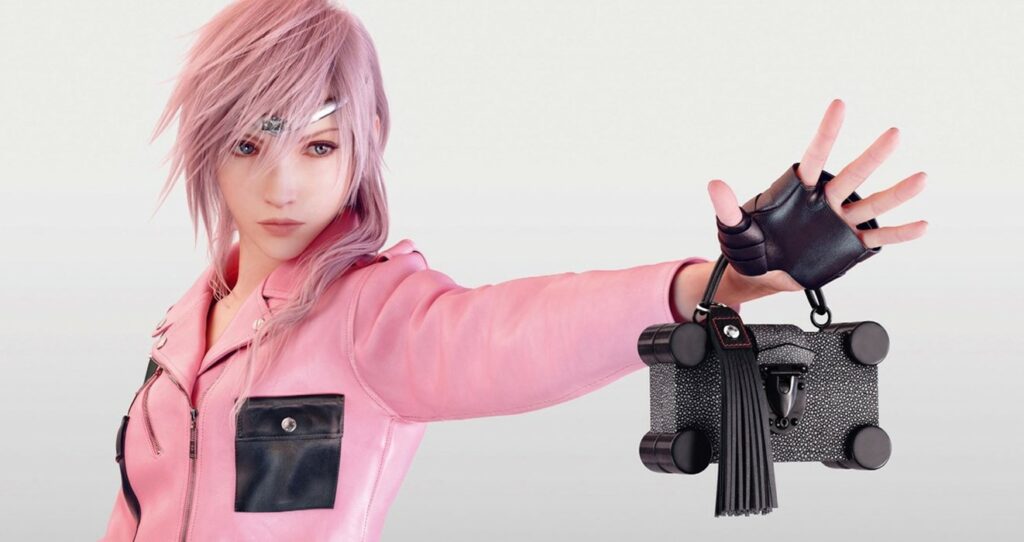
Louis Vuitton and Final Fantasy, 2016:

For their Spring/Summer 2016 collection, luxury fashion brand Louis Vuitton recruited a virtual characters from the Final Fantasy series to model physical garments and accessories.

Image source: https://www.dazeddigital.com/fashion/article/29188/1/final-destiny-s-lightning-breaks-silence-on-louis-vuitton 

The brand also released a mobile game entitled “Louis: The Game” to mark the brand founder’s 200-year birthday in 2021.

As shown in these examples, fashion brands have been venturing into the virtual worlds of contemporary games for a while, either through collaborations, creating their virtual experiences, or establishing unique spaces within existing video games. Therefore, the gaming space has opened up new opportunities for creative projects, but also marketing opportunities, and fashion brands appear to be ready and willing to engage. 

Main Reference:

Reay, E., Wanick, V. (2023). Skins in the Game: Fashion Branding and Commercial Video Games. In: Bazaki, E., Wanick, V. (eds) Reinventing Fashion Retailing. Palgrave Studies in Practice: Global Fashion Brand Management . Palgrave Macmillan, Cham. https://doi.org/10.1007/978-3-031-11185-3_5

07 | Digital Fashion – The Sustainability Question

Digital fashion is often touted as a more sustainable alternative to traditional fashion. Since there is no physical production involved, there is no need for raw materials, manufacturing, or shipping, potentially reducing the environmental impact associated with the fashion industry. At the same time, the discussion around digital products and their sustainability is a point of contention on its own, since the ever-growing need for larger server farms, computers and their energy consumption need to be weighed against traditional forms of production. The question to investigate in this instance, therefore is “are digital fashion design technologies a net positive for sustainability in the fashion industry?”. The following is a brief discussion of points for and against this claim and suggestions for further research. 

To begin this investigation, we must first narrow in on the exact point of contention we are about to engage with. First and foremost, it is important to define that the following discussion explicitly concerns the adoption of digital design techniques and their impact on the fashion industry as an integrated part of the whole design process. The aim of this discussion is decidedly not to isolate digital fashion design as its own standalone practice and discuss its impact on sustainability and the environment in isolation. It is not the intent of this text to view digital fashion practices detached from the overall fashion industry in this particular case. 

Having defined the field of discussion thus, we can make comparisons on the impact of digital versus traditional design practices. A useful starting point is to identify which steps and practices in traditional fashion design have the potential to be replaced with digital design technologies in the first place. 

One obvious use case for digital methods is the design process itself. Idea finding, sketching and mood boarding can all be done with digital tools, avoiding paper waste. This, however has quite a small impact on sustainability in regards to the entire process. 

Another frequently identified step in the production process is the prototyping phase. Prototyping fashion design products is an often time- and material intensive process. Using digital prototyping methods has the potential to cut down on cost, time and material usage in the overall process. Designers can more quickly explore and test design ideas and prototype garments in digital space. They can also utilise the findings from digital prototyping to optimise the production process by optimising pattern constellations and material usage. 

Finally, digital design methods can entirely replace the production phase if the collection or piece of clothing is designed to stay digital altogether. Here is also where we need to make an important distinction and introduce a vital caveat in the discussion so far: the distinction between using digital methods for traditional fashion production versus designing entirely for the digital space.

Many designers rightfully point out that in designing for a physical collection, all the above mentioned steps can hardly be entirely replaced with digital methods. Haptics, material behaviours, look and overall impression of textiles might be simulated in digital programs, but the simulation often does not translate to the reality of its physical counterpart, making any efforts to replace the traditional methods obsolete. 

Are digital fashion design tools therefore only an improvement to sustainability if the collections they produce stay within the digital space altogether? To answer this question, we would have to make calculations based on a predefined assumption, which we would have to agree on beforehand. One such assumption that is often proposed is that digital-only fashion products might have the potential to replace cheaply made, trendy fast fashion items, clothing pieces that go through the most rapid trend cycles and are usually purchased and discarded within the same year or even within the same fashion season. Proponents of this idea suggest that developments in augmented reality applications might hold the potential for future digital-only fashion to be “worn” in digital space and made visible in the physical space by AR devices, enabling the “wearers” to showcase their digital-only outfits in this way. But this idea seems quite utopian and depends entirely on a massively increased prevalence of AR device usage within the next years and decades. It might not be an impossible development, but, looking at the history of AR devices and their usage, it seems an unlikely development as of now. 

Another argument for digital-only fashion items gaining popularity is the nature of fashion merchandising and influencer culture that depends mostly on representing outfits on digital platforms such as TikTok and Instagram. For these platforms, physical ownership of a garment is not necessary. Rather, the models or influencers wanting to showcase a new outfit could just as well rely on digital fashion for their content. 

All the above mentioned strategies and theories on developments in the digital design market are interesting and hold potential for the future, but it seems that even with the novelty of digital fashion contributing to its popularity, it will ultimately lose out to traditional fashion in the long run. Because fashion remains a physical and haptic medium, digital fashion might only have the potential to supplement existing practices. From today’s point of view, it seems far-fetched that digital garments might replace sectors of traditional fashion in the consumer market any time soon. Therefore, the question of its sustainability impact remains a debatable point as well. Server farms and computer technologies that are necessary for producing digital fashion in the first place might even worsen the overall environmental impact of the already problematic fashion industry. Despite all these pessimistic outlooks, digital design methods might still hold potential for improving the fashion industry’s sustainability. But, as all other questions in this young design discipline, this needs to be analysed and researched in much more depth in order to draw meaningful conclusions on its overall impact. 

Further reading: 

Benson, Sophie (2021) Is digital fashion really the industry’s eco-friendly saviour? Dazed Digital. https://www.dazeddigital.com/fashion/article/53877/1/digital-fashion-clothing-industry-saviour-climate-sustainability-the-sims-avatar

Daria Casciani, Olga Chkanikova & Rudrajeet Pal (2022) Exploring the nature of digital transformation in the fashion industry: opportunities for supply chains, business models, and sustainability-oriented innovations, Sustainability: Science, Practice and Policy, 18:1, 773-795, DOI: 10.1080/15487733.2022.2125640

Hoekstra, Charlotte (2021). Digital fashion for sustainable change: A strategy for digital fashion at Tommy Hilfiger (Master Thesis). TU Delft. https://repository.tudelft.nl/islandora/object/uuid:d268a227-5be0-4969-bf6d-b2edd5fef0c8?collection=education

06 | NFTs, Blockchain Technology and Virtual Ownership in Digital Fashion 

In the sphere of digital fashion, items are sometimes being sold as NFTs, providing a sense of ownership and authenticity in the digital space. Buyers can use these NFTs to showcase and trade their virtual fashion items within specific platforms. This is especially interesting because it brings up discussions around the value of digital products in general, the merit of owning a purely virtual item and the relationship to the analogue equivalent of attributing value to fashion items. An interesting point of discussion for this topic is also the relationship between original fashion pieces and fake products or counterfeit items in the real world and in digital space. 

The blockchain technology that forms the basis for NFTs (Nonfungible tokens) has apparently solved an issue which many purely digital products faced before – the assertion and definition of exclusive ownership. Although there is still room for debate on this issue – which might reach back to fundamental questions on reproducibility of artworks raised as far back as Walter Benjamin’s seminal text „The Work of Art in the Age of its Technological Reproducibility” – blockchain technology has, at least in concept, provided a means of determining digital ownership. In consequence, this has enabled the creators of digital products to transfer a quality into digital space which is essential to the fashion market – exclusivity. The merit and necessity of this quality can and should debated, not only in digital, but also in traditional fashion. While the basis for exclusivity in traditional fashion was once rooted in the craftswomanship and quality of materials that went into producing a garment, an even superficial examination of current fashion practices shows that exclusivity today is much more linked to intangible – one might even say, imaginary – values such as brand names. And so the question of what gives a fashion item its ultimate value remains relevant for both traditional and digital fashion. 

While there can be debate about the organic rarity of source materials and the limited availability that lead to real life fashion items’ exclusivity due to fabric or craftswomanship limitations, the limitations on producibility in the digital space are debatably always artificially imposed. Nothing stops a fashion brand from rendering a million models of the same item as opposed to only one. And even in the case of only producing one original digital piece, we must enter into the long running discussion of what constitutes the digital original and what it means to have a unique and original piece that is purely digitally produced. The definition of the term “original” according to the Oxford Learner’s Dictionary reads “a document, work of art, etc. produced for the first time, from which copies are later made”.1

In the digital world however, it is often impossible to determine where and when an artwork or digital product was first created or published. Metadata can be altered and digital copies can be made without much skill or effort by people looking to use or profit from other creator’s digital products as their property. 

Further research and writing into this aspect of digital fashion, as demonstrated in the above text, therefore has many routes and paths it could follow. Questions of ownership, exclusivity and originality all warrant their own explorations and provide ample material for further discussion. Additionally, technical and legal aspects can be investigated in more detail to further discuss the use of NFT and blockchain technology in digital fashion.

References:

1 The Oxford Learner’s Dictionary. “Original” (Noun). https://www.oxfordlearnersdictionaries.com/definition/english/original_2

Further reading: 

Bethan Alexander & Niccolò Bellandi (2022) Limited or Limitless? Exploring the Potential of NFTs on Value Creation in Luxury Fashion, Fashion Practice, 14:3, 376-400. DOI: 10.1080/17569370.2022.2118969

Joy, A., Zhu, Y., Peña, C., & Brouard, M. (2022). Digital future of luxury brands: Metaverse, digital fashion, and non-fungible tokens. Strategic Change, 31(3), 337–343. DOI: https://doi.org/10.1002/jsc.2502

05 | Potentials and Problems in Digital Fashion for Video Games

In the gaming and virtual reality space, digital fashion is gaining popularity as a way for users to customise the appearance of their avatars. In this context, the word “avatar” refers to the player’s representation figure in the game. Players can purchase or earn virtual clothing items to enhance the aesthetics of their digital personas. These virtual clothing items are commonly referred to as “skins”. The phenomenon of skins and their importance in certain video games opens up a space of opportunities for digital fashion design. The following article will discuss some relevant terms and point out topics of interest for further research into this aspect of digital fashion design. 

In order to provide a basis for the further discussion, we must begin with a definition of the term “skin” in the context of video games. The website “Engaged Family Gaming” offers the following explanation: 

“A “skin” is a kind of item that players can acquire in games. They change the appearance of the players avatar (the character on the screen that represents the player). Skins can be as simple as a change in color scheme (often referred to as a Palette Swap), or as complex as a new avatar with different lighting effects and animations. Most companies are very careful to make sure these skins don’t effect [sic] the actual gameplay though. The characters will still play the same. They will just look different doing so.”1

According to this definition, the “skin” in a video game therefore does not only refer to an avatars clothing but can include the entire appearance of the figure. This fact alone opens up a discussion on the extent to which digital fashion design encompasses design decisions that go beyond the clothing choices of digital avatars. In the traditional fashion world, the appearance of models is often viewed as an influential factor on the presentation of garments in fashion shows and photo shootings. Although the vast extent to which a digital avatar can be customised and shaped does not compare to the possibilities present in working with actual human beings, an argument can be made that this is merely an extension and an improvement that the digital space offers for fashion designers when it comes to presenting their garment creations. Certainly, this way of viewing the issue opens up a discussion on the importance of the body in fashion design, and along with this also raises questions of ethics and body image politics which the present article does not have the capacity to elaborate on. It should however be noted at this point that the malleability of digital bodies is an interesting topic for further research and writing which is hereby pointed out. 

Another definition on the website videogames.org.au describes skins as follows: 

“A skin changes the look of an item in a video game. For example: the same gun in a game can have different ‘skins’. The skins make the gun look differently.  Skins are either earned within a video game or they can be purchased in the game’s store. Skins are purely cosmetic so they don’t change the gameplay or they don’t make you a better player. Some skins are rarer than others. So players with a rarer skin gets a certain recognition. Quite similar to branding on clothes.”2

Consequently, skins also extend to the appearance of items in the game. This extends the design possibilities to accessories and further items, which might be of interest for digital fashion designers. 

The above definition also brings up an interesting aspect of skins in mentioning that they can be earned or purchased and that some skins are rarer than others, comparing the value of certain skins to branded clothing. Consequently, this opens up a discussion on a potentially problematic side of skins – the practice of “skin betting”. The article on videogames.org.au discusses this problem by further explaining how skin betting works and affects game players. 

“Your child plays a game and purchases or wins some skins. The skins are held in a virtual wallet. The player takes their wallet to a different website. This website offers gambling and betting games. The player bets/gambles using skins as their tokens. The skins won can be traded for real money in some games.”2

To outsiders who are not familiar with the market of video games in the present day, this might appear as a niche issue. But the market for skin betting is large and growing. videogames.org.au explains that a further problem with the practice is that

“Skin betting is not governed by gambling law because skins are not considered to be ‘real money’ ”2

The article and other references on the topic can serve as a starting point for further explorations of this issue in the digital fashion design market. Although it might not be a direct design problem, the parallels to traditional fashion and the value assignments to certain items certainly are worth discussing in depth. It may also be worth investigating parallel practices in traditional fashion, such as counterfeiting and black market trade. 

References:

1 Duetzmann, Stephen  (2020, October 2). Video game definition of the week: “skins”. Engaged Family Gaming. https://engagedfamilygaming.com/videogames/video-game-definition-of-the-week-skins/. 

2 Videogames.org.au. Skins and Skin Betting. https://www.videogames.org.au/skin-betting/#:~:text=Skins%20are%20purely%20cosmetic%20so,similar%20to%20branding%20on%20clothes.

Further reading:

Berrin Beasley & Tracy Collins Standley (2002) Shirts vs. Skins: Clothing as an Indicator of Gender Role Stereotyping in Video Games, Mass Communication and Society, 5:3, 279-293, DOI: 10.1207/S15327825MCS0503_3

Reza, A., Chu, S., Khan, Z., Nedd, A., Castillo, A., Gardner, D. (2019). Skins for Sale: Linking Player Identity, Representation, and Purchasing Practices. In: Taylor, N., Christian-Lamb, C., Martin, M., Nardi, B. (eds) Information in Contemporary Society. iConference 2019. Lecture Notes in Computer Science(), vol 11420. Springer, Cham. https://doi.org/10.1007/978-3-030-15742-5_11

04 | Tracing the History of Digital Fashion

Although digital fashion design has been around for years, there are still many aspects of this new design discipline that are difficult to trace and define. One of these aspects it the history and origin of digital fashion as an independent category. This blogpost therefore, will present several potential origin points of the discipline and discuss challenges and opportunities for further writing on this facet of digital fashion.

A review of the current literature on digital fashion reveals that a universal origin point of digital fashion has not yet been agreed on. One could postulate various reasons for this. Essentially however, the issue can be condensed in the fact that digital fashion design is still not clearly separated from the disciplines it originates from or even its analog counterpart, which it has seemingly become a subcategory of in the minds of people engaging with it today. A possible method for determining the historical origins of digital fashion is to trace its roots in other design fields which have enabled or influenced it and from which it has developed. Among these design fields are undoubtably video game design and 3D modelling. Furthermore, it might be argued that the general basis for digital clothing design also has origins in traditional 2D animation and arguably also digital material simulation.

Scholarly research has yet to acquaint itself with the rapid contemporary developments in the field of digital fashion design. The fast paced nature of technological innovations and advancements makes it challenging for researchers in the field to draw tangible conclusions on the guiding questions the young discipline faces. In reading fashion industry publications and consulting online resources, one is frequently under the impression that digital fashion manifested out of thin air several years ago and has since been quickly expanding and gaining importance in the fashion sphere. 

This status quo on the history of digital fashion suggests that for further research into the topic, a history of digital fashion needs to be developed. As a fundamental step to this endeavour, a solid definition of the discipline should be established. If we accept a definition along the lines of Doyle 2022 which reads „Digital fashion is clothing that is not physically manufactured, including game skins, avatar clothing and Non-fungible tokens (NFT)”1 , we must accommodate a large variety of digitally existent clothing products into the term “digital fashion”. A more narrow definition might serve better when it comes to developing a clear history, but would potentially exclude interesting liminal and marginal case studies. It might further be useful to delineate digital fashion from traditional analog fashion by developing definitions of the two fields that point out their overlaps as well as their differences. 

To close this brief exploration of digital fashion design history, three main conclusions can be drawn. Firstly, the current literature on digital fashion does not reveal a comprehensive account of the discipline’s origin and history. Secondly, an effort to develop such a history could endeavour an investigation into the relevant disciplines which digital fashion design emerged from. Thirdly, the exploration of the disciplines history requires a working definition of digital fashion in order to provide a solid basis for further investigations into the subject.

References:

1 Doyle, Megan. (2022, March 2). Could digital fashion be an eco-friendly replacement for fast fashion? Ecocult. https://ecocult.com/digital-virtual-fashion-sustainability/.