#40 – Der Abspann

Normalerweise wird ein Film von einem Vorspann und Abspann eingerahmt, welche das Publikum als On-boarding und Off-boarding in die filmische Welt nutzen. Während der Vorspann weitaus kreativer gestaltet ist, schwebt in den meisten Köpfen heutzutage, wenn sie das Wort Filmabspann hören, das Bild eines weißen Rolltexts auf schwarzem Hintergrund, der sich von unten nach oben durchs Bild bewegt. Doch so sah und sieht das Ende nicht immer aus (vgl. Schaudig 2003, S.182). 

Historische Entwicklung

Die ausführlichen Abspannsequenzen, welche heute Industriestandard sind, sahen in den Anfängen der Filmindustrie noch ganz anderes aus. Trotzdem gab es beim Abspann weitaus weniger Veränderungen als beim Vorspann. Michael Schaudig nimmt als Beispiel die zwei produktionsaufwendigen Filme Ben Hur (1959) und Titanic (1997), welche beide mit elf Oscars geehrt worden sind. Während Ben Hurs Abspann 15 Sekunden andauert, spannt sich der Abspann von Titanic über sieben Minuten. Ihr Unterschied: Bei Titanic wird der gesamte Produktionskörper und -firmen im Rolltext genannt, unterdessen wird bei Ben Hur lediglich das Ende-Signet The End – A Metro-Goldywn–Mayer Productioneingeblendet (vgl. Schaudig 2003, S.182f).

Zwar war das Ende-Signet am Anfang der Kinematographie kein ein fixer Bestandteil, doch im Gegensatz zu heute, nicht ausgestorben. Ihre erste Anwendung fanden Ende-Signets bereits in der Ära der Jahrmarkt-, Wander- und Varieté-Vorstellungen. Damals wurden zusätzliche Informationen, wie das Ende-Signet, sowie „dass Damen während der Vorstellung Hüte abnehmen mögen oder dass man im Zuschauerraum zusammenrücken solle“ (Schaudig 2003, S.184), auf einem zweiten Projektor, der sogenannte Schriftprojektor, ausgestrahlt. Ebenso wurde dieser Diaprojekt genutzt, das Publikum beim Wechseln der Filmrollen zu unterhalten. Da die einzelnen Dias nicht an einen bestimmten Film gebunden waren, waren viele kunstvoll mit handgemalten Ornamenten bestückt. Bis in die 1940er Jahre verwendeten große Produktionsfirmen ihre standardisierten End-Standbilder (auch unter dem Namen single titlebekannt). Diese waren, wie bereits erwähnt, von Film zu Film gleich und beinhalteten das jeweilige Unternehmenslogo und den Schriftzug The End‚ Das Ende oder Finis (vgl. Schaudig 2003, S.183ff).

Mit der Auflösung des Studiosystems wurden die namentlichen Nennungen immer umfangreicher zu werden. Deshalb begann in den 1960er Jahren eine Verlagerung vieler Kreditierungen vom Vorspann in Form eines Rolltitels in den Nachspann. Inhaltlich werden nun nach Relevanz „die Rollen bzw. die Funktionen und Namen der Produktionsbeteiligten sowie die urheberrechtlichen Belege (Fremdfilmmaterial, Musikverwendung), die betriebswirtschaftlichen Konditionen (Koproduzenten, Finanzierungsfonds)“ (Schaudig 2003, S.182) aufgelistet. Zeitgleich mit dem Aufkommen des Rolltexts verschwand zunehmend das Ende-Signet (vgl. Schaudig 2003, S.182-185).

Varianten

Während das Ende-Signet einen definitiven und prägnanten Schluss bildete, welcher auch als die Schwelle von extra- und intradiegetischer Welt gesehen werden kann, haben sich im modernen Abspann mehrere Varianten und Nuance gebildet (vgl. Schaudig 2003, S.186f). 

Das gängigste Modell ist der bereits erwähnte Rolltext mit weißer Schrift auf schwarzem Hintergrund. Trotzdem wird dieser oftmals aufgebrochen, indem der Text zum Beispiel von oben nach unten durch das Bild fließt. Diese Variante ist für Zuschauer:innen ein langweiliger Prozess, was dazu führt, dass sie schon während des Nachspanns den Kinosaal verlassen (vgl. Schaudig 2003, S.190).

Innovative Endsequenzen sollen den Kinobesucher zum Bleiben animieren. In der Regel wird das durch kreative Mischformen erreicht. So werden Outtakes der Dreharbeiten neben den Rolltext integriert. Ein Beispiel dafür ist A Bug’s Life (1998) von Pixar. Hier hat die Animationsfirma eigens für den Nachspann amüsante Szenen und Pannen erstellt. Man sieht beispielsweise wie „der vermeintliche Tonmann sein Mikrophon aus Versehen beim Dreh‘ ins Bild hält (vgl. Möllers 2006, S.52).

In manchen Filmen wird der übliche Vorspann ans Ende verlagert. Dieser wird auch Main-on-End–Title genannt. Im Gegensatz zum Vorspann, der die Rezipienten ins Geschehen einführen soll, ist die Hauptaufgabe des Nachspanns, die Handlung noch einmal Revue passieren zu lassen und dies in einem finalen Statement zu verpacken. Ein Beispiel dazu wäre Iron Man (2008) (vgl. Braha, Bryne 2013, S.9). Trotzdem findet meistens in diesen Sequenzen eine Zweiteilung in Main-on-End-Title und Rolltext statt, da der Produktionsstab viel zu umfangreich ist, dass alles in einer Main-on-End-Title Sequenz dargestellt werden könnte ohne, dass sie unter mindestens 15 Minuten dauert. In manchen Filmreihen wird die Zweiteilung genutzt, um zwischen den zwei Teilen, den Zuschauer:innen noch Hinweise für den möglichen weiteren Verlauf des Nachfolgefilms zu bieten. Auch kann das nach dem Rolltext passieren. Vor allem die Marvel-Studios bedienen sich dieser Variante (vgl. Buhse 2014, S.18). 

Abspann im Fernsehen

Im Fernsehen wird die Endsequenz oftmals stark gekürzt oder ganz weggelassen (vgl. Schaudig 2003, S.182). Das steht ganz im Sinne des Bestrebens des Fernsehens, nach endlosem Bildfluss. Bis Mitte der 1990er Jahren war zu Sendeschluss der öffentlichen-rechtlichen Sender in Deutschland ein Sendesignet zusehen. Doch dies wurde für ein Dauerübertragungsfluss ersetzt (vgl. Schaudig 2003, S. 192). Außerdem kostet das Abspielen von Serien- und Filmabspännen dem Fernsehen wertvolle Zeit, in welcher sie Werbung oder weiteres Programm abspielen könnten. Warum sollten sie auch, wenn bereits im Kino das Publikum kein Interesse am Rolltext hat und aus dem Vorstellungsraum gehen.

Fazit

Zurückkommend auf den Vergleich zwischen Ben Hur und Titanic kann man auch beim Abspann die Entwicklung der Filmbranche ablesen. Zu Zeiten des Studiobetriebs, fand man im Abspann lediglich ein Ende-Signet, welches dann vom typischen Rolltext ersetzt worden ist. Auch entwickelte sich in den letzten Jahren die kreativere Variante des Abspanns, nämlich die Main-on-the-End-Sequenz. Auch werden von Firmen wie Marvel der Abspann als Teaser für nachfolgende Filme verwendet. Dagegen hat sich das Ende-Signet fast vollkommen verabschiedet. Auch sieht man an der Stellung des Abspanns im Fernsehen, dass der Abspann im Vergleich zum Vorspann zweitrangig ist, da er oft im Fernsehen nicht mehr ausgestrahlt wird.

Quellenverzeichnis

Braha, Yael, Byrne, Bill: Creative Motion Graphic Titling for Film, Video, & the Web. Burlington: Focal Press, 2013

Buhse Eric: Der Vorspann als Bedeutungsträger – Zu einer zentralen Strategie zeitgenössicher Fernsehserien. Darmstadt: Büchner-Verlag, 2014

Möllers, Nadine: Das Main Title Design von Kinoproduktionen. Potsdam-Babelsberg: Grin Verlag, 2006

Schaudig, Michael: Das Ende vom «Ende». In: montage AV – Zeitschrift für Theorie und Geschichte audiovisueller Kommunikation, 12/2, 2003, S. 182-194 
#39 – Kategorienbildung von Titelsequenzen

Die Erscheinungsmöglichkeiten von Titelsequenzen sind vielfältig. Neben der Einteilung nach Platzierung im Film (ganz am Anfang, nach einer Eröffnungsszene oder ganz am Ende), können Vorspanne verschiedene gestalterische Elemente aufgreifen, welche auch gänzlich von der Machart des Films abweichen kann. Somit stellt sich die Frage: Kann man Titelsequenzen auch mit Hilfe ihrer Charakteristika, neben der Verortung im Film, kategorisieren?  

In der Literatur gibt es nicht viele Quellen, welche sich mit dieser Fragestellung auseinandersetzen. Nadine Möllers beschäftigte sich 2006 in ihrer Diplomarbeit an der Hochschule für Film- und Fernsehen „Konrad Wolf“ Potsdam Babelsberg unter anderem einer möglichen Kategorisierung von Titelsequenzen. Ihr Kriterium für eine Differenzierung der Anfangssequenzen ist die Unterscheidbarkeit in ihrer Funktion. Sie erwähnt dabei auch, dass diese nicht universell auf Titelsequenzen anwendbar sei (vgl. Möllers 2006, S.40).

In der narrativen Funktion finde man im Sequel eine Subhandlung vor, in der die wichtigsten Informationen, wie Charaktere, Ort oder Zeit, vorgestellt werden. Sie können als Resümee in Erscheinung treten, wie zum Beispiel im Film Catch Me If You Can (2002) designt von Oliver Kuntzel. Der Zuschauer erfasst die inhaltliche Vorwegnahme erst im Heranschreiten des weiteren Verlaufs (vgl. Möllers 2006, S.40). Ein moderneres Beispiel wäre die Disney+ Serie Percy Jackson (2023). Ebenfalls wie bei Catch Me If You Can werden, im Serienvorspann Inhalte und Konflikte der Serie vorweggenommen. Diese werden dem Publikum aber erst nach Eintreffen der Konflikte bewusst. 

Vorspannsequenzen, welche den Rezipienten auf der Gefühlsebene ansprechen, zählt Möllers zu der emotionalen Funktion (vgl. Möllers 2006, S.42f). Die Verbindung von Musik und verzerrten schwarz-weiß Aufnahmen von Gesichtsteilen im Film Seconds (1966) löst beim Betrachter oder bei der Betrachterin Unbehagen aus. Dieser Vorspann wurde von Saul Bass designt.

Weiteres führt Möllers die informative Funktion an. Anfangssequenzen dieser Kategorie würden in ihrer Gestaltung wesentliche Ereignisse, Zeitangaben oder Begebenheiten des Spielfilms beinhalten (vgl. Möllers 2006, S. 43). Beim Film Juno (2007) haben Gareth Smith und Jenny Lee mit einer Cut-out Animation die Hauptprotagonistin Juno durch ihre Nachbarschaft gehen lassen. Die Resultate sind eine indirekte Charakterisierung Junos und eine Sensibilisierung auf die darauffolgende Atmosphäre.

Die ästhetische Visualisierung eines Sequels fällt laut Möllers in die formale Funktion. Beispielsweise im Film Good Bye Lenin (2002), wird anhand von symbolischen Bildern und Farbgestaltung den Betrachter:innen vermittelt, dass die Handlung in der DDR stattfindet (vgl. Möllers 2006, S.44f). 

Laut Möllers erzeugt die verrätselte bzw. verwirrende Funktion in einem Vorspann einen Spannungsaufbau, welcher bei den Rezipienten und Rezipientinnen einen Bedarf nach Klärung veranlasst (vgl. Möllers 2006, S.46f). Titeldesigner Kyle Cooper bedient sich dieser Funktion bei seiner Anfangssequenz für Dreamcatcher (2003). Hier verformen sich Bilder von Wäldern zu Nahaufnahmen von einem Traumfänger, um sich dann wiederum in Bilder von nicht erkennbaren Strukturen zu verwandeln. Der Rezipient oder die Rezipientin kann kaum etwas vom Verlauf der Handlung erahnen.

Als eine andere Funktion erwähnt Möllers die kommerzielle Seite. Diese verbindet die Titelsequenz mit dem Marketing. Diesbezüglich wird ein eigenes Erscheinungsbild für den Film entworfen, welches sich nicht nur in der Anfangs- und Endsequenz widerspiegelt, sondern auch im Marketingkonzept der gesamten Produktion vorzufinden ist. Ein Beispiel dazu wäre der 3D-Animationsfilm Monster AG (2001). Hier wurde seitens des Sequels von Pixar eine eigene 2D Animation erstellt (vgl. Möllers 2006, S.48).

Sehr beliebt bei Fortsetzungsfilmen ist, laut Möllers, die wiedererkennbare Funktion. Hier legen Produzenten und Produzentinnen besonders viel Wert auf die Wiedererkennung, was dem Titeldesigner oder der Titeldesignerin ermöglicht, mit vorangegangenen Designelementen, wie Typografie, zu arbeiten (vgl. Möllers 2006, S.48f). Beispielsweise, adaptiert die James Bond-Reihe ihre Gewehrlauf-Sequenz je nach neuem Darsteller, aber in den Grundzügen bleibt sie gleich. Auch den Filmen der Harry Potter-Reihe liegt eine einheitliche Titelsequenz zugrunde. Das schwebende Warner Bros Picture-Logo und die schwebenden Titel variieren nur in Farbe und Gestaltung. Bei der Nachfolgereihe Fantastic Beasts and where to find them orientieren sich die Titelsequenzen an der Gestaltung der Harry Potter-Reihe. 

Fazit

Wie bereits erwähnt ist das eine mögliche Kategorisierung von Titelsequenzen, welche sich vor allem auf die grundlegende Funktion des Vorspanns stützt. Interessant wäre es die Titelsequenzen unter anderen Aspekten wie Genre zu analysieren. Gibt es auch Muster, welche das Genre eines Films bereits in der Titelsequenz verraten? 

Quellenverzeichnis

Möllers, Nadine: Das Main Title Design von Kinoproduktionen. Potsdam-Babelsberg: Grin Verlag, 2006

#8 Impulse: Vampire Therapist – a unique Take on Mental Health in Games

Introduction

When I was thinking about what activity I could do for my last blog post, I considered serious games and how they might approach the topic of therapy. So, I logged onto Steam, one of the biggest video game platforms, and searched for the term therapy. To my surprise, not many games came up, and most were of questionable quality. However, I stumbled upon a game called Vampire Therapist by Little Bat Games—a game where you play as a cowboy vampire acting as a therapist for other vampires. The premise sounded absurd, but with a 96% positive review score, my curiosity was piqued. So, I decided to try the free Steam demo.

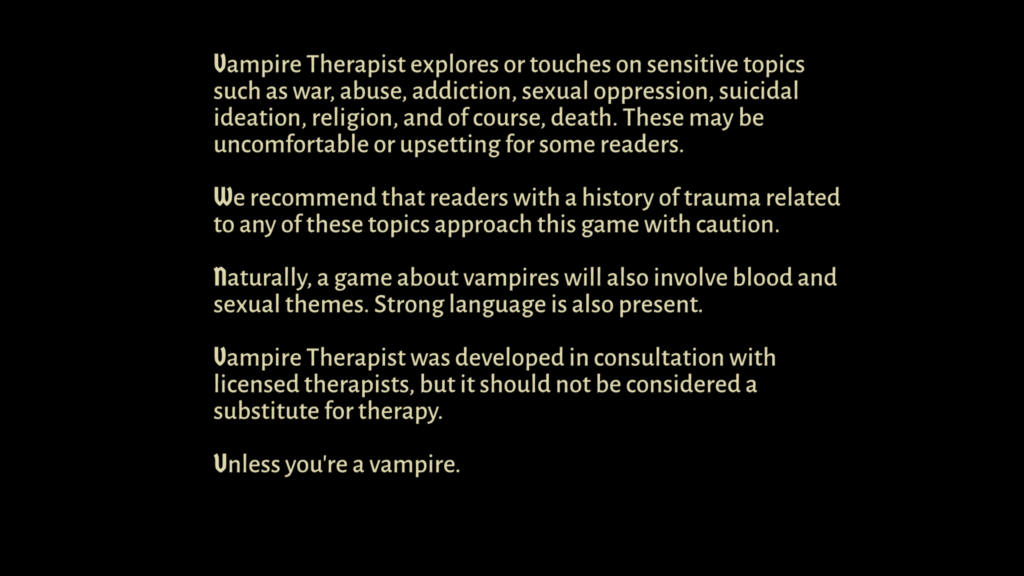
The game starts of with a short information panel.

My Experience with the Game

The game describes itself as a visual novel dark comedy. As the player, you act primarily as a listener, making choices from predefined text options. The game can be roughly split into two parts: the story and the therapy sessions—though, of course, they are closely intertwined. During the story sections, you mostly listen as the narrative unfolds. In the therapy sections, however, you have to actively engage, listening carefully to what the characters say and then identifying the psychological concepts at play. This can get pretty tricky and forces the player to really think about and understand the concepts being presented.

The player takes on the role of a cowboy vampire who listens to the struggles of other supernatural beings—werewolves dealing with anger issues, ghosts struggling to move on, and other creatures wrestling with their personal demons (both literal and figurative). In the demo, you meet an older vampire who serves as both a mentor and therapist—someone who helps you on your journey to aid others. The first patient you encounter is a failed scientist (or at least he believes himself to be one) who became addicted to his own chemicals. What I found particularly interesting is how the protagonist, despite being the helper, also requires guidance to challenge his own preconceptions and grow.

The visuals are moody and certainly fit the theme. I wish to point out the voice acting which, at least major characters, has been very good so far.

A screenshot taken from the game. The options we can choose during the dialogue are displayed at the bottom.

What makes Vampire Therapist stand out is how it blends fantasy with real-world mental health concepts. While the characters may be supernatural, their struggles feel deeply human—self-doubt, trauma, anxiety, and the need for self-acceptance. Instead of just telling players about these issues, the game allows them to engage with them firsthand. It also approaches these heavy topics with a lot of charm, clever metaphors, and humor, creating a safe space to explore difficult emotions in a more approachable way.

The game takes a bit of time to get going, but over the course of my playthrough, it introduced essential elements of Cognitive Behavioral Therapy (CBT). Specifically, it focuses on cognitive distortions—false or irrational ways of thinking that negatively impact our perception of ourselves and the world. One example is „Polarized Thinking“, or as the game cleverly calls it, „Nosferatu Thinking“—the tendency to see things in black and white, without acknowledging complexity. Other cognitive distortions explored in the game include:

  • Should Statements – imposing unrealistic expectations on oneself or others.
  • Control Fallacy – believing we have total control over everything or no control at all.
  • Labeling – defining oneself or others in an overly simplistic, often negative way.
  • Disqualifying the Positive – downplaying or ignoring positive experiences.

The game introduces these concepts gradually, giving players enough time to absorb and reflect on them. For me, this playful, interactive approach was surprisingly effective—I found myself quickly internalizing these ideas.

Conclusion

Going into this, I wasn’t expecting much—especially with a premise this absurd. And, to be fair, parts of it are absurd and comedic. But beneath the humor, I found something much deeper: a thoughtful exploration of CBT techniques and a game that genuinely tries to teach the player something meaningful.

Vampire Therapist is more than just a quirky indie game—it’s a clever and engaging look at mental health, self-acceptance, and the importance of compassionate listening. And I’m glad I got to experience it.

Links

https://store.steampowered.com/app/2481020/Vampire_Therapist
https://www.thegamer.com/vampire-therapist-review
https://vampiretherapist.com
https://www.therapistaid.com/worksheets/cognitive-distortions

https://en.wikipedia.org/wiki/Cognitive_distortion#:~:text=A cognitive distortion is a,to being exaggerated or irrational.

#7 Impulse: Delving into Art as Therapy

Introduction

Art has long been recognized as a powerful tool for self-expression and emotional healing. Art therapy combines creativity with therapeutic techniques to help individuals process emotions, reduce stress, and gain insights into their thoughts and feelings. For this blog post, I dedicated one hour to a guided art therapy session using an online tutorial, focusing on creating a piece of art as a way to explore my emotions and relax.

I enjoy drawing and painting, but I usually have a clear goal in mind when I create something. This more intuitive, open-ended approach to painting was unfamiliar to me, and I was intrigued to see how it would feel.

Art as Therapy

I started by selecting a theme that resonated with me. Guided art therapy sessions often use prompts such as:

  • Draw your current emotional state using colors and shapes.
  • Create a representation of a safe space.
  • Illustrate a memory that brings you peace.

I chose a commonly used prompt: „Draw your emotions as a landscape.“ This allowed me to visualize how I was feeling and express it creatively.

Before starting, I set up a calming environment by playing soft instrumental music and creating a clutter-free workspace. I already had plenty of art supplies, so I decided to work with paper and watercolors.

Of course, I’m not a professional in art therapy, but I did some research and watched videos beforehand. One key takeaway that kept coming up was the importance of focusing on the process rather than the outcome. At first, it was difficult to let go of the idea of having a predefined goal or direction, but as time went on, I found myself getting into the rhythm of simply creating.

At the end of the session, I looked at my artwork and reflected on what it might reveal about my state of mind. I asked myself:

  • What feelings does this evoke?
  • Are there elements I didn’t expect to include?
  • How do I feel now compared to before I started?

However, the most important part wasn’t trying to interpret the artwork itself but rather focusing on the experience during the activity. What thoughts came up while I was painting? Were there any moments of emotional resistance? Afterward, I took some time to journal my thoughts and answer these questions.

Conclusion

Art therapy is a versatile and accessible way to support mental well-being, and even a single session can offer surprising insights into your inner world. Its strength lies in creating a safe and open space for self-reflection.

By the end of the session, I felt noticeably more relaxed, even though parts of the process brought up conflicting emotions. I’m glad I gave it a try—it was an interesting way to engage with mental health therapy, and it gave me some valuable insights should I choose to explore this further in my master’s thesis.

Links

#6 Impulse: Home lower back physiotherapy exercises

Introduction

The activity I chose for this blog post was to sit down and follow a roughly one-hour physiotherapy exercise routine. Personally, I already have some experience with physiotherapy since I have scoliosis and other back-related issues from birth. However, I’ve only ever done physiotherapy sporadically, and I know how challenging it can be to stick to an exercise routine. By doing this, I wanted to explore how exercises designed for a specific issue are structured and gain more insight into the experience.

My Experience as a Patient

The internet provides no shortage of training and exercise videos. However, picking the right one to address your specific problems can be tricky. Exercise is generally regarded as beneficial, but it’s not always easy to determine which exercises are most effective or appropriate for your condition. These questions often go unanswered, especially for someone searching for self-guided resources.

I decided to focus on exercises for lower back pain. Many of these were similar to those prescribed to me during physiotherapy for my scoliosis. Physical therapy for back pain typically has the following goals:

  • Decrease painful symptoms.
  • Improve lower back function in everyday life.
  • Increase the spine’s flexibility and range of motion.
  • Formulate a maintenance program to prevent recurring back problems.

While I wasn’t committing to a full program, I wanted to take this one-time session seriously, as understanding exercise structures could be valuable for my thesis if I choose to explore this topic further.

Most exercises weren’t particularly difficult for me since I’m not dealing with acute back pain. However, I noticed how stiff my lower back was and occasionally opted for easier variations, even when I didn’t intend to. This highlights a common issue: patients might attempt exercises beyond their current ability level to avoid feeling weak. This could lead to improper form or even injury.

Interestingly, some sources I consulted offered progressive variations of the same exercises, making them harder or easier based on a patient’s skill level. This ties into the concept of progressive difficulty, or progressive overload, a principle widely used in bodybuilding. It involves gradually increasing exercise intensity—whether by adding weight, repetitions, or speed—to stimulate muscle growth and improve strength. This principle applies to therapy as well, as patients need to consistently challenge their limits to make meaningful progress.

I found myself fully focused on performing the exercises correctly, which made the time pass quickly. However, I can see how they might become boring for someone more familiar with them. From my own experience, the hardest part is simply starting the routine. Once I begin, performing the exercises isn’t as difficult—but overcoming that initial lack of motivation is a challenge in itself.

After finishing the session, I felt quite exhausted and experienced some delayed-onset muscle soreness (DOMS) the next day. This is a normal response to physical exertion, though it can indicate excessive stress if it becomes severe. While I didn’t feel any real pain during the exercises, I recognize that pain is a possible factor in physiotherapy, especially for patients with serious conditions. It’s crucial to balance pushing through discomfort with avoiding harm. Exercising with mild pain can be safe but should always be approached with caution.

Conclusion

Although I only performed a single one-hour exercise session rather than committing to a full regimen, the experience highlighted key aspects of physiotherapy. Effective programs typically include a combination of strengtheningmobilizing, and stretching exercises tailored to the patient’s specific needs. These routines are often structured with progressive difficulty to ensure sustained improvement over time.

I also realized the importance of accessibility and motivation in physiotherapy. For patients, starting and sticking to a routine can be more challenging than performing the exercises themselves. Providing clear guidance, a sense of progression, and some form of feedback—whether through a therapist or an engaging program—can significantly impact adherence and results.

This brief experiment gave me a greater appreciation for the effort required in physiotherapy, not only from the practitioner’s perspective but also from the patient’s. It reinforced the idea that effective therapy is not just about performing exercises—it’s about creating a sustainable, personalized plan that addresses physical and motivational challenges alike.

Links

Exercise reference:

#5 Impulse: Skiing and Therapy

Introduction

I recently went on a skiing trip, and since the last time I skied was 10 years ago, I decided to book a one-on-one instructional lesson with a skiing teacher. It turned out to be a great decision—she taught in a very intuitive way, and before long, I was confidently speeding down the slopes. However, my hubris got the best of me, and I ended up injuring my knee. While it wasn’t a serious injury, it hurt enough to linger for the next week.

This experience got me thinking about how exercises are taught, how they can be made fun and exciting, and how skiing-related injuries are treated.

My Experiences and Research

First, I want to talk about my skiing instructor and her teaching methods. She began by explaining common mistakes beginners make, such as not bending their knees enough or failing to lean forward properly. One exercise I particularly enjoyed involved holding my ski poles out in front of me and exaggerating my movements whenever I took a corner. This gave me a clear focus for each turn and made it easier for her to identify and correct my mistakes.

Curious to learn more, I delved deeper into the intersection of skiing and therapy, uncovering some fascinating insights. One story that stood out to me was about JJ Chalmers, a Royal Marine who was severely injured by a bomb explosion in Afghanistan. He later embarked on a skiing trip with his family and faced the challenge of picking up skiing again despite his disabilities. With the help of Whistler Adaptive, a sports-focused charity, JJ managed to relearn skiing, though it wasn’t without its difficulties. One option he considered but ultimately didn’t choose was the sit-ski, a device that allows users to ski while sitting down—something I hadn’t heard of before. Sit-skis are frequently used by people with physical disabilities and offer a way to enjoy skiing in a seated position.

A beginner with an instructor learning to ski using sit-skies

I also came across a fascinating scientific study examining the usability of a skiing game for Finnish and Japanese elderly people. The game was simple, with players controlling it by leaning and mimicking the arm movements of pushing with ski poles. The results highlighted some valuable considerations for creating effective, enjoyable therapy experiences:

  • Elderly participants preferred real-world environments.
  • Visual cues were crucial for delivering information, though many elderly users particularly appreciated voice-based instructions.
  • Positive feedback was strongly preferred over negative reinforcement.
  • Ensuring a safe environment and lowering the risk of injury were paramount.
  • Minimizing frustration in gameplay was essential to avoid discouraging participants.
  • Controller-free interaction using gesture controls was preferred over physical controllers.

This study underscored the importance of thoughtful research when designing playful therapy methods, especially when catering to a specific target demographic. Many factors—such as user preferences, safety, and feedback—must be considered to create an engaging and effective experience.

Reflecting on my own injury, even though it wasn’t severe, gave me a new appreciation for the challenges of pain and recovery. I tried several knee and skiing exercises I found online, and while some were exhausting and required a lot of focus, others felt tedious. One thing that struck me was the lack of feedback—without guidance, it’s hard to know whether you’re performing an exercise correctly. I believe this highlights the importance of incorporating feedback mechanisms, whether through a coach, a game, or some other tool, to make recovery both effective and engaging.

Conclusion

My skiing trip, despite the setback of a minor knee injury, was a valuable learning experience. It reminded me of the importance of intuitive teaching methods and how much fun exercises can be when taught creatively. My research into skiing therapy and gamification opened my eyes to the potential of using technology and thoughtful design to make therapy more accessible and engaging—whether through adaptive skiing devices like the sit-ski or gamified therapy for elderly individuals.

Ultimately, skiing is not just a sport but also a platform for resilience, innovation, and recovery. From helping people with disabilities regain confidence on the slopes to using gamification to make therapy more appealing, the possibilities are inspiring. My own experience, combined with these insights, leaves me excited about how skiing and therapy can intersect to create positive change.

Further reading and information

#4 Impulse: Analysis of mental health and wellbeing apps

Introduction

For this blog post, I explored several mental health and well-being apps. I selected some of the most popular and highly-rated ones from the Google Play Store, then spent time analyzing each. My goal was to understand how these apps approach mental health therapy and why they resonate with so many users, as evidenced by their high download numbers. I also wanted to assess whether I could see myself using any of them in my daily life.

Analysis

Addisca (4.8 ⭐, 10,000+ downloads)

Addisca is a mental training app that uses short videos featuring real people to explain its concepts. The app boasts a consistent art and design style, creating a cohesive experience. It offers small, structured lessons on mental health topics, presented as a journey where users must complete lessons in sequence. A helpful feature is the estimated completion time displayed for each lesson.

The lessons themselves include questions and end with a summary. Users earn badges as rewards and can customize their avatars. While some features are locked behind a paywall, the free content seemed reasonable. Overall, Addisca combines simplicity with a structured approach that feels engaging.

Betwixt (4.9 ⭐, 100,000+ downloads)

Betwixt stands out as an interactive story of self-discovery rather than a traditional mental health app. Although it isn’t explicitly designed as therapy, it tackles heavy themes related to mental health within its narrative, branding itself as an “epic adventure” to reduce stress and anxiety while promoting self-care. Importantly, the app clarifies that it isn’t a substitute for professional therapy.

I didn’t progress far into the story, as it requires a significant time commitment, but the text-based adventure is atmospheric, with moody visuals and immersive audio. Based on its high ratings and user comments, Betwixt seems capable of leaving a lasting impression. I’m intrigued enough to continue exploring the story in the future.

How We Feel (4.9 ⭐, 100,000+ downloads)

How We Feel is a mindfulness app that helps users track their emotions and identify patterns over time. Essentially, it functions as a well-being journal. The app has a minimal yet colorful art style featuring whimsical characters.

One aspect I appreciated was its transparent privacy policy, which explicitly states that it doesn’t send local information to external servers. The app divides emotions into four quadrants: high energy/unpleasant, high energy/pleasant, low energy/unpleasant, and low energy/pleasant. It prompts users to log their emotions several times daily, asking about their activities, location, companions, and feelings. This process helps users identify triggers for positive and negative moments in their lives.

How We Feel also offers short videos on mental health topics and an analysis section to view personal statistics. An optional feature allows users to share their emotions with friends. While I initially found the idea of sharing emotions uncomfortable, I can see how it might foster deeper connections. Thankfully, the app allows users to control what and when they share.

ME+ (4.7 ⭐, 10M+ downloads)

ME+ has a modern and youthful feel, likely appealing to a younger audience. Users start with a short quiz about themselves and then “sign” a self-commitment contract, encouraging personal accountability. The app features a playful art style, with a chicken mascot as its standout character.

ME+ offers to-do lists, premade content, and varying exercise lengths, some as short as a few minutes and others lasting up to 10 minutes. Completing tasks earns users badges and streaks, reinforcing motivation. However, the app’s aggressive marketing—emphasizing its reviews and download numbers—felt off-putting. Similarly, its monetization strategies detracted from an otherwise enjoyable experience.

VOS (4.6 ⭐, 1M+ downloads)

VOS felt like a clone of ME+, with slight differences in its art style. It didn’t hold my interest long, as the functionality and design were strikingly similar.

Wysa (4.6 ⭐, 1M+ downloads)

Wysa focuses on its chat feature, where users can talk with its penguin mascot about mental health topics. The chat includes interactive elements, like questions with multiple-choice answers, and the responses adapt to user inputs.

The app also includes exercises and a journey section for tracking progress. Notably, Wysa offers users the option to connect with a licensed therapist, making it a more holistic tool for those seeking professional support alongside self-guided help.

Conclusion

The immense popularity of mental health and well-being apps reflects a clear societal demand for accessible mental health resources. Many apps incorporate gamification features like badges, streaks, and rewards to enhance engagement. Another common thread across most apps is the use of playful art styles and charming mascots, which help make heavy topics more approachable.

Of all the apps I tried, How We Feel resonated with me the most. Its emphasis on daily reflection and emotional tracking felt impactful and easy to integrate into my routine. I could genuinely see myself using it in the future. Exploring these apps provided valuable insights into how technology can address complex themes in an approachable manner. This experience also reinforced the importance of designing mental health tools that balance accessibility with meaningful engagement.

#3 Impulse: Games and Therapy Podcasts

Introduction

The activity I chose for this blog post was listening to podcasts. I ended up exploring two fascinating episodes: one focused on the role of gaming in mental health care and the other on using gamification for hand rehabilitation.

Podcast #1: Levelling Up Mental Healthcare: Bridging the Gap with Gaming and Evidence-Based Therapy – with Dr. Bee Lim

The first podcast explored the growing recognition of gaming as a valuable tool in mental health care, particularly for healthcare professionals. Dr. Bee Lim provided several compelling examples of how gaming can help manage stress and burnout while enhancing therapy.

Key Takeaways:

  • Gaming as a Mental Health Tool: Casual gaming can serve as an effective mental break for professionals like surgeons and CEOs, improving focus, creativity, and precision. For example, laparoscopic surgeons who gamed regularly performed tasks faster and more accurately while maintaining a positive emotional state.
  • Rehabilitation Through Gaming: Games like Pokémon Go are being “prescribed” to encourage physical activity, helping patients monitor their progress while fostering a sense of achievement. Gamification can provide long-term motivation for patients, addressing the common issue of disengagement with traditional therapy exercises.
  • Intergenerational Connections: Games such as Flutter facilitate bonding between children and grandparents, reducing isolation and fostering meaningful relationships. This highlights gaming’s potential to bridge generational gaps while providing emotional support.
  • Balancing Entertainment and Therapy: The podcast used the analogy of “broccoli” (evidence-based therapy) and “chocolate” (engaging gaming experiences). The ideal therapeutic tool combines the two, creating a “new brand of chocolate” that is both enjoyable and evidence-based.

One particularly innovative idea discussed was using gaming as “playable therapy.” For instance, therapeutic games like BeTuned are being designed to blend engaging gameplay with evidence-based benefits. These tools aim to make therapy more approachable and effective by aligning it with clients’ interests and fostering a sense of agency.

Gaming’s potential as a therapeutic tool is immense, especially when health professionals embrace its integration into therapy. By combining evidence-based methods with the interactive and engaging elements of games, therapy can become both effective and enjoyable.

Podcast #2: Episode 13: Dr. Paul Rinne & Nicola Goldsmith – Levelling Up Hand Rehab

The second podcast delved into the challenges and opportunities of integrating technology into rehabilitation, focusing on gamification in hand therapy. Dr. Paul Rinne, a neuroscientist, highlighted the complexities of creating tools that balance engagement with therapeutic goals.

Key Takeaways:

  • Accessibility Challenges: Traditional rehabilitation tools often require expensive equipment, trained staff, or specialized environments, limiting accessibility. The solution? Developing affordable, portable devices and games that bring therapy into patients’ homes.
  • Therapeutic Gamification vs. Entertainment: Unlike entertainment-focused gaming, therapeutic games prioritize function over fun. Activities are designed to meet patients’ specific rehabilitation needs, offering individualized exercises that adapt to the user’s age, cognitive ability, and physical challenges.
  • Keeping Patients Engaged: Simple, game-like activities—such as flicking through pictures of 100 cats—encourage patients to participate while providing valuable data on their progress. This approach keeps the process engaging without compromising therapeutic value.
  • Agency and Motivation: A core principle of effective rehabilitation is showing patients what they can achieve. Sensitive sensors track progress and visualize it in meaningful ways, such as simulating real-world tasks like playing a musical instrument or carrying groceries. This approach not only motivates patients but also strengthens neuroplasticity, aiding recovery.
  • Rehabilitation for Everyday Life: The ultimate goal of therapeutic gamification is to create tools that closely replicate real-world functions, ensuring that progress in therapy translates directly to daily activities. For example, an app might simulate playing the cello, offering both physical and emotional benefits.

One of the most valuable insights from this podcast was the emphasis on patient-centric design. By starting with the user and tailoring activities to their needs, the tools can provide measurable, impactful results.

Conclusion

Listening to these podcasts was both enjoyable and enlightening. They showcased the exciting ways gaming and technology are being integrated into therapy, from helping healthcare professionals manage stress and burnout to designing specialized rehabilitation tools. The key takeaway is that the fusion of enjoyment and evidence-based therapy offers a new paradigm in healthcare—one where technology is not just for entertainment but a powerful resource for healing and recovery.

As technology evolves, I’m excited to see how these innovative approaches will be refined to offer even more personalized, effective, and engaging therapeutic experiences. The intersection of gaming, therapy, and neuroscience holds immense potential to transform physical and mental health care in the years to come.

Further Reading and Information

Other podcasts I considered:

#2 Impulse: Book „Usability und User Experience Design: Das umfassende Handbuch“

Introduction

The activity I chose for this impulse is to read the book which I rented as part of our master’s thesis course. The book is titled “Usability und User Experience Design: Das umfassende Handbuch” written by Michaela Kauer-Franz and Benjamin Franz. Since it is a massive book with ~750 pages I will only dive deeper into some sections which I personally found interesting and which I expect to be very useful to me during the thesis. Also the book is entirely in German and I will paraphrase it into English.

Page 33 marks the beginning of chapter 2 and is about the history of UXD. What I found enlightening about this chapter is that the field of UX design is something ancient even though people did not label it as such. Also the two words: “Ergonomie” and “Arbeitswissenschaft” are interesting to me – the authors argue here that these two fields were instrumental in shaping modern UXD. In general this chapter will be good for definitions as the authors give a definition for the most important terms used in UXD such as: Usability, Effectivity, Efficiency, Satisfaction, User Experience and many more. Subchapter 2.3 was particularly interesting to me. In this chapter the authors talk about ergonomics, usability and user experience. They describe these terms using a tree metaphor.

Ergonomics are the roots of the tree as they are fundamental. If a product, service, etc. is actively harmful to the user it is simply not well designed. Usability makes up the trunk, the stability needed for general use. And lastly the user experience are the leaves – making the user feel enthusiastic and happy when using a product. Defining User Experience exactly can be difficult, however the book gives some examples of valuable values which can create a good UX: competence, connection, significance, stimulation, safety, popularity and autonomy.

Page 117 deals with usability engineering in the medical field according to the norm IEC 62366-1. This small chapter provides a nice flowchart regarding the process. Interestingly, the process in the medical field is very detailed and more focused on assessing the risks associated with the use of medical equipment. It will be very useful to me in the future.

The data driven UX design process or 3DUX for short is nicely showcased as a graphic on page 130. This process is, as the name implies, based on research and data, especially valuing the direct contact with the user.

Chapter 6, starting on page 165, is about the general mindset for usability and UX design. Though this chapter is not something I am likely to reference in my thesis, it is undoubtedly good to keep in mind during the process. It talks about the difference between knowledge and assumptions, something we have also already discussed in Design and Research with Birgit. It also showcases an assumption-knowledge-matrix which can help you identify your assumptions. All of this is to create a design basis which is based on facts and data which will help one make better informed decisions and defend one’s decisions.

Starting on page 253, chapter 7.3 deals with human information processing and specifically with the stimulus-response model which is a simple way of understanding this topic. Since I will be dealing with a project in the medical field I find it valuable to gain a deeper understanding on this topic, thus this chapter will be quite useful for my thesis.

The context of use analysis is explained on page 361 and it is a valuable tool to define the combination of users, goals, tasks, resources and the environment in order to understand the current context and to have a foundation of information which one can then build upon. It is written very well and most interestingly it specifically deals with an example in the medical field. In a medical context users may be medical professionals or patients or both. The authors provide three questions which one should ask in such a context:

  • Is the patient also the user of the product?
  • Is the patient systematically restricted in a particular way by his illness?
  • Is the patient in need of protection in a special way?

I believe the information in this chapter, especially on the medical field, is of valuable information to my thesis.

The last chapter I specifically took a look at was chapter 12 on page 581. It deals with evaluating design solutions and it deals with how to pick the proper tool for ones specific case. It is a dense chapter full of information and it would not make sense to summarize everything about the chapter here but I will be sure to reference it in the future.

Conclusion

To summarize, the book “Usability and User Experience Design” might have seemed daunting at first with its 752 pages. However, it has proven to be very well researched and written in a way that makes this information easily digestible. It covers a huge variety of topics covering the whole spectrum of usability and UX design. I am glad I picked this book and I am sure it will prove very useful during the writing of my master’s thesis.

Further reading/information:

#1 Impulse: GDC Vault Talk about Neuroscience and UX Design

For my seconds impulse activity I chose this talk from the Game Developers Conference 2015. In this talk Celia Hodent talks about some ways in which our brain influences how we play games and how errors in the design and improve the quality of the design by utilizing UX methods.

I specifically chose this talk for several reasons. For one I was just curious about the topic and I believe that knowing a bit about neuroscience and how to properly use UX methods will help me in my master’s thesis. Furthermore, I know that GDC is a well-known and respected resource and so I was confident that I would learn something from it. I personally really enjoyed the talk and am excited to share my thoughts about it. The talk was quite dense and so I won’t go into detail about every little thing. Furthermore, I will also sometimes put some extra notes for me into brackets. The talk is structured into several parts and I will also keep the same structure in my blogpost.

Introduction

The talk titled “The Gamer’s Brain: How Neuroscience and UX Can Impact Design” by Celia Hodent, presented at GDC 2015, explores how understanding the brain can help game designers create better user experiences. Hodent then starts off with a small experiment which challenges our understanding of how logical we think we are.

Perception

Information is organized through a 3-level process which can be either top→down or bottom→up.

  • Cognition
  • Perception
  • Sensation

She brings the example of simple stripes representing Street Fighter characters which would be an example of information that is only meaningful if you have the context/knowledge for it.

She then talks about UI in games, namely in League of Legends and Far Cry 4. She uses these examples to talk about Gestalt theory and perception. Namely, the laws of proximity and similarity are discussed. I found the Far Cry 4 example especially interesting as it is a good example of what not to do and I learned a lot from it.

She then goes on to talk about FFF, Form Follows Function. Good experiences should have good level of affordance and should avoid multistability (where it can be interpreted in different ways). Examples that are mentioned here are iOS app icons, e.g. the camera and mail icon is based on real world examples / stereotypes which can help the user to easily identify the function.

One aspect of the talk that was very interesting for me was her example of ability icon testing for an early pre-alpha build of the game Fortnite. She goes into detail how the testing was done and what results very gleaned from it. The test was split into two questions users had to answer:

  • what is the form of the icon? what can you see?
  • what is the function of the icon? what does this icon do?

Some icons may be very recognizable and fulfill the first question correctly but may be totally misleading when it comes to the meaning/function. Previously I had never heard of test likes this being done in this way and setting and even though the test was very simple a lot of information could be gathered from it.

When designing one should also keep in mind that perception isn’t always equal to reality. What the player perceives is what matters. One example for this is that players had a hard time hitting the zombies in Fortnite. The first idea as to what the problem might be was that they are too quick and their heads too small. However, during testing they found out that the actual problem was the zombies pathfinding and not their speed or size. So often times the most obvious solution may not address the underlying problem.

Memory

Memory works in three phases:

sensory memory (attention) → working memory (encoding) → long-term memory (storage)

One aspect to consider is time. The forgetting curve by Ebbinghaus shows how long people are generally able to store and recall information. When designing an experience like video games where people may play a couple hours, then take a break for several days and then return, it is important to keep this in mind. Because of this users may feel a discrepancy when they return to their game where their level of mastery may feel like it has been downgraded. Games like Assasin’s Creed help the player by e.g. displaying the controls in the right hand corner so the player does not have to remember the controls and can always see them when he*she returns to the game after a break.

Hodent also talks about learning and tutorials. By charting the features they needed to teach the players in a table and prioritizing their order, they were able to make informed decisions on how the tutorial should look like. Through testing they were able to ideate on it an create an affective and efficient onboarding experience.

She recommends to verify ones hypotheses in UX tests early on and use analytics later in the process.

Attention

Hodent goes on to explain that multitasking is a myth and things can be easily missed if they happen at the same time – humans operating on a spotlight basis. Colors and shapes can help direct the players gaze to important information. In many shooter games when the player gets hit the direction the projectile came from is indicated by a red arrow close to the center of the screen. However, in Unreal Tournament 3 this wasn’t very effective because the UI was already filled with the color red. The same problem happened in Fortnite where the enemy health bars were red. They were later changed to orange to reduce the “red overload” as she calls it.

When it comes to learning the deeper the player processes the information the better he*she learns/retains. Some technical terms in this context are:

  • Context = learning by doing
  • Meaning = worthwhile now (for player’s life/mission/goal)
  • Narrative = immerses the player, can create deeper meaning

Ideally players would be learning by doing with a strong context and meaning. Learn then do would not be advisable as it lacks the agency and does create a shallow learning experience.

Conclusion

The brain is a machine that, even though we believe ourselves to be logical and objective, is affected by multiple biases and limitations. The understanding of these patterns and the way our brain operates allows us to create better experiences for the end user. And even if we keep in mind that the player’s brain is heavily biased we, as designers, should also keep in mind that our brain is just as biased.

I really enjoyed listening to this talk by Celia Hodent. I especially found the part about UI icons and how to test them very insightful and will definitely be able to use this information for my own testing which I plan to do as part of my master’s thesis.

Further reading/information: